2025: Digital Labor Enters the Workforce
Explore how the rise of agentic AI and digital labor is transforming workforce strategies and how you can harness them to scale pipeline in 2025 and beyond.

Kraig Swensrud
No items found.
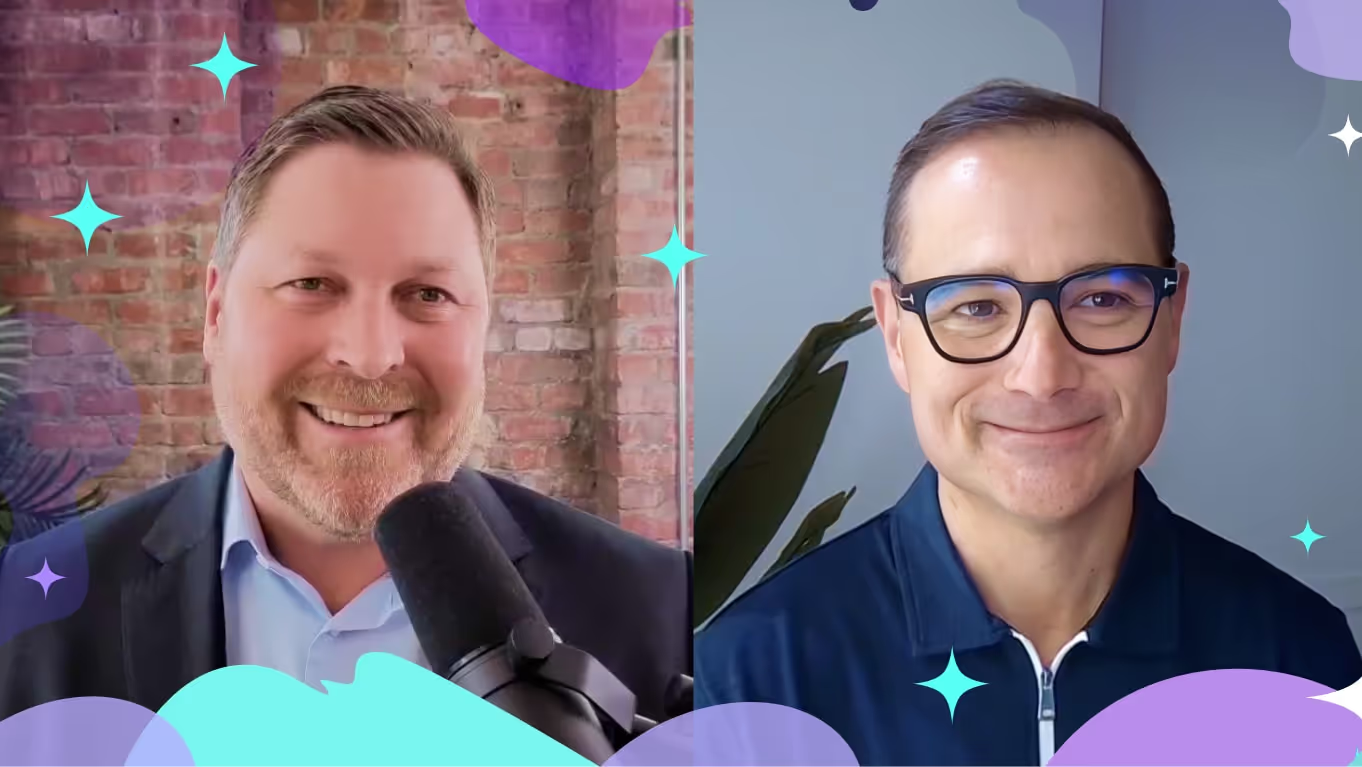


Explore how the rise of agentic AI and digital labor is transforming workforce strategies and how you can harness them to scale pipeline in 2025 and beyond.



TRANSCRIPT
Kraig Swensrud – Qualified
Alright. Hello, and welcome everybody. My name is Kraig Swensrud. I’m the founder and CEO of Qualified, and I’m so pleased to be joined today by a very special guest. Bill Patterson, the EVP of corporate strategy at Salesforce, is here. Bill, welcome to the AI SDR Summit.
Bill Patterson – Salesforce
Kraig, thank you for having me. Great to be here with you.
Kraig Swensrud – Qualified
Yeah. It’s so great to have you. So in the next 20 minutes, as we kinda lead off in this keynote, we’re gonna discuss the state of the union and how digital labor is entering the workforce in 2025. Obviously, something that Salesforce has a strong perspective on.
You know, you guys have been a pioneer in AI technology for over a decade. I think it was 2014 that you first introduced Einstein and predictive artificial intelligence within the enterprise. So can you give us some perspective on kind of the waves of enterprise AI that Salesforce has predicted, and where are we at right now with agentic AI?
Bill Patterson – Salesforce
Yeah. Yeah. I love to think about, you know, kind of the purpose and mission of Salesforce and why sort of AI sort of meant so much to our customers to bring it into that everyday application experience. You know?
Like, our heritage has always been about making the job easier for sellers, for service professionals, for marketers. And so, even back to our core, Salesforce automation was really about how to make this around an easier experience.
And so back in 2013, 2014, we brought in Einstein. Einstein was really about bringing AI into the flow of work, but the kind of AI that we’re talking about there was using the power of machine learning and predictive intelligence to really get data to then forecast, you know, kinda what to do next and sort of an everyday kind of experience.
And then we sort of saw this generative movement happened. Right? The gen, the, what chat gbt brought into the world and what we kind of saw around sort of the transformer model sort of entering into the space. This is where you now start to see, like, the AI can work really on behalf and start to generate value, really as I sort of use it.
And so that Copilot error that we really saw really around two years ago was how kind of productivity started to, like, create value in the moments of interactions.
And I think then we started to now, like, think, you know, going beyond just sort of, like, human in the loop kind of technology, how do we start using agents that can really work with users on behalf of users and then sort of make just sort of work transform altogether? That’s kind of the era that we’re in right now.
And I think the sort of mission between the predictive era, the generative era, the agentic era, that’s where a lot of organizations sort of find themselves today. I think all of this is in grand spirit of, you know, kinda going to a world of of AGI, which I think is, in 2019, we thought that was, like, eighty years into the future.
Friday. We think that’s gonna happen faster now. Right? And so I think this is gonna be a great case where all of this great technology to serve businesses to really help them perform better. I think that’s been the, you know, what excites us so much about this moment.
Kraig Swensrud – Qualified
Well, it is incredibly exciting on the road to AGI. I mean, you guys have really been at the forefront with predictive and generative and copilots. And now, as you say, we’re squarely in this world of autonomous agents and agentic AI. I think that’s the term of the year.
So here we are in 2025, and we’re talking about digital labor. Right? So Marc Benioff, CEO of Salesforce, has stated this is the last generation of CEOs that’s gonna manage a purely human workforce. So here we are.
We got a digital workforce coming into work alongside the human workforce. How do you envision that that actually happens? What does that collaborative future sort of look like where humans and AI are working side by side?
Bill Patterson – Salesforce
Yeah. You know, I think it’s such a great question, and I think it’s, it comes up in every single one of my customer engagements I had today, which is, you know, what does that sort of look like? And I think, at this time, it really puts businesses back to the foundations of of kind of their values.
And for us at Salesforce, you know, trust, just like in your organization, Kraig, trust is our number one value. And so you have to be able to trust that agents are gonna do, you know, kinda work well with humans and work well on, you know, to actually get the job done that we do.
We can’t have it hallucinating, especially in a world of customer relationships. Can’t have it hallucinating sort of responses if that’s actually not how the business is choosing to operate, you know, for the for themselves.
And so trust is sort of at the foundation of of all of this digital labor movement, and I do think our two organizations really speak to that quite well for the or the companies that we kinda work with.
I do think, you know, really, the the the collaborative style of what agents are really becoming are really putting a new trust equation to really make sure that as a user, I’m getting value for that.
I work with eighty something agents here at Salesforce. I have a sales agent. I have a research agent. I have a competitor agent that are all kinda working to give me great insights. And it’s just making sure that that data is not only trusted, but it’s also really helping me in the moment I need it to get a task done around my job.
So I do think this is the last era that you won’t have just sort of human labor performing those tasks. I think you have agentic labor that’s actually performing that function for me, helps me, you know, kind of be more productive, helps me sort of get what I need in the moment, and is always available even whatever hour I’m working, you know, in a day.
And so I definitely think this is gonna be something that as trust sort of enters in the equation, every employee is gonna have to sort of learn to to work comfortably with this great new technology.
Kraig Swensrud – Qualified
Yeah. You guys have always said it really well that trust is the currency of business, and now we have this new agentic digital labor who’s coming into our enterprises. And, of course, we have to have trust.
But in 2024 was really the year where, as software companies and industry visionaries, people were talking about agents, autonomous agents. And I think everybody was inspired by what was possible, but it left a lot of us kinda scratching our heads because we had trouble understanding, well, what do you mean exactly? Where do I start?
And so you guys have been really great because you guys have been preaching the use cases. And I think you’ve got a whole page on your website that just talks about agentic use cases within the enterprise.
And I think that when I was reading that page, I’m like, oh my god. Like, the light bulb is kinda turning on, going, I get it. I see how I can bring these agents into not just specific departments, but, like, either job functions or tasks.
So can you tell me which areas, in your opinion, of an organization are gonna benefit kinda first from this first wave of digital labor transformation?
Bill Patterson – Salesforce
Yeah. This is such an exciting time because for so many companies and so many organizations, human labor and the constraint of human labor has been sort of the barrier for them to do more or to sort of transform their organization.
And so when we sort of work with our customers, we’re really kinda asking the deepest questions. Where do you find the biggest amount of constraint? And where do you find constraint today to always be available for your customers, always be available for, you know, kind of service use cases, sales use cases, et cetera?
So let me give you a few. Customer service is one of the best places where agents can sort of, you know, kind of operationalize more elastic engagement for your company.
And we’ve always sort of seen customer service utilize technologies for things like deflection and, you know, sort of, you know, instead of having to, hey, take a phone call, maybe I can answer that question through a website metaphor.
Well, now it’s not about deflection in customer service. It’s about really enriching that engagement. So not only do I answer your question, how do I curate that into now an area to make you aware of what else we can sort of add value to?
And that’s what agents really do well, is understand not just your intent to solve the question that you asked, but also to know the relationship with that customer to sort of invoke more in time and time on site with the customer you’re serving.
Commerce, another great use case. Not just sort of help me buy a product today, but also make me available. What else is in your inventory that I might have interest in?
And so that’s why, you know, things like areas that are not just sort of about, like, the one and done interaction anymore. Using these agentic experiences to sort of pull you into new funnels of engagement and new funnels of opportunity are immensely powerful.
And then finally, you know, what you guys do, the whole area of sales development and business development, really using the power of information and through a curated sort of interaction model to pull you into that funnel.
What an immense opportunity for us to use the power of, like, great innovation like you’re creating and platforms like Salesforce to back that solution to help you kinda sell more, sell more effectively, and sell more, no matter what time of day or what kind of region that you’re doing business in.
These agents are just so powerful in that regard.
Kraig Swensrud – Qualified
I think that use cases are where it’s at right now because that’s how people tend to understand what the agents can do.
I love that you’re focused on customer service. That was the first use case you said because you’re right. In these call centers, traditionally, it was about deflecting away from humans. Right?
And so it was like, nope. Don’t call the call center. Go on the website and figure it out. And what did we all do in that phone tree? We were screaming into the phone, human, human. Right?
But now it’s gonna be like, no. They’re not gonna try to deflect. They’re gonna try to funnel that to agents because the agent can perform this ability as well or, in many cases, better than a human at a cost that’s far superior.
So that’s a killer use case. Commerce, as you said, I think is a great use case. But we’re here at the AI SDR Summit. I think this is obviously another great use case, pipeline generation for companies in the form of sales development.
So let’s go a little bit deeper on kind of the AI SDR agent movement. And, you know, given your role, you’re the EVP of corporate strategy at Salesforce. You’re super in tune with the needs of a go-to-market organization. I think that goes without saying.
You mentioned the SDRs are a natural place for digital labor to kinda come into the enterprise. Like, what is it specifically, in your opinion, about this role that makes it more ideal as a place to start with digital labor and AI agents versus maybe other functions?
Bill Patterson – Salesforce
I think for many organizations, let’s say, you know, kinda how it used to be, I’m always sort of like at this from two kinda shift way of thinking.
But how it used to be is that the SDR function was oftentimes sort of the first job a sales professional might take within an organization. And it’s often sometimes the cheapest labor pool that you have in sort of your sales organization at large.
And that’s how a lot of organizations have sort of planned to build their sales team, is how do I bring my new energy and this new sort of employee base into that function.
What I think is sort of really fascinating is now organizations are actually finding digital SDRs to be more effective ways of selling and actually more effective ways of curating the funnel and bringing you through that funnel with velocity, bringing you through that with more predictability, and not having that cherry-picking moment.
Because these digital labor and digital workers can actually handle more volume than humans can in an hour workday. Right?
And so forty percent of leads today in most organizations actually go untouched completely because there’s just not enough hours in a day for you to try and make that outbound call and outbound outreach and outbound email to go out from an interaction flow.
So what used to be sort of like the cheapest way to curate the funnel is actually in a digital way now becoming a more effective way to drive the funnel.
And I think now what organizations who are approaching it only from a labor economic standpoint, where they want to hire cheaper labor, actually need to think is it’s more important to think about more effective labor here.
And so I think this is sort of the kind of thing that sales teams are gonna completely remake the complexion of the organization, where all of that function is really digitally enabled.
That what gets through the actual funnel and is more qualified does need now more of a human touch so that you can now have that assistance with the actual reps that maybe come out and visit you on site.
It’s a complete way to kinda change the velocity of a selling force, and I’m so excited that I think you guys are taking a pioneering role to help with that thesis, to help marketers and sales teams become more effective with each other.
Kraig Swensrud – Qualified
It’s an—I think you hit the nail on the head. It’s an obvious place to be more effective and an easy place to start.
So a human SDR team, you mentioned they’re kind of at the beginning of their journey to become a sales professional. But when you add up a team of human SDRs, it’s often hundreds of thousands, if not millions of dollars. But let’s say that’s not the primary issue, which of course we know cost is always an issue.
Capacity is always a concern. Speed and the fact that people can only work on one thing at a time is a concern. These young professionals, they’re a couple months on the job and they don’t know our industry and our market and our products, and they can’t really answer the right questions in the right way.
And then if they’re really good, they leave and they get promoted. Right? And so we’re constantly backfilling, constantly churning over these individuals. And you’re like, man, we can do better.
I was talking to a company in Southern California, a big health care company, and they said, for example, they just missed fourteen hundred inbound chat requests on their website from their ICP buyers because they didn’t have the capacity.
And then there was a great story of CMOs from Dreamforce who were like, I can’t get my team to follow up with the Dreamforce leads. And we’re like, why? And it’s because they just don’t have the time to do those kind of higher up the funnel follow ups.
And you’re like, man, there’s so much opportunity that we’re missing. This is a very, very logical place to start for so many reasons.
So let’s kinda look ahead for a second. We’ve got hundreds, if not thousands, of companies who’ve already adopted AI SDR agents. Many of them are tuning into this program here today.
And this technology, it’s only been in market for about a year. And so I always say inside of my company, like, the AI years are like dog years. We’ve only lived a year, but it feels like we’ve progressed in our industry like seven years.
So from your perspective and your vantage point, which is really strategic, you see the market as a whole. You’re cutting the top ranks at Salesforce, and you see so many different things that many of us don’t see.
How quickly do you think organizations are gonna be adopting AI SDR agents within their go-to-market teams? Is this something that CMOs and CROs need to be thinking about now? Can it wait till next year?
We’re all wondering, like, how fast do we need—it feels like we’re moving fast, but how fast do we need to move? What do you think the adoption rate should be, and what would be kinda your message to C-level execs in the go-to-market?
Bill Patterson – Salesforce
Yeah. I think, well, first off, if you’re not investing in these digital roles and digital worker functions, you’re already really far behind.
And I think the other truth of it is that you cannot just buy this off the rack, off the shelf, and just make it work and it just turns on and instantly all of a sudden you have a seasoned digital worker role.
It takes time for these digital workers to be trained and curated and iterated with, where they actually go from kind of like a digital intern almost to a digital professional.
So that is a pathway, like you said, in dog years, that you have to start working now. Start small. Start curating these experiences. Have a big vision for where it can go.
But you’re never gonna achieve and realize that vision unless you’re acting today. And I think that’s definitely true for most organizations.
A lot of companies, when they invest in these technical moments, fail to really get things into production because maybe they try and bite off more than they can chew.
I really think these task-based, function-based, use-case-based agents are the place to start.
And I think that’s the first thing I would say strategically. Let the tactic drive your strategy. Get it live. Get it in production. Get it interacting with your customers.
And then bring them on that journey too and let them know, like, hey, in your case, Piper is now driving the funnel for us. And that allows companies to start to engage with these new agents and new technology like never before.
And I think that’s sort of where we are now.
What I do think a lot of CEOs need to understand is it goes back to something we were just talking about, Kraig, where labor pools are not getting bigger. They’re actually getting smaller.
It’s really hard to find qualified professionals to perform these tasks. And so organizations have to think about what is gonna be human-bound and what is gonna be digitally driven.
As labor populations shrink across geographies, the only way to compete and scale is through digital labor. The tactical and strategic have to meet somewhere.
And I do think CEOs and the C-suite have to start thinking now about what do we do today to secure our future.
Kraig Swensrud – Qualified
I think your perspective is so great, Bill, about getting started with something small. Don’t bite off more than you can chew.
This moment reminds me of what you all pioneered at Salesforce around cloud computing. It’s a major platform shift, and we haven’t seen one like this in 20 years.
So here we are again, and C-level executives are wondering if they should wait until things firm up. But the companies that moved early in the cloud revolution dominated their markets.
So let me end on organizational transformation, because that’s what’s really hard. I have teams of humans. I’m bringing on digital labor. What does my org chart look like?
Processes have to change. Workflows have to change. Change is scary.
Final question. What advice would you give leaders about driving internal change management for the future of digital labor and AI SDRs?
Bill Patterson – Salesforce
I’ve always believed that the structure of your organization reflects the strategy you’re trying to execute.
The question organizations need to ask is where are the value-added processes and experiences where humans do their best work—where it’s emotive, adaptive, and personal.
A lot of scalable and commoditized processes can be digitized. That allows organizations to streamline operations with digital functions and use human labor as the value add on top.
This is not about creating digital replacements. It’s about allowing digital to take on lower-value, higher-volume tasks so humans can do their best work.
Bring employees along the journey. Have a vision for streamlining and simplifying tasks.
And fundamentally rethink processes. Many processes today are just digitized versions of the past. This is the moment to rethink what’s right for your customers, your company, and what makes your organization unique.
Kraig Swensrud – Qualified
2025 is the moment. Salesforce is famous for saying the only constant in our industry is change, and now is that moment.
I want to thank our special guest, EVP of corporate strategy at Salesforce, Bill Patterson. Thanks so much for being here today.
Bill Patterson – Salesforce
Thank you, Kraig. Pleasure to be with you.

Learn how top GTM teams are using AI agents to drive pipeline across inbound and outbound, and what early results reveal about the future of agentic pipeline generation.

Hear from Alex Bard, Managing Director at Redpoint, and Scott Beechuk, Partner at Norwest, on why AI SDRs are attracting major funding, and where they see the category heading over the next 3–5 years.

G2’s Blue Bowen and Gartner’s Michele Buckley break down the capabilities of AI SDRs—from list building to meeting booking—and what buyers should be familiar with as this new category takes shape.
Explore how the rise of agentic AI and digital labor is transforming workforce strategies and how you can harness them to scale pipeline in 2025 and beyond.
TRANSCRIPT
Kraig Swensrud – Qualified
Alright. Hello, and welcome everybody. My name is Kraig Swensrud. I’m the founder and CEO of Qualified, and I’m so pleased to be joined today by a very special guest. Bill Patterson, the EVP of corporate strategy at Salesforce, is here. Bill, welcome to the AI SDR Summit.
Bill Patterson – Salesforce
Kraig, thank you for having me. Great to be here with you.
Kraig Swensrud – Qualified
Yeah. It’s so great to have you. So in the next 20 minutes, as we kinda lead off in this keynote, we’re gonna discuss the state of the union and how digital labor is entering the workforce in 2025. Obviously, something that Salesforce has a strong perspective on.
You know, you guys have been a pioneer in AI technology for over a decade. I think it was 2014 that you first introduced Einstein and predictive artificial intelligence within the enterprise. So can you give us some perspective on kind of the waves of enterprise AI that Salesforce has predicted, and where are we at right now with agentic AI?
Bill Patterson – Salesforce
Yeah. Yeah. I love to think about, you know, kind of the purpose and mission of Salesforce and why sort of AI sort of meant so much to our customers to bring it into that everyday application experience. You know?
Like, our heritage has always been about making the job easier for sellers, for service professionals, for marketers. And so, even back to our core, Salesforce automation was really about how to make this around an easier experience.
And so back in 2013, 2014, we brought in Einstein. Einstein was really about bringing AI into the flow of work, but the kind of AI that we’re talking about there was using the power of machine learning and predictive intelligence to really get data to then forecast, you know, kinda what to do next and sort of an everyday kind of experience.
And then we sort of saw this generative movement happened. Right? The gen, the, what chat gbt brought into the world and what we kind of saw around sort of the transformer model sort of entering into the space. This is where you now start to see, like, the AI can work really on behalf and start to generate value, really as I sort of use it.
And so that Copilot error that we really saw really around two years ago was how kind of productivity started to, like, create value in the moments of interactions.
And I think then we started to now, like, think, you know, going beyond just sort of, like, human in the loop kind of technology, how do we start using agents that can really work with users on behalf of users and then sort of make just sort of work transform altogether? That’s kind of the era that we’re in right now.
And I think the sort of mission between the predictive era, the generative era, the agentic era, that’s where a lot of organizations sort of find themselves today. I think all of this is in grand spirit of, you know, kinda going to a world of of AGI, which I think is, in 2019, we thought that was, like, eighty years into the future.
Friday. We think that’s gonna happen faster now. Right? And so I think this is gonna be a great case where all of this great technology to serve businesses to really help them perform better. I think that’s been the, you know, what excites us so much about this moment.
Kraig Swensrud – Qualified
Well, it is incredibly exciting on the road to AGI. I mean, you guys have really been at the forefront with predictive and generative and copilots. And now, as you say, we’re squarely in this world of autonomous agents and agentic AI. I think that’s the term of the year.
So here we are in 2025, and we’re talking about digital labor. Right? So Marc Benioff, CEO of Salesforce, has stated this is the last generation of CEOs that’s gonna manage a purely human workforce. So here we are.
We got a digital workforce coming into work alongside the human workforce. How do you envision that that actually happens? What does that collaborative future sort of look like where humans and AI are working side by side?
Bill Patterson – Salesforce
Yeah. You know, I think it’s such a great question, and I think it’s, it comes up in every single one of my customer engagements I had today, which is, you know, what does that sort of look like? And I think, at this time, it really puts businesses back to the foundations of of kind of their values.
And for us at Salesforce, you know, trust, just like in your organization, Kraig, trust is our number one value. And so you have to be able to trust that agents are gonna do, you know, kinda work well with humans and work well on, you know, to actually get the job done that we do.
We can’t have it hallucinating, especially in a world of customer relationships. Can’t have it hallucinating sort of responses if that’s actually not how the business is choosing to operate, you know, for the for themselves.
And so trust is sort of at the foundation of of all of this digital labor movement, and I do think our two organizations really speak to that quite well for the or the companies that we kinda work with.
I do think, you know, really, the the the collaborative style of what agents are really becoming are really putting a new trust equation to really make sure that as a user, I’m getting value for that.
I work with eighty something agents here at Salesforce. I have a sales agent. I have a research agent. I have a competitor agent that are all kinda working to give me great insights. And it’s just making sure that that data is not only trusted, but it’s also really helping me in the moment I need it to get a task done around my job.
So I do think this is the last era that you won’t have just sort of human labor performing those tasks. I think you have agentic labor that’s actually performing that function for me, helps me, you know, kind of be more productive, helps me sort of get what I need in the moment, and is always available even whatever hour I’m working, you know, in a day.
And so I definitely think this is gonna be something that as trust sort of enters in the equation, every employee is gonna have to sort of learn to to work comfortably with this great new technology.
Kraig Swensrud – Qualified
Yeah. You guys have always said it really well that trust is the currency of business, and now we have this new agentic digital labor who’s coming into our enterprises. And, of course, we have to have trust.
But in 2024 was really the year where, as software companies and industry visionaries, people were talking about agents, autonomous agents. And I think everybody was inspired by what was possible, but it left a lot of us kinda scratching our heads because we had trouble understanding, well, what do you mean exactly? Where do I start?
And so you guys have been really great because you guys have been preaching the use cases. And I think you’ve got a whole page on your website that just talks about agentic use cases within the enterprise.
And I think that when I was reading that page, I’m like, oh my god. Like, the light bulb is kinda turning on, going, I get it. I see how I can bring these agents into not just specific departments, but, like, either job functions or tasks.
So can you tell me which areas, in your opinion, of an organization are gonna benefit kinda first from this first wave of digital labor transformation?
Bill Patterson – Salesforce
Yeah. This is such an exciting time because for so many companies and so many organizations, human labor and the constraint of human labor has been sort of the barrier for them to do more or to sort of transform their organization.
And so when we sort of work with our customers, we’re really kinda asking the deepest questions. Where do you find the biggest amount of constraint? And where do you find constraint today to always be available for your customers, always be available for, you know, kind of service use cases, sales use cases, et cetera?
So let me give you a few. Customer service is one of the best places where agents can sort of, you know, kind of operationalize more elastic engagement for your company.
And we’ve always sort of seen customer service utilize technologies for things like deflection and, you know, sort of, you know, instead of having to, hey, take a phone call, maybe I can answer that question through a website metaphor.
Well, now it’s not about deflection in customer service. It’s about really enriching that engagement. So not only do I answer your question, how do I curate that into now an area to make you aware of what else we can sort of add value to?
And that’s what agents really do well, is understand not just your intent to solve the question that you asked, but also to know the relationship with that customer to sort of invoke more in time and time on site with the customer you’re serving.
Commerce, another great use case. Not just sort of help me buy a product today, but also make me available. What else is in your inventory that I might have interest in?
And so that’s why, you know, things like areas that are not just sort of about, like, the one and done interaction anymore. Using these agentic experiences to sort of pull you into new funnels of engagement and new funnels of opportunity are immensely powerful.
And then finally, you know, what you guys do, the whole area of sales development and business development, really using the power of information and through a curated sort of interaction model to pull you into that funnel.
What an immense opportunity for us to use the power of, like, great innovation like you’re creating and platforms like Salesforce to back that solution to help you kinda sell more, sell more effectively, and sell more, no matter what time of day or what kind of region that you’re doing business in.
These agents are just so powerful in that regard.
Kraig Swensrud – Qualified
I think that use cases are where it’s at right now because that’s how people tend to understand what the agents can do.
I love that you’re focused on customer service. That was the first use case you said because you’re right. In these call centers, traditionally, it was about deflecting away from humans. Right?
And so it was like, nope. Don’t call the call center. Go on the website and figure it out. And what did we all do in that phone tree? We were screaming into the phone, human, human. Right?
But now it’s gonna be like, no. They’re not gonna try to deflect. They’re gonna try to funnel that to agents because the agent can perform this ability as well or, in many cases, better than a human at a cost that’s far superior.
So that’s a killer use case. Commerce, as you said, I think is a great use case. But we’re here at the AI SDR Summit. I think this is obviously another great use case, pipeline generation for companies in the form of sales development.
So let’s go a little bit deeper on kind of the AI SDR agent movement. And, you know, given your role, you’re the EVP of corporate strategy at Salesforce. You’re super in tune with the needs of a go-to-market organization. I think that goes without saying.
You mentioned the SDRs are a natural place for digital labor to kinda come into the enterprise. Like, what is it specifically, in your opinion, about this role that makes it more ideal as a place to start with digital labor and AI agents versus maybe other functions?
Bill Patterson – Salesforce
I think for many organizations, let’s say, you know, kinda how it used to be, I’m always sort of like at this from two kinda shift way of thinking.
But how it used to be is that the SDR function was oftentimes sort of the first job a sales professional might take within an organization. And it’s often sometimes the cheapest labor pool that you have in sort of your sales organization at large.
And that’s how a lot of organizations have sort of planned to build their sales team, is how do I bring my new energy and this new sort of employee base into that function.
What I think is sort of really fascinating is now organizations are actually finding digital SDRs to be more effective ways of selling and actually more effective ways of curating the funnel and bringing you through that funnel with velocity, bringing you through that with more predictability, and not having that cherry-picking moment.
Because these digital labor and digital workers can actually handle more volume than humans can in an hour workday. Right?
And so forty percent of leads today in most organizations actually go untouched completely because there’s just not enough hours in a day for you to try and make that outbound call and outbound outreach and outbound email to go out from an interaction flow.
So what used to be sort of like the cheapest way to curate the funnel is actually in a digital way now becoming a more effective way to drive the funnel.
And I think now what organizations who are approaching it only from a labor economic standpoint, where they want to hire cheaper labor, actually need to think is it’s more important to think about more effective labor here.
And so I think this is sort of the kind of thing that sales teams are gonna completely remake the complexion of the organization, where all of that function is really digitally enabled.
That what gets through the actual funnel and is more qualified does need now more of a human touch so that you can now have that assistance with the actual reps that maybe come out and visit you on site.
It’s a complete way to kinda change the velocity of a selling force, and I’m so excited that I think you guys are taking a pioneering role to help with that thesis, to help marketers and sales teams become more effective with each other.
Kraig Swensrud – Qualified
It’s an—I think you hit the nail on the head. It’s an obvious place to be more effective and an easy place to start.
So a human SDR team, you mentioned they’re kind of at the beginning of their journey to become a sales professional. But when you add up a team of human SDRs, it’s often hundreds of thousands, if not millions of dollars. But let’s say that’s not the primary issue, which of course we know cost is always an issue.
Capacity is always a concern. Speed and the fact that people can only work on one thing at a time is a concern. These young professionals, they’re a couple months on the job and they don’t know our industry and our market and our products, and they can’t really answer the right questions in the right way.
And then if they’re really good, they leave and they get promoted. Right? And so we’re constantly backfilling, constantly churning over these individuals. And you’re like, man, we can do better.
I was talking to a company in Southern California, a big health care company, and they said, for example, they just missed fourteen hundred inbound chat requests on their website from their ICP buyers because they didn’t have the capacity.
And then there was a great story of CMOs from Dreamforce who were like, I can’t get my team to follow up with the Dreamforce leads. And we’re like, why? And it’s because they just don’t have the time to do those kind of higher up the funnel follow ups.
And you’re like, man, there’s so much opportunity that we’re missing. This is a very, very logical place to start for so many reasons.
So let’s kinda look ahead for a second. We’ve got hundreds, if not thousands, of companies who’ve already adopted AI SDR agents. Many of them are tuning into this program here today.
And this technology, it’s only been in market for about a year. And so I always say inside of my company, like, the AI years are like dog years. We’ve only lived a year, but it feels like we’ve progressed in our industry like seven years.
So from your perspective and your vantage point, which is really strategic, you see the market as a whole. You’re cutting the top ranks at Salesforce, and you see so many different things that many of us don’t see.
How quickly do you think organizations are gonna be adopting AI SDR agents within their go-to-market teams? Is this something that CMOs and CROs need to be thinking about now? Can it wait till next year?
We’re all wondering, like, how fast do we need—it feels like we’re moving fast, but how fast do we need to move? What do you think the adoption rate should be, and what would be kinda your message to C-level execs in the go-to-market?
Bill Patterson – Salesforce
Yeah. I think, well, first off, if you’re not investing in these digital roles and digital worker functions, you’re already really far behind.
And I think the other truth of it is that you cannot just buy this off the rack, off the shelf, and just make it work and it just turns on and instantly all of a sudden you have a seasoned digital worker role.
It takes time for these digital workers to be trained and curated and iterated with, where they actually go from kind of like a digital intern almost to a digital professional.
So that is a pathway, like you said, in dog years, that you have to start working now. Start small. Start curating these experiences. Have a big vision for where it can go.
But you’re never gonna achieve and realize that vision unless you’re acting today. And I think that’s definitely true for most organizations.
A lot of companies, when they invest in these technical moments, fail to really get things into production because maybe they try and bite off more than they can chew.
I really think these task-based, function-based, use-case-based agents are the place to start.
And I think that’s the first thing I would say strategically. Let the tactic drive your strategy. Get it live. Get it in production. Get it interacting with your customers.
And then bring them on that journey too and let them know, like, hey, in your case, Piper is now driving the funnel for us. And that allows companies to start to engage with these new agents and new technology like never before.
And I think that’s sort of where we are now.
What I do think a lot of CEOs need to understand is it goes back to something we were just talking about, Kraig, where labor pools are not getting bigger. They’re actually getting smaller.
It’s really hard to find qualified professionals to perform these tasks. And so organizations have to think about what is gonna be human-bound and what is gonna be digitally driven.
As labor populations shrink across geographies, the only way to compete and scale is through digital labor. The tactical and strategic have to meet somewhere.
And I do think CEOs and the C-suite have to start thinking now about what do we do today to secure our future.
Kraig Swensrud – Qualified
I think your perspective is so great, Bill, about getting started with something small. Don’t bite off more than you can chew.
This moment reminds me of what you all pioneered at Salesforce around cloud computing. It’s a major platform shift, and we haven’t seen one like this in 20 years.
So here we are again, and C-level executives are wondering if they should wait until things firm up. But the companies that moved early in the cloud revolution dominated their markets.
So let me end on organizational transformation, because that’s what’s really hard. I have teams of humans. I’m bringing on digital labor. What does my org chart look like?
Processes have to change. Workflows have to change. Change is scary.
Final question. What advice would you give leaders about driving internal change management for the future of digital labor and AI SDRs?
Bill Patterson – Salesforce
I’ve always believed that the structure of your organization reflects the strategy you’re trying to execute.
The question organizations need to ask is where are the value-added processes and experiences where humans do their best work—where it’s emotive, adaptive, and personal.
A lot of scalable and commoditized processes can be digitized. That allows organizations to streamline operations with digital functions and use human labor as the value add on top.
This is not about creating digital replacements. It’s about allowing digital to take on lower-value, higher-volume tasks so humans can do their best work.
Bring employees along the journey. Have a vision for streamlining and simplifying tasks.
And fundamentally rethink processes. Many processes today are just digitized versions of the past. This is the moment to rethink what’s right for your customers, your company, and what makes your organization unique.
Kraig Swensrud – Qualified
2025 is the moment. Salesforce is famous for saying the only constant in our industry is change, and now is that moment.
I want to thank our special guest, EVP of corporate strategy at Salesforce, Bill Patterson. Thanks so much for being here today.
Bill Patterson – Salesforce
Thank you, Kraig. Pleasure to be with you.
Explore how the rise of agentic AI and digital labor is transforming workforce strategies and how you can harness them to scale pipeline in 2025 and beyond.
TRANSCRIPT
Kraig Swensrud – Qualified
Alright. Hello, and welcome everybody. My name is Kraig Swensrud. I’m the founder and CEO of Qualified, and I’m so pleased to be joined today by a very special guest. Bill Patterson, the EVP of corporate strategy at Salesforce, is here. Bill, welcome to the AI SDR Summit.
Bill Patterson – Salesforce
Kraig, thank you for having me. Great to be here with you.
Kraig Swensrud – Qualified
Yeah. It’s so great to have you. So in the next 20 minutes, as we kinda lead off in this keynote, we’re gonna discuss the state of the union and how digital labor is entering the workforce in 2025. Obviously, something that Salesforce has a strong perspective on.
You know, you guys have been a pioneer in AI technology for over a decade. I think it was 2014 that you first introduced Einstein and predictive artificial intelligence within the enterprise. So can you give us some perspective on kind of the waves of enterprise AI that Salesforce has predicted, and where are we at right now with agentic AI?
Bill Patterson – Salesforce
Yeah. Yeah. I love to think about, you know, kind of the purpose and mission of Salesforce and why sort of AI sort of meant so much to our customers to bring it into that everyday application experience. You know?
Like, our heritage has always been about making the job easier for sellers, for service professionals, for marketers. And so, even back to our core, Salesforce automation was really about how to make this around an easier experience.
And so back in 2013, 2014, we brought in Einstein. Einstein was really about bringing AI into the flow of work, but the kind of AI that we’re talking about there was using the power of machine learning and predictive intelligence to really get data to then forecast, you know, kinda what to do next and sort of an everyday kind of experience.
And then we sort of saw this generative movement happened. Right? The gen, the, what chat gbt brought into the world and what we kind of saw around sort of the transformer model sort of entering into the space. This is where you now start to see, like, the AI can work really on behalf and start to generate value, really as I sort of use it.
And so that Copilot error that we really saw really around two years ago was how kind of productivity started to, like, create value in the moments of interactions.
And I think then we started to now, like, think, you know, going beyond just sort of, like, human in the loop kind of technology, how do we start using agents that can really work with users on behalf of users and then sort of make just sort of work transform altogether? That’s kind of the era that we’re in right now.
And I think the sort of mission between the predictive era, the generative era, the agentic era, that’s where a lot of organizations sort of find themselves today. I think all of this is in grand spirit of, you know, kinda going to a world of of AGI, which I think is, in 2019, we thought that was, like, eighty years into the future.
Friday. We think that’s gonna happen faster now. Right? And so I think this is gonna be a great case where all of this great technology to serve businesses to really help them perform better. I think that’s been the, you know, what excites us so much about this moment.
Kraig Swensrud – Qualified
Well, it is incredibly exciting on the road to AGI. I mean, you guys have really been at the forefront with predictive and generative and copilots. And now, as you say, we’re squarely in this world of autonomous agents and agentic AI. I think that’s the term of the year.
So here we are in 2025, and we’re talking about digital labor. Right? So Marc Benioff, CEO of Salesforce, has stated this is the last generation of CEOs that’s gonna manage a purely human workforce. So here we are.
We got a digital workforce coming into work alongside the human workforce. How do you envision that that actually happens? What does that collaborative future sort of look like where humans and AI are working side by side?
Bill Patterson – Salesforce
Yeah. You know, I think it’s such a great question, and I think it’s, it comes up in every single one of my customer engagements I had today, which is, you know, what does that sort of look like? And I think, at this time, it really puts businesses back to the foundations of of kind of their values.
And for us at Salesforce, you know, trust, just like in your organization, Kraig, trust is our number one value. And so you have to be able to trust that agents are gonna do, you know, kinda work well with humans and work well on, you know, to actually get the job done that we do.
We can’t have it hallucinating, especially in a world of customer relationships. Can’t have it hallucinating sort of responses if that’s actually not how the business is choosing to operate, you know, for the for themselves.
And so trust is sort of at the foundation of of all of this digital labor movement, and I do think our two organizations really speak to that quite well for the or the companies that we kinda work with.
I do think, you know, really, the the the collaborative style of what agents are really becoming are really putting a new trust equation to really make sure that as a user, I’m getting value for that.
I work with eighty something agents here at Salesforce. I have a sales agent. I have a research agent. I have a competitor agent that are all kinda working to give me great insights. And it’s just making sure that that data is not only trusted, but it’s also really helping me in the moment I need it to get a task done around my job.
So I do think this is the last era that you won’t have just sort of human labor performing those tasks. I think you have agentic labor that’s actually performing that function for me, helps me, you know, kind of be more productive, helps me sort of get what I need in the moment, and is always available even whatever hour I’m working, you know, in a day.
And so I definitely think this is gonna be something that as trust sort of enters in the equation, every employee is gonna have to sort of learn to to work comfortably with this great new technology.
Kraig Swensrud – Qualified
Yeah. You guys have always said it really well that trust is the currency of business, and now we have this new agentic digital labor who’s coming into our enterprises. And, of course, we have to have trust.
But in 2024 was really the year where, as software companies and industry visionaries, people were talking about agents, autonomous agents. And I think everybody was inspired by what was possible, but it left a lot of us kinda scratching our heads because we had trouble understanding, well, what do you mean exactly? Where do I start?
And so you guys have been really great because you guys have been preaching the use cases. And I think you’ve got a whole page on your website that just talks about agentic use cases within the enterprise.
And I think that when I was reading that page, I’m like, oh my god. Like, the light bulb is kinda turning on, going, I get it. I see how I can bring these agents into not just specific departments, but, like, either job functions or tasks.
So can you tell me which areas, in your opinion, of an organization are gonna benefit kinda first from this first wave of digital labor transformation?
Bill Patterson – Salesforce
Yeah. This is such an exciting time because for so many companies and so many organizations, human labor and the constraint of human labor has been sort of the barrier for them to do more or to sort of transform their organization.
And so when we sort of work with our customers, we’re really kinda asking the deepest questions. Where do you find the biggest amount of constraint? And where do you find constraint today to always be available for your customers, always be available for, you know, kind of service use cases, sales use cases, et cetera?
So let me give you a few. Customer service is one of the best places where agents can sort of, you know, kind of operationalize more elastic engagement for your company.
And we’ve always sort of seen customer service utilize technologies for things like deflection and, you know, sort of, you know, instead of having to, hey, take a phone call, maybe I can answer that question through a website metaphor.
Well, now it’s not about deflection in customer service. It’s about really enriching that engagement. So not only do I answer your question, how do I curate that into now an area to make you aware of what else we can sort of add value to?
And that’s what agents really do well, is understand not just your intent to solve the question that you asked, but also to know the relationship with that customer to sort of invoke more in time and time on site with the customer you’re serving.
Commerce, another great use case. Not just sort of help me buy a product today, but also make me available. What else is in your inventory that I might have interest in?
And so that’s why, you know, things like areas that are not just sort of about, like, the one and done interaction anymore. Using these agentic experiences to sort of pull you into new funnels of engagement and new funnels of opportunity are immensely powerful.
And then finally, you know, what you guys do, the whole area of sales development and business development, really using the power of information and through a curated sort of interaction model to pull you into that funnel.
What an immense opportunity for us to use the power of, like, great innovation like you’re creating and platforms like Salesforce to back that solution to help you kinda sell more, sell more effectively, and sell more, no matter what time of day or what kind of region that you’re doing business in.
These agents are just so powerful in that regard.
Kraig Swensrud – Qualified
I think that use cases are where it’s at right now because that’s how people tend to understand what the agents can do.
I love that you’re focused on customer service. That was the first use case you said because you’re right. In these call centers, traditionally, it was about deflecting away from humans. Right?
And so it was like, nope. Don’t call the call center. Go on the website and figure it out. And what did we all do in that phone tree? We were screaming into the phone, human, human. Right?
But now it’s gonna be like, no. They’re not gonna try to deflect. They’re gonna try to funnel that to agents because the agent can perform this ability as well or, in many cases, better than a human at a cost that’s far superior.
So that’s a killer use case. Commerce, as you said, I think is a great use case. But we’re here at the AI SDR Summit. I think this is obviously another great use case, pipeline generation for companies in the form of sales development.
So let’s go a little bit deeper on kind of the AI SDR agent movement. And, you know, given your role, you’re the EVP of corporate strategy at Salesforce. You’re super in tune with the needs of a go-to-market organization. I think that goes without saying.
You mentioned the SDRs are a natural place for digital labor to kinda come into the enterprise. Like, what is it specifically, in your opinion, about this role that makes it more ideal as a place to start with digital labor and AI agents versus maybe other functions?
Bill Patterson – Salesforce
I think for many organizations, let’s say, you know, kinda how it used to be, I’m always sort of like at this from two kinda shift way of thinking.
But how it used to be is that the SDR function was oftentimes sort of the first job a sales professional might take within an organization. And it’s often sometimes the cheapest labor pool that you have in sort of your sales organization at large.
And that’s how a lot of organizations have sort of planned to build their sales team, is how do I bring my new energy and this new sort of employee base into that function.
What I think is sort of really fascinating is now organizations are actually finding digital SDRs to be more effective ways of selling and actually more effective ways of curating the funnel and bringing you through that funnel with velocity, bringing you through that with more predictability, and not having that cherry-picking moment.
Because these digital labor and digital workers can actually handle more volume than humans can in an hour workday. Right?
And so forty percent of leads today in most organizations actually go untouched completely because there’s just not enough hours in a day for you to try and make that outbound call and outbound outreach and outbound email to go out from an interaction flow.
So what used to be sort of like the cheapest way to curate the funnel is actually in a digital way now becoming a more effective way to drive the funnel.
And I think now what organizations who are approaching it only from a labor economic standpoint, where they want to hire cheaper labor, actually need to think is it’s more important to think about more effective labor here.
And so I think this is sort of the kind of thing that sales teams are gonna completely remake the complexion of the organization, where all of that function is really digitally enabled.
That what gets through the actual funnel and is more qualified does need now more of a human touch so that you can now have that assistance with the actual reps that maybe come out and visit you on site.
It’s a complete way to kinda change the velocity of a selling force, and I’m so excited that I think you guys are taking a pioneering role to help with that thesis, to help marketers and sales teams become more effective with each other.
Kraig Swensrud – Qualified
It’s an—I think you hit the nail on the head. It’s an obvious place to be more effective and an easy place to start.
So a human SDR team, you mentioned they’re kind of at the beginning of their journey to become a sales professional. But when you add up a team of human SDRs, it’s often hundreds of thousands, if not millions of dollars. But let’s say that’s not the primary issue, which of course we know cost is always an issue.
Capacity is always a concern. Speed and the fact that people can only work on one thing at a time is a concern. These young professionals, they’re a couple months on the job and they don’t know our industry and our market and our products, and they can’t really answer the right questions in the right way.
And then if they’re really good, they leave and they get promoted. Right? And so we’re constantly backfilling, constantly churning over these individuals. And you’re like, man, we can do better.
I was talking to a company in Southern California, a big health care company, and they said, for example, they just missed fourteen hundred inbound chat requests on their website from their ICP buyers because they didn’t have the capacity.
And then there was a great story of CMOs from Dreamforce who were like, I can’t get my team to follow up with the Dreamforce leads. And we’re like, why? And it’s because they just don’t have the time to do those kind of higher up the funnel follow ups.
And you’re like, man, there’s so much opportunity that we’re missing. This is a very, very logical place to start for so many reasons.
So let’s kinda look ahead for a second. We’ve got hundreds, if not thousands, of companies who’ve already adopted AI SDR agents. Many of them are tuning into this program here today.
And this technology, it’s only been in market for about a year. And so I always say inside of my company, like, the AI years are like dog years. We’ve only lived a year, but it feels like we’ve progressed in our industry like seven years.
So from your perspective and your vantage point, which is really strategic, you see the market as a whole. You’re cutting the top ranks at Salesforce, and you see so many different things that many of us don’t see.
How quickly do you think organizations are gonna be adopting AI SDR agents within their go-to-market teams? Is this something that CMOs and CROs need to be thinking about now? Can it wait till next year?
We’re all wondering, like, how fast do we need—it feels like we’re moving fast, but how fast do we need to move? What do you think the adoption rate should be, and what would be kinda your message to C-level execs in the go-to-market?
Bill Patterson – Salesforce
Yeah. I think, well, first off, if you’re not investing in these digital roles and digital worker functions, you’re already really far behind.
And I think the other truth of it is that you cannot just buy this off the rack, off the shelf, and just make it work and it just turns on and instantly all of a sudden you have a seasoned digital worker role.
It takes time for these digital workers to be trained and curated and iterated with, where they actually go from kind of like a digital intern almost to a digital professional.
So that is a pathway, like you said, in dog years, that you have to start working now. Start small. Start curating these experiences. Have a big vision for where it can go.
But you’re never gonna achieve and realize that vision unless you’re acting today. And I think that’s definitely true for most organizations.
A lot of companies, when they invest in these technical moments, fail to really get things into production because maybe they try and bite off more than they can chew.
I really think these task-based, function-based, use-case-based agents are the place to start.
And I think that’s the first thing I would say strategically. Let the tactic drive your strategy. Get it live. Get it in production. Get it interacting with your customers.
And then bring them on that journey too and let them know, like, hey, in your case, Piper is now driving the funnel for us. And that allows companies to start to engage with these new agents and new technology like never before.
And I think that’s sort of where we are now.
What I do think a lot of CEOs need to understand is it goes back to something we were just talking about, Kraig, where labor pools are not getting bigger. They’re actually getting smaller.
It’s really hard to find qualified professionals to perform these tasks. And so organizations have to think about what is gonna be human-bound and what is gonna be digitally driven.
As labor populations shrink across geographies, the only way to compete and scale is through digital labor. The tactical and strategic have to meet somewhere.
And I do think CEOs and the C-suite have to start thinking now about what do we do today to secure our future.
Kraig Swensrud – Qualified
I think your perspective is so great, Bill, about getting started with something small. Don’t bite off more than you can chew.
This moment reminds me of what you all pioneered at Salesforce around cloud computing. It’s a major platform shift, and we haven’t seen one like this in 20 years.
So here we are again, and C-level executives are wondering if they should wait until things firm up. But the companies that moved early in the cloud revolution dominated their markets.
So let me end on organizational transformation, because that’s what’s really hard. I have teams of humans. I’m bringing on digital labor. What does my org chart look like?
Processes have to change. Workflows have to change. Change is scary.
Final question. What advice would you give leaders about driving internal change management for the future of digital labor and AI SDRs?
Bill Patterson – Salesforce
I’ve always believed that the structure of your organization reflects the strategy you’re trying to execute.
The question organizations need to ask is where are the value-added processes and experiences where humans do their best work—where it’s emotive, adaptive, and personal.
A lot of scalable and commoditized processes can be digitized. That allows organizations to streamline operations with digital functions and use human labor as the value add on top.
This is not about creating digital replacements. It’s about allowing digital to take on lower-value, higher-volume tasks so humans can do their best work.
Bring employees along the journey. Have a vision for streamlining and simplifying tasks.
And fundamentally rethink processes. Many processes today are just digitized versions of the past. This is the moment to rethink what’s right for your customers, your company, and what makes your organization unique.
Kraig Swensrud – Qualified
2025 is the moment. Salesforce is famous for saying the only constant in our industry is change, and now is that moment.
I want to thank our special guest, EVP of corporate strategy at Salesforce, Bill Patterson. Thanks so much for being here today.
Bill Patterson – Salesforce
Thank you, Kraig. Pleasure to be with you.
Explore how the rise of agentic AI and digital labor is transforming workforce strategies and how you can harness them to scale pipeline in 2025 and beyond.
TRANSCRIPT
Kraig Swensrud – Qualified
Alright. Hello, and welcome everybody. My name is Kraig Swensrud. I’m the founder and CEO of Qualified, and I’m so pleased to be joined today by a very special guest. Bill Patterson, the EVP of corporate strategy at Salesforce, is here. Bill, welcome to the AI SDR Summit.
Bill Patterson – Salesforce
Kraig, thank you for having me. Great to be here with you.
Kraig Swensrud – Qualified
Yeah. It’s so great to have you. So in the next 20 minutes, as we kinda lead off in this keynote, we’re gonna discuss the state of the union and how digital labor is entering the workforce in 2025. Obviously, something that Salesforce has a strong perspective on.
You know, you guys have been a pioneer in AI technology for over a decade. I think it was 2014 that you first introduced Einstein and predictive artificial intelligence within the enterprise. So can you give us some perspective on kind of the waves of enterprise AI that Salesforce has predicted, and where are we at right now with agentic AI?
Bill Patterson – Salesforce
Yeah. Yeah. I love to think about, you know, kind of the purpose and mission of Salesforce and why sort of AI sort of meant so much to our customers to bring it into that everyday application experience. You know?
Like, our heritage has always been about making the job easier for sellers, for service professionals, for marketers. And so, even back to our core, Salesforce automation was really about how to make this around an easier experience.
And so back in 2013, 2014, we brought in Einstein. Einstein was really about bringing AI into the flow of work, but the kind of AI that we’re talking about there was using the power of machine learning and predictive intelligence to really get data to then forecast, you know, kinda what to do next and sort of an everyday kind of experience.
And then we sort of saw this generative movement happened. Right? The gen, the, what chat gbt brought into the world and what we kind of saw around sort of the transformer model sort of entering into the space. This is where you now start to see, like, the AI can work really on behalf and start to generate value, really as I sort of use it.
And so that Copilot error that we really saw really around two years ago was how kind of productivity started to, like, create value in the moments of interactions.
And I think then we started to now, like, think, you know, going beyond just sort of, like, human in the loop kind of technology, how do we start using agents that can really work with users on behalf of users and then sort of make just sort of work transform altogether? That’s kind of the era that we’re in right now.
And I think the sort of mission between the predictive era, the generative era, the agentic era, that’s where a lot of organizations sort of find themselves today. I think all of this is in grand spirit of, you know, kinda going to a world of of AGI, which I think is, in 2019, we thought that was, like, eighty years into the future.
Friday. We think that’s gonna happen faster now. Right? And so I think this is gonna be a great case where all of this great technology to serve businesses to really help them perform better. I think that’s been the, you know, what excites us so much about this moment.
Kraig Swensrud – Qualified
Well, it is incredibly exciting on the road to AGI. I mean, you guys have really been at the forefront with predictive and generative and copilots. And now, as you say, we’re squarely in this world of autonomous agents and agentic AI. I think that’s the term of the year.
So here we are in 2025, and we’re talking about digital labor. Right? So Marc Benioff, CEO of Salesforce, has stated this is the last generation of CEOs that’s gonna manage a purely human workforce. So here we are.
We got a digital workforce coming into work alongside the human workforce. How do you envision that that actually happens? What does that collaborative future sort of look like where humans and AI are working side by side?
Bill Patterson – Salesforce
Yeah. You know, I think it’s such a great question, and I think it’s, it comes up in every single one of my customer engagements I had today, which is, you know, what does that sort of look like? And I think, at this time, it really puts businesses back to the foundations of of kind of their values.
And for us at Salesforce, you know, trust, just like in your organization, Kraig, trust is our number one value. And so you have to be able to trust that agents are gonna do, you know, kinda work well with humans and work well on, you know, to actually get the job done that we do.
We can’t have it hallucinating, especially in a world of customer relationships. Can’t have it hallucinating sort of responses if that’s actually not how the business is choosing to operate, you know, for the for themselves.
And so trust is sort of at the foundation of of all of this digital labor movement, and I do think our two organizations really speak to that quite well for the or the companies that we kinda work with.
I do think, you know, really, the the the collaborative style of what agents are really becoming are really putting a new trust equation to really make sure that as a user, I’m getting value for that.
I work with eighty something agents here at Salesforce. I have a sales agent. I have a research agent. I have a competitor agent that are all kinda working to give me great insights. And it’s just making sure that that data is not only trusted, but it’s also really helping me in the moment I need it to get a task done around my job.
So I do think this is the last era that you won’t have just sort of human labor performing those tasks. I think you have agentic labor that’s actually performing that function for me, helps me, you know, kind of be more productive, helps me sort of get what I need in the moment, and is always available even whatever hour I’m working, you know, in a day.
And so I definitely think this is gonna be something that as trust sort of enters in the equation, every employee is gonna have to sort of learn to to work comfortably with this great new technology.
Kraig Swensrud – Qualified
Yeah. You guys have always said it really well that trust is the currency of business, and now we have this new agentic digital labor who’s coming into our enterprises. And, of course, we have to have trust.
But in 2024 was really the year where, as software companies and industry visionaries, people were talking about agents, autonomous agents. And I think everybody was inspired by what was possible, but it left a lot of us kinda scratching our heads because we had trouble understanding, well, what do you mean exactly? Where do I start?
And so you guys have been really great because you guys have been preaching the use cases. And I think you’ve got a whole page on your website that just talks about agentic use cases within the enterprise.
And I think that when I was reading that page, I’m like, oh my god. Like, the light bulb is kinda turning on, going, I get it. I see how I can bring these agents into not just specific departments, but, like, either job functions or tasks.
So can you tell me which areas, in your opinion, of an organization are gonna benefit kinda first from this first wave of digital labor transformation?
Bill Patterson – Salesforce
Yeah. This is such an exciting time because for so many companies and so many organizations, human labor and the constraint of human labor has been sort of the barrier for them to do more or to sort of transform their organization.
And so when we sort of work with our customers, we’re really kinda asking the deepest questions. Where do you find the biggest amount of constraint? And where do you find constraint today to always be available for your customers, always be available for, you know, kind of service use cases, sales use cases, et cetera?
So let me give you a few. Customer service is one of the best places where agents can sort of, you know, kind of operationalize more elastic engagement for your company.
And we’ve always sort of seen customer service utilize technologies for things like deflection and, you know, sort of, you know, instead of having to, hey, take a phone call, maybe I can answer that question through a website metaphor.
Well, now it’s not about deflection in customer service. It’s about really enriching that engagement. So not only do I answer your question, how do I curate that into now an area to make you aware of what else we can sort of add value to?
And that’s what agents really do well, is understand not just your intent to solve the question that you asked, but also to know the relationship with that customer to sort of invoke more in time and time on site with the customer you’re serving.
Commerce, another great use case. Not just sort of help me buy a product today, but also make me available. What else is in your inventory that I might have interest in?
And so that’s why, you know, things like areas that are not just sort of about, like, the one and done interaction anymore. Using these agentic experiences to sort of pull you into new funnels of engagement and new funnels of opportunity are immensely powerful.
And then finally, you know, what you guys do, the whole area of sales development and business development, really using the power of information and through a curated sort of interaction model to pull you into that funnel.
What an immense opportunity for us to use the power of, like, great innovation like you’re creating and platforms like Salesforce to back that solution to help you kinda sell more, sell more effectively, and sell more, no matter what time of day or what kind of region that you’re doing business in.
These agents are just so powerful in that regard.
Kraig Swensrud – Qualified
I think that use cases are where it’s at right now because that’s how people tend to understand what the agents can do.
I love that you’re focused on customer service. That was the first use case you said because you’re right. In these call centers, traditionally, it was about deflecting away from humans. Right?
And so it was like, nope. Don’t call the call center. Go on the website and figure it out. And what did we all do in that phone tree? We were screaming into the phone, human, human. Right?
But now it’s gonna be like, no. They’re not gonna try to deflect. They’re gonna try to funnel that to agents because the agent can perform this ability as well or, in many cases, better than a human at a cost that’s far superior.
So that’s a killer use case. Commerce, as you said, I think is a great use case. But we’re here at the AI SDR Summit. I think this is obviously another great use case, pipeline generation for companies in the form of sales development.
So let’s go a little bit deeper on kind of the AI SDR agent movement. And, you know, given your role, you’re the EVP of corporate strategy at Salesforce. You’re super in tune with the needs of a go-to-market organization. I think that goes without saying.
You mentioned the SDRs are a natural place for digital labor to kinda come into the enterprise. Like, what is it specifically, in your opinion, about this role that makes it more ideal as a place to start with digital labor and AI agents versus maybe other functions?
Bill Patterson – Salesforce
I think for many organizations, let’s say, you know, kinda how it used to be, I’m always sort of like at this from two kinda shift way of thinking.
But how it used to be is that the SDR function was oftentimes sort of the first job a sales professional might take within an organization. And it’s often sometimes the cheapest labor pool that you have in sort of your sales organization at large.
And that’s how a lot of organizations have sort of planned to build their sales team, is how do I bring my new energy and this new sort of employee base into that function.
What I think is sort of really fascinating is now organizations are actually finding digital SDRs to be more effective ways of selling and actually more effective ways of curating the funnel and bringing you through that funnel with velocity, bringing you through that with more predictability, and not having that cherry-picking moment.
Because these digital labor and digital workers can actually handle more volume than humans can in an hour workday. Right?
And so forty percent of leads today in most organizations actually go untouched completely because there’s just not enough hours in a day for you to try and make that outbound call and outbound outreach and outbound email to go out from an interaction flow.
So what used to be sort of like the cheapest way to curate the funnel is actually in a digital way now becoming a more effective way to drive the funnel.
And I think now what organizations who are approaching it only from a labor economic standpoint, where they want to hire cheaper labor, actually need to think is it’s more important to think about more effective labor here.
And so I think this is sort of the kind of thing that sales teams are gonna completely remake the complexion of the organization, where all of that function is really digitally enabled.
That what gets through the actual funnel and is more qualified does need now more of a human touch so that you can now have that assistance with the actual reps that maybe come out and visit you on site.
It’s a complete way to kinda change the velocity of a selling force, and I’m so excited that I think you guys are taking a pioneering role to help with that thesis, to help marketers and sales teams become more effective with each other.
Kraig Swensrud – Qualified
It’s an—I think you hit the nail on the head. It’s an obvious place to be more effective and an easy place to start.
So a human SDR team, you mentioned they’re kind of at the beginning of their journey to become a sales professional. But when you add up a team of human SDRs, it’s often hundreds of thousands, if not millions of dollars. But let’s say that’s not the primary issue, which of course we know cost is always an issue.
Capacity is always a concern. Speed and the fact that people can only work on one thing at a time is a concern. These young professionals, they’re a couple months on the job and they don’t know our industry and our market and our products, and they can’t really answer the right questions in the right way.
And then if they’re really good, they leave and they get promoted. Right? And so we’re constantly backfilling, constantly churning over these individuals. And you’re like, man, we can do better.
I was talking to a company in Southern California, a big health care company, and they said, for example, they just missed fourteen hundred inbound chat requests on their website from their ICP buyers because they didn’t have the capacity.
And then there was a great story of CMOs from Dreamforce who were like, I can’t get my team to follow up with the Dreamforce leads. And we’re like, why? And it’s because they just don’t have the time to do those kind of higher up the funnel follow ups.
And you’re like, man, there’s so much opportunity that we’re missing. This is a very, very logical place to start for so many reasons.
So let’s kinda look ahead for a second. We’ve got hundreds, if not thousands, of companies who’ve already adopted AI SDR agents. Many of them are tuning into this program here today.
And this technology, it’s only been in market for about a year. And so I always say inside of my company, like, the AI years are like dog years. We’ve only lived a year, but it feels like we’ve progressed in our industry like seven years.
So from your perspective and your vantage point, which is really strategic, you see the market as a whole. You’re cutting the top ranks at Salesforce, and you see so many different things that many of us don’t see.
How quickly do you think organizations are gonna be adopting AI SDR agents within their go-to-market teams? Is this something that CMOs and CROs need to be thinking about now? Can it wait till next year?
We’re all wondering, like, how fast do we need—it feels like we’re moving fast, but how fast do we need to move? What do you think the adoption rate should be, and what would be kinda your message to C-level execs in the go-to-market?
Bill Patterson – Salesforce
Yeah. I think, well, first off, if you’re not investing in these digital roles and digital worker functions, you’re already really far behind.
And I think the other truth of it is that you cannot just buy this off the rack, off the shelf, and just make it work and it just turns on and instantly all of a sudden you have a seasoned digital worker role.
It takes time for these digital workers to be trained and curated and iterated with, where they actually go from kind of like a digital intern almost to a digital professional.
So that is a pathway, like you said, in dog years, that you have to start working now. Start small. Start curating these experiences. Have a big vision for where it can go.
But you’re never gonna achieve and realize that vision unless you’re acting today. And I think that’s definitely true for most organizations.
A lot of companies, when they invest in these technical moments, fail to really get things into production because maybe they try and bite off more than they can chew.
I really think these task-based, function-based, use-case-based agents are the place to start.
And I think that’s the first thing I would say strategically. Let the tactic drive your strategy. Get it live. Get it in production. Get it interacting with your customers.
And then bring them on that journey too and let them know, like, hey, in your case, Piper is now driving the funnel for us. And that allows companies to start to engage with these new agents and new technology like never before.
And I think that’s sort of where we are now.
What I do think a lot of CEOs need to understand is it goes back to something we were just talking about, Kraig, where labor pools are not getting bigger. They’re actually getting smaller.
It’s really hard to find qualified professionals to perform these tasks. And so organizations have to think about what is gonna be human-bound and what is gonna be digitally driven.
As labor populations shrink across geographies, the only way to compete and scale is through digital labor. The tactical and strategic have to meet somewhere.
And I do think CEOs and the C-suite have to start thinking now about what do we do today to secure our future.
Kraig Swensrud – Qualified
I think your perspective is so great, Bill, about getting started with something small. Don’t bite off more than you can chew.
This moment reminds me of what you all pioneered at Salesforce around cloud computing. It’s a major platform shift, and we haven’t seen one like this in 20 years.
So here we are again, and C-level executives are wondering if they should wait until things firm up. But the companies that moved early in the cloud revolution dominated their markets.
So let me end on organizational transformation, because that’s what’s really hard. I have teams of humans. I’m bringing on digital labor. What does my org chart look like?
Processes have to change. Workflows have to change. Change is scary.
Final question. What advice would you give leaders about driving internal change management for the future of digital labor and AI SDRs?
Bill Patterson – Salesforce
I’ve always believed that the structure of your organization reflects the strategy you’re trying to execute.
The question organizations need to ask is where are the value-added processes and experiences where humans do their best work—where it’s emotive, adaptive, and personal.
A lot of scalable and commoditized processes can be digitized. That allows organizations to streamline operations with digital functions and use human labor as the value add on top.
This is not about creating digital replacements. It’s about allowing digital to take on lower-value, higher-volume tasks so humans can do their best work.
Bring employees along the journey. Have a vision for streamlining and simplifying tasks.
And fundamentally rethink processes. Many processes today are just digitized versions of the past. This is the moment to rethink what’s right for your customers, your company, and what makes your organization unique.
Kraig Swensrud – Qualified
2025 is the moment. Salesforce is famous for saying the only constant in our industry is change, and now is that moment.
I want to thank our special guest, EVP of corporate strategy at Salesforce, Bill Patterson. Thanks so much for being here today.
Bill Patterson – Salesforce
Thank you, Kraig. Pleasure to be with you.
Discover how we can help you convert more prospects into pipeline–right from your website.

Stay up to date with weekly drops of fresh B2B marketing and sales content.



.svg)


