Episode 11 | Bonterra says stop treating AI like Clippy
Bonterra CMO Stacy West shares how agentic AI helps marketing teams move beyond basic automation to expand capacity and drive real impact.

Sarah McConnell
No items found.
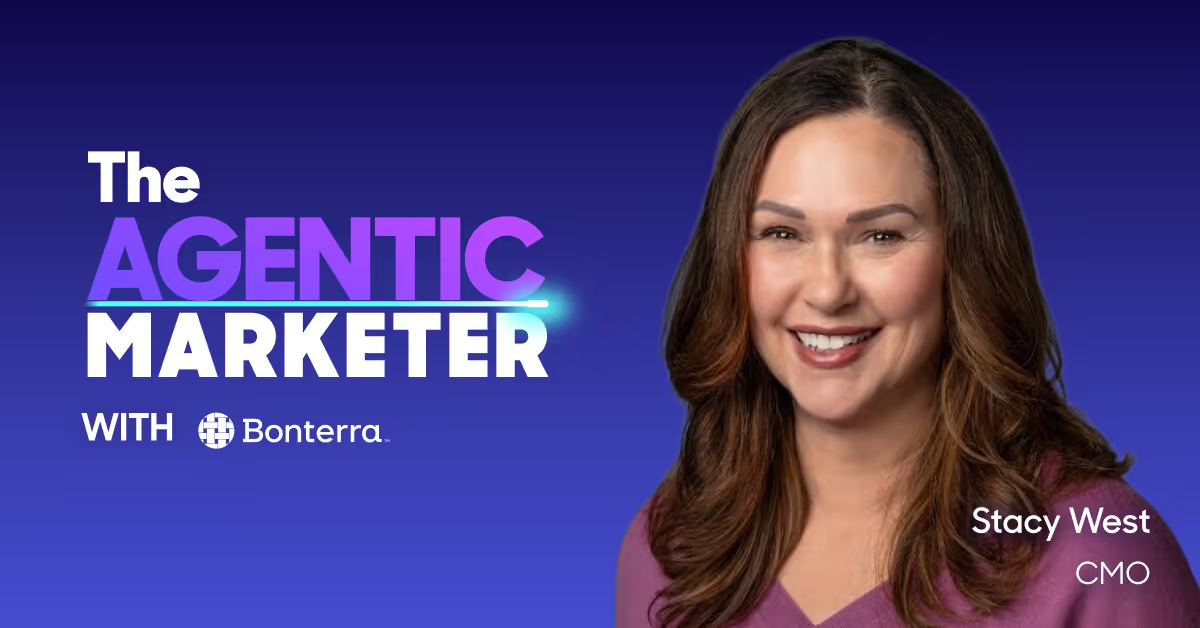


Bonterra CMO Stacy West shares how agentic AI helps marketing teams move beyond basic automation to expand capacity and drive real impact.



This episode of The Agentic Marketer features an interview with Stacy West, CMO at Bonterra, a software company dedicated to powering social good organizations. Bonterra helps nonprofits and funders raise money, engage donors, and expand their impact through technology that frees people to focus more time on their missions.
Stacy shares how Bonterra is embracing agentic marketing by treating AI not just as a tool, but as a true teammate. She explains how agentic AI is helping her team expand capacity, rethink workflows, and move faster across content creation, campaign orchestration, and data analysis. From top-down leadership support to reworking day-to-day processes, Stacy breaks down what it really takes to move from AI experimentation to meaningful adoption.
She also dives into how Bonterra is using agentic AI internally and within its products, including Bonterra Q, to provide fundraising coaching, donor segmentation, and actionable insights that help organizations raise more money while reducing manual effort. Throughout the conversation, Stacy highlights how AI is reshaping the role of marketers, accelerating collaboration with product and sales teams, and changing how CMOs must lead in the agentic era.
Key Takeaways:
TRANSCRIPT
Sarah McConnell – Qualified
Okay, thank you so much, Stacy, for joining us today on The Agentic Marketer. Before we jump into any of the questions, I would love for you just to tell me a little bit about yourself and the work that you're doing over at Bonterra.
Stacy West – Bonterra
Great, well thanks for having me, Sarah. I've been looking forward to this and being able to talk about marketing. I'm the CMO at Bonterra. We do software for social good organizations. So every day what we're doing is helping people who are trying to raise money, helping people who are trying to give money, you know, continue that work. Our software supports that. And, you know, from an agentic perspective, we are doing things that are helping people spend more time on their missions. A big part—sorry, go ahead.
Sarah McConnell – Qualified
I think that's such an incredible mission. I love—it must be really incredible to work at a company that has such a strong mission. You know, you're doing good out there. So I really love that.
Stacy West – Bonterra
It feels good to come to work every day, I'm not gonna lie.
Sarah McConnell – Qualified
Now, you kind of mentioned agentically. So obviously the show is called The Agentic Marketer. It's a new term. I know everyone—AI, agentic—we're hearing it a lot. But how would you define what agentic marketing means to you and the team over at Bonterra?
Stacy West – Bonterra
So I'd say, you know, agentic marketing is using AI not just as a tool, but looking at it more like a teammate. You know, something that's going to be more like an assistant that's going to look ahead, make suggestions, monitor what's happening, and give us real-time insights instead of just using it as a support administrative tool.
Sarah McConnell – Qualified
Yep, I really like that definition. We've always said a couple of years ago it felt like co-pilots were really—you know, that was the craze. And they were riding alongside you and they were helping you do things, but they needed you there to support you. And then I like that definition. Agentic feels more like it is autonomous. It is running on its own. It's forward thinking. So I do think that's a really good way to delineate it. At Bonterra, it sounds like you guys are doing some agentic marketing. You're thinking about this well internally.
I think it's always hard to go from experimenting. AI was easy to experiment with when ChatGPT came out. I know people were getting their hands on it. They were always experimenting. But we've seen that the leap from experimentation to integrating it into their teams has been more difficult. I'm curious, how did you make that transition at Bonterra from experimentation to actually integrating it as a teammate, like you mentioned?
Stacy West – Bonterra
I mean, for us, first of all, it was a top-down mandate from our CEO. He really saw this and has been pushing this for a while—that this is the way that we are going to really be able to help our customers long term. And we need to embrace it. If we want our customers to embrace it, we need to be able to embrace it internally. And how can we use it, not just as administrative support, but as something that's really going to help drive the business forward?
And so I think honestly, what it takes is a mind shift. You have to stop looking at it as a shiny new toy that you can play with and it can help you write an email or it can help you with some headlines, to really looking at it as: How do we rework our workflows to incorporate AI, to really make us as productive as possible, to expand our capacity?
And for our customers—all of our customers who are nonprofits and even the funders—are aspects of their business, they're all marketers. They're trying to raise money. They're trying to vet nonprofits to fund. So in that regard, any expansion of capacity that you can provide with AI tools like our Bonterra Q, our agentic AI that gives them coaching for fundraising, helps them with donor segmentation, helps them say, “Hey, you could make these one-time donors become sustaining donors, and here's how we could do that, and I can help you with the campaign.”
Anytime you can make that shift to expand capacity so people can focus on the aspects of their job that they really love, I think is huge. But the leaders have to embrace it, and it really has to become integrated into your processes.
Sarah McConnell – Qualified
Yes, I agree. I think when it's coming top down, which I feel like a lot of us as marketers felt last year—whether it's coming from the board or the CEO or your CMO—they were pushing you to start to take that experimentation a step further. It's always interesting if I talk to peers and they're like, “No, our leadership has been more hesitant. It's been more bottoms up, where we've had to come to them and make the push to start using this.”
I do think it's easier when your leadership team is very much invested and asking you. And I like how you mentioned it's like—start to integrate it in. I think it's easy to experiment for a long time and see that it's interesting but then drop it out of your workflow and not make it integral. And I think the push from leadership of saying, “Report to me on how this is going. Are you actually using it in your day-to-day? And are you freeing up time to then focus on things that I'm asking you to do?” does really help push those teams into that, “Okay, I'm using this on a day-to-day now. It's not just a one-off.”
Stacy West – Bonterra
Right, right. I think, you know, if you look at it like: Let AI handle some of the tactical pieces. That gives the humans who are really talented the bandwidth to listen, to empathize, to really engage in ways that are more real and humanless.
Sarah McConnell – Qualified
Yeah, there was a great example I had recently where we did an event. There were six different sessions. It was a lot of content. It was all really good content. And we were trying to turn them around and give some of the speakers clips to use within their social. And we get to work with marketers, which is always really fun. But I was like, “Man, I'm going to have to comb through all of these transcripts and figure out what I want to cut.” And I was like, “Wait, there's agentic that can do—like AI can do—there's got to be something out there.”
And we had a tool. We were able to use that and within a half day had given me 30 different clips for social. And those are such simple things that I think people were experimenting with where I'm like, “Oh no, this needs to be something we put into our process documentation post-event. We're starting to do that.” Because I don't want to put anyone on my team—taking a couple of days combing through transcripts and doing timestamp cutting is not a good use of their creative and strategic thinking.
Stacy West – Bonterra
Yeah, and that's the kind of work that just feels soul-sucking some of the time. And I think that people who aren't in marketing don't realize how much of that work is behind the scenes. It's the digging through data, it's the combing through transcripts, it's—to really bring this together. And so if you can have those tools that take some of the burden off there, then people can continue to do the part that really invigorates them. Storytellers want to tell stories. Creatives want to create. Nobody wants to spend their time digging through data to find insights.
Sarah McConnell – Qualified
No, we definitely don't. And that's my job and I still don't really want to do it. So I'm curious, Stacy, as we've talked about this and teams are using this a lot more frequently—obviously, I think it's becoming more and more commonplace—do you think the adoption of AI and anything agentic within marketing teams, how is that going to evolve our roles as marketers? Are we going to have different roles, or do you think it's—you know, we've kind of touched on it—is it just going to help us be more strategic and creative? But how do you think that's helping us evolve as marketers?
Stacy West – Bonterra
I mean, we've already seen it a little bit on our team where what we've said to our teammates is: Don't be afraid of it. Don't be afraid that it's going to replace you. AI is never going to replace you completely. What it's going to do is free you up to do those parts of your job that we hired you to do—to be creative, to be a storyteller, to be an excellent writer, to think strategically about the problems we can help our customers solve.
In that regard, AI is never going to be able to do that the way a person can do that and make it real. But you can certainly use it to support you. And so when we look at bringing on new team members or when we're interviewing, we want to make sure that people are comfortable using AI—that they come to it with an AI-first mindset. And we tell our own employees, “You really need to embrace this and be able to use it not to help you write emails, but use it in a way that helps you drive strategy and helps you uncover maybe things you hadn't thought about before or ways to approach a problem or a story, and use it in a much more strategic way.”
And as you do that, you're going to develop your skillset. And so we can take people and elevate them up in their career so that they're doing more of the strategic, creative work and AI is just helping support them in that way.
Sarah McConnell – Qualified
That is very true.
Stacy West – Bonterra
And it will make them ultimately more marketable, because nobody stays at a company forever anymore. And so it's like, you need to have these skills. So you need to embrace these tools and use them to their fullest and become really conversant in them, and that's going to make you more marketable.
Sarah McConnell – Qualified
Absolutely. Yeah, I know when I came back off maternity leave, I felt like things had changed already so much—and this was, what, five months ago? And to your point of you're asking about it in interviews, I was like, “This is—it's become so much ingrained in the process that as we're interviewing candidates, you know, if you're ever to leave a job, you have to have real world experience using this or it's going to be hard to make yourself marketable.” And I like that you're saying it takes a good leader to have the mindset of: This is going to help you long term. You won't be in a role forever. This is something that whether you're here at this company or moving on to a different role, this is going to be asked no matter what. So you might as well hone that skill and work on it now. I think it's good leadership to encourage them to do that.
Stacy West – Bonterra
Thank you. It's like, yeah, you make it work for you, you know.
Sarah McConnell – Qualified
Yeah. Now, on your team today, I'm curious—where is agentic and AI showing up the most frequently? You're obviously using it, you're encouraging your team to use it. What are the use cases on your team currently that you see agentic and AI making the biggest impact?
Stacy West – Bonterra
I mean, obviously we started with Qualified with having an agentic BDR. That was one of the easiest use cases. But I think kind of the three areas where it impacts marketing the most or the soonest is in the content workflows—first drafts, repurposing, taking big pieces of content and chunking them out into a whole ecosystem of content to be used in different channels.
In the campaign orchestration—watching metrics, doing A/B testing, making real-time recommendations.
And then in the data digestion—pulling insights from huge amounts of data. We have so much data in this company, like most companies these days. And so having—we have a custom agent, a bot that engineering built for us that looks at things up funnel for us and pulls insights. And so when we see something like: Why did this spike? Or why did this go down? Instead of having people have to comb through Salesforce data or Snowflake data or this dashboard or that dashboard, we have an agent that can point out anomalies or point out things and help us pull those insights.
And for marketing, that's a real breath of fresh air. Nobody wants to just comb through the data looking. So they spend less time digging through the data for insights and more time using those insights to drive what they're doing in their day-to-day.
Sarah McConnell – Qualified
Now on that point of data and metrics, I think one of the things people always struggle with when they think about AI and agentic marketing in general is: How do I measure this? Is it changing the way that we're being measured? Do I need to change the metrics that I'm talking to my CEO about or my board about? How are you guys measuring success with anything that is agentic at Bonterra? Has it changed at all or is it still the same metrics you've always been looking at? I'm just curious what that measurement of success looks like.
Stacy West – Bonterra
I mean, our measurements for success, and I don't know of a marketing role in B2B where it would be a lot different, is: How much pipeline are we helping to drive and how many bookings are we helping to drive? That's ultimately how you get there. It's different with AI. But when we look at the tools, you want to have an ROI on the tools that you bring in that are agentic. And so some of them we look at time saved—so things that took a week, they can now do in a day on some of the content creation and content development. So that's huge.
There's a lot of—so when you can do things like that, then you don't have to hire as many people or you don't have to hire creative agency support because your people can turn these things out faster. And so I think that's when we look at like: Hey, our goal is to drive pipeline and drive bookings, but how are we using these AI tools and how are we measuring the efficacy of those tools? I think it just is different depending on the tool. With Qualified, it's like: How many meetings did we get? With content, it's like: How much capacity did this open up or how much faster or how much more content were we able to create and deliver?
Sarah McConnell – Qualified
Yep, I 100% agree. We haven't changed any of our meaningful metrics. Still to your point—I don't know too many marketers nowadays that aren't being measured on pipeline and meetings booked. That seems to be—
Stacy West – Bonterra
I know, like I don't know where those jobs are.
Sarah McConnell – Qualified
No, I don't know. I don't know anyone who's just looking at leads and MQLs anymore. I think the boards have started to figure out marketing should be held to a number—like an actual monetary number—which is fun. I know I went into demand gen for that reason. I really like that challenge. But I don't think AI has meaningfully changed that that's how we're reporting on things.
But to your point, it does change a little bit in each use case. And I found what we've struggled—not really struggled—the mindset shift of: There is also an element of time saved or headcount savings that wasn't something we necessarily measured before that now we're figuring out. So I totally agree that the metrics have always stayed, but there are some newer specific measurements that we're having to look at that are new, I think, for marketing teams, which it sounds like you're also looking at at Bonterra.
Stacy West – Bonterra
Yeah. And I think it's more about trying to—are we getting the value from these tools that we need to get? But ultimately it's how we get to the goals that we need to hit. I'm pretty sure our CEO—they care less about how you're getting there than that you're getting there. But there is also a focus from our board and our CEO on: How are you bringing agentic in? Because they just know that this is going to make us be more successful, be able to do things more quickly, be able to test things more quickly.
So it was one of the things I really liked about joining this company—that they were very forward-looking, that we had agentic products that were being currently built in beta. It was really exciting.
Sarah McConnell – Qualified
That's amazing. Now I want to shift a little bit to forward-looking, which I know is always harder. But our first question for you is: We've talked about your AI BDR, SDR that you have, and that was one of your first agentic steps into the agentic world. Content and data are some of the use cases that you're seeing internally at Bonterra. Are there any other compelling use cases that you've heard of from a marketing perspective, whether it be from peers or things that you've seen online, that you think we're going to start seeing more frequently that you aren't already using? What are some of these future-looking compelling use cases for AI agents that you think are going to start emerging or are emerging right now?
Stacy West – Bonterra
I think that we are getting really close, if not already there, with agents that can run campaigns from end to end, including the reporting. And right now we still have people that are using agentic for the different parts and pieces of the campaign and then pulling it all together. And the reporting may be separate—it may be agentic, but it's still separate. But eventually it'll be all one fluid motion.
And it's going to allow us to make changes that much more quickly in real time. I think that's going to be a big one. I think that being able to do hyper-personalization in real time is one that's going to be coming. If you can speak more directly to somebody about, really specifically, the problem we can help them solve, that just makes everything that much more effective.
We have, from our customers' perspective—when they're doing fundraising, we have agents that will match volunteers, optimize their fundraising, optimize their donor segmentation and their donor lists, and things like that. And then still, I think there is a place for automating all the back-office administrative stuff that frees up the time for your talented people to do what they are talented at.
Sarah McConnell – Qualified
Yeah, I agree with those. And the campaign one in particular I'm very excited about. I agree—there are ways to set up agents now where they can help with different pieces of a full end-to-end campaign. Like we talked about, taking different content and turning it into an ecosystem of content—there's agentic AI that can help with that. And then I've seen prompts or agents where you can have it take all of your data and the way that campaigns are performing and then make recommendations on how they would adjust that budget.
But it is in disparate places. And being able to have a use case where that is end-to-end, I think, would save marketers a lot of time and just make things feel more cohesive. I think right now, pulling things out of different systems and using different agents does make it a little difficult. I'm very excited for that use case to come to fruition.
Stacy West – Bonterra
I mean, just think about if we could get to the point where we have—it runs the campaign from end to end and then gives you really good, accurate multi-touch reporting. And that is the bane of every marketer’s existence. Good, accurate multi-touch so that you can explain to your board or whomever that it's not that this one webinar drove these deals—it's that you can show them and map the whole ecosystem and all of the touches. That would be the dream.
Sarah McConnell – Qualified
That really is the dream. Now, you talked about this a little bit already as far as encouraging your team to get their hands on AI and leading from the top down. But I'm curious: How do you think CMOs are going to have to lead differently in the AI era? Are there things you're going to have to fundamentally change in how you lead teams now that AI has become so incorporated into our day-to-day?
Stacy West – Bonterra
Yeah, I think that we've got to be system designers—looking at the entire marketing environment and how it goes back to process. How do we bring this in and make it part of the entire system? So it's not just org design. It's your process. It's the systems that you use to drive the business, to be a strategic driver in the business. I think that's going to be a big part of it.
I think that marketing, along with HR, is always kind of the culture steward in the company. I think having an environment where you allow people to experiment with different agents and not everything's going to work perfectly, but you want to have people feel like they can try things. So having that mindset of experimentation and encouraging people to do that.
And I think what this does is it makes everything so much more cross-functional than it has been in the past. Because now you're gathering insights that will impact product. We always had to work cross-functionally, but product would typically deliver their product, marketing would market the product, we would send the leads to sales. But now we're able to get so many more insights that it really brings everything together into one package where you're working much more closely with product and much more closely with sales—able to really focus on: Here's how we're going to approach enterprise sales versus more commoditized sales. And here are the things that we're seeing that people are really keying in on that might inform product roadmap. So I think it brings it all together, and we work together much more closely.
Sarah McConnell – Qualified
I agree. I was actually just doing a different podcast where I was the guest and not the host. And we were talking about launching products with AI. And it was so interesting. I was talking to the host and he was asking about our playbook at Qualified of launching AI products. And to your exact point, Stacy, I was like, “It's so fast now.” Things move so quickly, but we're so much more tightly aligned with our product team as we’re moving through because we can build so quick.
But we have to get things to market so much faster that it's sort of a forcing function to make marketing and product much closer than they were before. Because there's no longer the thing where product makes it and then marketing has time to sit and think about the narrative and how to bring that to market and what's the plan. You're looking at, at best case, months. And now it's like, no. You don't have months. You've got weeks maybe. So you're building both product and narrative at the same time and getting those out to market because you can iterate so fast—which is something I've really enjoyed. I've really liked that force to be closer to product and being able to give feedback on that.
And also it's fun. It's a new challenge to be able to have to bring stuff to market so much quicker than we did before. So I agree. I think that is definitely a by-product in how CMOs will have to think about how they work with the product team in ways that they hadn't had to before.
Stacy West – Bonterra
Like go faster, go faster.
Our own agentic—our Bonterra Q that we launched on October 1st—was in a hackathon. They started this in a hackathon at the end of March. And by October 1st, we were launching a fully baked agentic AI function in multiple products that had all these different skills. It was truly astounding, where in the past it could have taken product 18 months or two years to build that and then you'd get one skill.
So the speed at which agentic has allowed—whether they're using Cursor or Claude or the next kind of programming, whatever the next cool thing will be—they are developing so much faster. It's like developing, testing in real time, getting feedback from people in beta real time, and just making adjustments on the fly. It’s really pretty astounding.
As much as it changes the world for marketers, it's got to be a really big shift for engineering.
Sarah McConnell – Qualified
Absolutely. Now, my last question for you before we move into our lightning round is: As you think about mistakes that might be made—as we're marketers in B2B organizations—what do you think we might still be doing wrong a year from now? I'm curious what you would caution people that they might be getting wrong, whether it's now or in the future, that we can start to look out for. How do you think B2B orgs—what do you think we might still be doing incorrectly a year from now when it comes to AI?
Stacy West – Bonterra
I think that those companies who are not going to see and really recognize the full value of AI are those who are just going to continue to use it like Clippy—when Clippy was in Excel—where they're just using it to help me write emails or to help me write, do tasks here and there, and not really embracing the sophistication of what some of these tools can do.
So I think those are the people that are not gonna be on board and are not gonna see the value because they're not fully embracing all of the functionality that's available to them.
Sarah McConnell – Qualified
Yeah, I totally agree. Teams that aren't starting to incorporate it into a process—and it sounds really simple—but sharing it out with a team, bringing it out of the silo of whatever your organization is doing and sharing it org-wide, putting it in process documentation or making it more widely known is going to limit how teams can succeed with AI. So I 100% agree with you on that, Stacy. They have to stop thinking—it’s not just experimentation. It's part of your workflow now. You have to take that step across that chasm from experimentation to leading with AI.
Stacy West – Bonterra
Yep, 100%.
Sarah McConnell – Qualified
Now, to wrap things up, we have our lightning round, which is one of my favorite portions. So it's quick, fun questions with quick, fun answers. And my first one is: What AI tool did you start testing first as a marketer that wasn't ChatGPT? Because that's usually people's answer.
Stacy West – Bonterra
I think it was one of the first tools that allowed you to do multiple headlines. And it just seemed so magical, where you could say, “Here's the campaign,” or “Here's the social ad,” or “Here's the email,” and, “Can you recommend other headlines?” And it was just like—✨. And now it would be like—
Sarah McConnell – Qualified
Wild to think. I would say that when that was—to your point—it was so magical and you're like, “This is incredible.” And now we just had a conversation about how we think agentic AI is going to help us do campaigns end to end in the very near future. And before it was like, “You gave me multiple headlines—that's incredible!” We've really come along.
Stacy West – Bonterra
Yeah, yeah, but it was just like—so exciting.
Sarah McConnell – Qualified
Okay, what do you think is the most overrated buzzword in Martech right now?
Stacy West – Bonterra
Oh my God—AI powered. Like everything is “AI powered, AI powered.” And then you look at it, it's like—is it agentic? Is it ethical? Is it trustworthy? Is it worth a darn? But you look at some stuff and it's “AI powered” when it's really just looking up documentation. It's not really agentic. Or “purpose built” is my other one that it's like—
Sarah McConnell – Qualified
I hope it was a good one. Those high-fiving words.
Stacy West – Bonterra
It is software. It is literally purpose built for the times.
Sarah McConnell – Qualified
I hope it's purpose built for something; otherwise why are you building it?
Stacy West – Bonterra
Right? We have a big product–market fit problem.
Sarah McConnell – Qualified
Okay, one marketer that you would recommend people follow who you think is ahead of the curve on AI.
Stacy West – Bonterra
You know, one person that—I don't—it's probably not great to say—I don't follow a ton of marketers. But one person that I find really, really insightful is Pam Didner, who used to be—I think she was at Intel for like 20 years, and then she's off doing her own consultancy. But she has been talking about the AI marketer for quite some time. If you go to her website, she's got a couple of guides that she's written that you can download.
I think she is really—and she's now consulting, helping lots of marketing organizations—but I find her to be pragmatic in a way that—you know, you don't have a marketer who's telling you things and it's like, “Really? Thank you for pointing out the obvious.” But I think she's got some insights about how to really incorporate this and use it to achieve your goals. Because it's not using AI for AI sake. It's using AI to help you reach a goal more efficiently.
Sarah McConnell – Qualified
Amazing. And my last question: If you could automate one part of your life outside of work with AI, what would it be?
Stacy West – Bonterra
I will say, as a result of the pandemic where every single night was like, “What are we going to do for dinner?” If there was AI that would magically know what people's preferences are and what your cravings might be, and meal plan, and do the grocery list, and submit your Instacart order, and then pull up the recipes—and every night, “Here's what you need and here's the list”—that would be amazing.
Sarah McConnell – Qualified
That would be magic.
Stacy West – Bonterra
You have an eight-month-old—that would be magical for you.
Sarah McConnell – Qualified
It really would. My husband and I always—we can do the dinner recipes, but lunches we're always like, “We have to figure out lunch again? What are we going to do?” Three times a day…
Stacy West – Bonterra
“Have to eat again today…” But yeah, I mean, that would be amazing.
Sarah McConnell – Qualified
Yes, I agree. I think you might be the second guest who said meal planning. And I know I've tried with ChatGPT or Perplexity or whatever to do the “Here's what I'm looking—here's what I like,” and so far the recipe suggestions I've gotten have—it's to your point of they don't know my cravings. I don't have time to plug in everything that's in my fridge. It's not quite there yet. It's become more work than it would take for me to sit and deliberate over what I want to cook for dinner or lunch. So if you find that in the future—
Stacy West – Bonterra
Here are the things I always have in rotation.
Sarah McConnell – Qualified
Yes—if you find that in the future, Stacy, please send it to me, because I would also like to automate that part of my life. Okay, Stacy, thank you so much for joining us today. It was great to have you on the show. Thank you so much for sharing all of your insights with us today.
Stacy West – Bonterra
I will send you an email.
Stacy West – Bonterra
Thank you, Sarah. It was a pleasure.

Discover how Emburse drives real AI adoption by creating a culture of experimentation. Heidi Wurpel shares why giving teams “permission to play” accelerates agentic marketing.
.jpg)
Learn how G2 approaches agentic marketing, speeds up inbound, and adapts to LLM-native buyers in this conversation with CMO Sydney Sloan.
.jpg)
Discover how agentic AI is reshaping modern marketing as Emplifi CMO Susan Ganeshan shares insights on lifecycle engagement, scaling teams, and reducing churn.
.jpg)
Brightly Software’s Whitney Rosa explains why B2B marketing is shifting from campaign-centric to system-centric, powered by AI agents that automate decisions, optimize in real time, and scale marketing impact.
.jpg)
Learn how Talkspace uses AI SDR agents and agentic marketing to replace static funnels and turn website traffic into qualified pipeline.
.jpg)
Our show The Agentic Marketer interviews today's leading B2B marketers to discover how they're actually using agentic AI day to day to hit their pipeline goals. Learn the 7 things agentic marketers are doing right now to stay ahead of the curve.
Bonterra CMO Stacy West shares how agentic AI helps marketing teams move beyond basic automation to expand capacity and drive real impact.
This episode of The Agentic Marketer features an interview with Stacy West, CMO at Bonterra, a software company dedicated to powering social good organizations. Bonterra helps nonprofits and funders raise money, engage donors, and expand their impact through technology that frees people to focus more time on their missions.
Stacy shares how Bonterra is embracing agentic marketing by treating AI not just as a tool, but as a true teammate. She explains how agentic AI is helping her team expand capacity, rethink workflows, and move faster across content creation, campaign orchestration, and data analysis. From top-down leadership support to reworking day-to-day processes, Stacy breaks down what it really takes to move from AI experimentation to meaningful adoption.
She also dives into how Bonterra is using agentic AI internally and within its products, including Bonterra Q, to provide fundraising coaching, donor segmentation, and actionable insights that help organizations raise more money while reducing manual effort. Throughout the conversation, Stacy highlights how AI is reshaping the role of marketers, accelerating collaboration with product and sales teams, and changing how CMOs must lead in the agentic era.
Key Takeaways:
TRANSCRIPT
Sarah McConnell – Qualified
Okay, thank you so much, Stacy, for joining us today on The Agentic Marketer. Before we jump into any of the questions, I would love for you just to tell me a little bit about yourself and the work that you're doing over at Bonterra.
Stacy West – Bonterra
Great, well thanks for having me, Sarah. I've been looking forward to this and being able to talk about marketing. I'm the CMO at Bonterra. We do software for social good organizations. So every day what we're doing is helping people who are trying to raise money, helping people who are trying to give money, you know, continue that work. Our software supports that. And, you know, from an agentic perspective, we are doing things that are helping people spend more time on their missions. A big part—sorry, go ahead.
Sarah McConnell – Qualified
I think that's such an incredible mission. I love—it must be really incredible to work at a company that has such a strong mission. You know, you're doing good out there. So I really love that.
Stacy West – Bonterra
It feels good to come to work every day, I'm not gonna lie.
Sarah McConnell – Qualified
Now, you kind of mentioned agentically. So obviously the show is called The Agentic Marketer. It's a new term. I know everyone—AI, agentic—we're hearing it a lot. But how would you define what agentic marketing means to you and the team over at Bonterra?
Stacy West – Bonterra
So I'd say, you know, agentic marketing is using AI not just as a tool, but looking at it more like a teammate. You know, something that's going to be more like an assistant that's going to look ahead, make suggestions, monitor what's happening, and give us real-time insights instead of just using it as a support administrative tool.
Sarah McConnell – Qualified
Yep, I really like that definition. We've always said a couple of years ago it felt like co-pilots were really—you know, that was the craze. And they were riding alongside you and they were helping you do things, but they needed you there to support you. And then I like that definition. Agentic feels more like it is autonomous. It is running on its own. It's forward thinking. So I do think that's a really good way to delineate it. At Bonterra, it sounds like you guys are doing some agentic marketing. You're thinking about this well internally.
I think it's always hard to go from experimenting. AI was easy to experiment with when ChatGPT came out. I know people were getting their hands on it. They were always experimenting. But we've seen that the leap from experimentation to integrating it into their teams has been more difficult. I'm curious, how did you make that transition at Bonterra from experimentation to actually integrating it as a teammate, like you mentioned?
Stacy West – Bonterra
I mean, for us, first of all, it was a top-down mandate from our CEO. He really saw this and has been pushing this for a while—that this is the way that we are going to really be able to help our customers long term. And we need to embrace it. If we want our customers to embrace it, we need to be able to embrace it internally. And how can we use it, not just as administrative support, but as something that's really going to help drive the business forward?
And so I think honestly, what it takes is a mind shift. You have to stop looking at it as a shiny new toy that you can play with and it can help you write an email or it can help you with some headlines, to really looking at it as: How do we rework our workflows to incorporate AI, to really make us as productive as possible, to expand our capacity?
And for our customers—all of our customers who are nonprofits and even the funders—are aspects of their business, they're all marketers. They're trying to raise money. They're trying to vet nonprofits to fund. So in that regard, any expansion of capacity that you can provide with AI tools like our Bonterra Q, our agentic AI that gives them coaching for fundraising, helps them with donor segmentation, helps them say, “Hey, you could make these one-time donors become sustaining donors, and here's how we could do that, and I can help you with the campaign.”
Anytime you can make that shift to expand capacity so people can focus on the aspects of their job that they really love, I think is huge. But the leaders have to embrace it, and it really has to become integrated into your processes.
Sarah McConnell – Qualified
Yes, I agree. I think when it's coming top down, which I feel like a lot of us as marketers felt last year—whether it's coming from the board or the CEO or your CMO—they were pushing you to start to take that experimentation a step further. It's always interesting if I talk to peers and they're like, “No, our leadership has been more hesitant. It's been more bottoms up, where we've had to come to them and make the push to start using this.”
I do think it's easier when your leadership team is very much invested and asking you. And I like how you mentioned it's like—start to integrate it in. I think it's easy to experiment for a long time and see that it's interesting but then drop it out of your workflow and not make it integral. And I think the push from leadership of saying, “Report to me on how this is going. Are you actually using it in your day-to-day? And are you freeing up time to then focus on things that I'm asking you to do?” does really help push those teams into that, “Okay, I'm using this on a day-to-day now. It's not just a one-off.”
Stacy West – Bonterra
Right, right. I think, you know, if you look at it like: Let AI handle some of the tactical pieces. That gives the humans who are really talented the bandwidth to listen, to empathize, to really engage in ways that are more real and humanless.
Sarah McConnell – Qualified
Yeah, there was a great example I had recently where we did an event. There were six different sessions. It was a lot of content. It was all really good content. And we were trying to turn them around and give some of the speakers clips to use within their social. And we get to work with marketers, which is always really fun. But I was like, “Man, I'm going to have to comb through all of these transcripts and figure out what I want to cut.” And I was like, “Wait, there's agentic that can do—like AI can do—there's got to be something out there.”
And we had a tool. We were able to use that and within a half day had given me 30 different clips for social. And those are such simple things that I think people were experimenting with where I'm like, “Oh no, this needs to be something we put into our process documentation post-event. We're starting to do that.” Because I don't want to put anyone on my team—taking a couple of days combing through transcripts and doing timestamp cutting is not a good use of their creative and strategic thinking.
Stacy West – Bonterra
Yeah, and that's the kind of work that just feels soul-sucking some of the time. And I think that people who aren't in marketing don't realize how much of that work is behind the scenes. It's the digging through data, it's the combing through transcripts, it's—to really bring this together. And so if you can have those tools that take some of the burden off there, then people can continue to do the part that really invigorates them. Storytellers want to tell stories. Creatives want to create. Nobody wants to spend their time digging through data to find insights.
Sarah McConnell – Qualified
No, we definitely don't. And that's my job and I still don't really want to do it. So I'm curious, Stacy, as we've talked about this and teams are using this a lot more frequently—obviously, I think it's becoming more and more commonplace—do you think the adoption of AI and anything agentic within marketing teams, how is that going to evolve our roles as marketers? Are we going to have different roles, or do you think it's—you know, we've kind of touched on it—is it just going to help us be more strategic and creative? But how do you think that's helping us evolve as marketers?
Stacy West – Bonterra
I mean, we've already seen it a little bit on our team where what we've said to our teammates is: Don't be afraid of it. Don't be afraid that it's going to replace you. AI is never going to replace you completely. What it's going to do is free you up to do those parts of your job that we hired you to do—to be creative, to be a storyteller, to be an excellent writer, to think strategically about the problems we can help our customers solve.
In that regard, AI is never going to be able to do that the way a person can do that and make it real. But you can certainly use it to support you. And so when we look at bringing on new team members or when we're interviewing, we want to make sure that people are comfortable using AI—that they come to it with an AI-first mindset. And we tell our own employees, “You really need to embrace this and be able to use it not to help you write emails, but use it in a way that helps you drive strategy and helps you uncover maybe things you hadn't thought about before or ways to approach a problem or a story, and use it in a much more strategic way.”
And as you do that, you're going to develop your skillset. And so we can take people and elevate them up in their career so that they're doing more of the strategic, creative work and AI is just helping support them in that way.
Sarah McConnell – Qualified
That is very true.
Stacy West – Bonterra
And it will make them ultimately more marketable, because nobody stays at a company forever anymore. And so it's like, you need to have these skills. So you need to embrace these tools and use them to their fullest and become really conversant in them, and that's going to make you more marketable.
Sarah McConnell – Qualified
Absolutely. Yeah, I know when I came back off maternity leave, I felt like things had changed already so much—and this was, what, five months ago? And to your point of you're asking about it in interviews, I was like, “This is—it's become so much ingrained in the process that as we're interviewing candidates, you know, if you're ever to leave a job, you have to have real world experience using this or it's going to be hard to make yourself marketable.” And I like that you're saying it takes a good leader to have the mindset of: This is going to help you long term. You won't be in a role forever. This is something that whether you're here at this company or moving on to a different role, this is going to be asked no matter what. So you might as well hone that skill and work on it now. I think it's good leadership to encourage them to do that.
Stacy West – Bonterra
Thank you. It's like, yeah, you make it work for you, you know.
Sarah McConnell – Qualified
Yeah. Now, on your team today, I'm curious—where is agentic and AI showing up the most frequently? You're obviously using it, you're encouraging your team to use it. What are the use cases on your team currently that you see agentic and AI making the biggest impact?
Stacy West – Bonterra
I mean, obviously we started with Qualified with having an agentic BDR. That was one of the easiest use cases. But I think kind of the three areas where it impacts marketing the most or the soonest is in the content workflows—first drafts, repurposing, taking big pieces of content and chunking them out into a whole ecosystem of content to be used in different channels.
In the campaign orchestration—watching metrics, doing A/B testing, making real-time recommendations.
And then in the data digestion—pulling insights from huge amounts of data. We have so much data in this company, like most companies these days. And so having—we have a custom agent, a bot that engineering built for us that looks at things up funnel for us and pulls insights. And so when we see something like: Why did this spike? Or why did this go down? Instead of having people have to comb through Salesforce data or Snowflake data or this dashboard or that dashboard, we have an agent that can point out anomalies or point out things and help us pull those insights.
And for marketing, that's a real breath of fresh air. Nobody wants to just comb through the data looking. So they spend less time digging through the data for insights and more time using those insights to drive what they're doing in their day-to-day.
Sarah McConnell – Qualified
Now on that point of data and metrics, I think one of the things people always struggle with when they think about AI and agentic marketing in general is: How do I measure this? Is it changing the way that we're being measured? Do I need to change the metrics that I'm talking to my CEO about or my board about? How are you guys measuring success with anything that is agentic at Bonterra? Has it changed at all or is it still the same metrics you've always been looking at? I'm just curious what that measurement of success looks like.
Stacy West – Bonterra
I mean, our measurements for success, and I don't know of a marketing role in B2B where it would be a lot different, is: How much pipeline are we helping to drive and how many bookings are we helping to drive? That's ultimately how you get there. It's different with AI. But when we look at the tools, you want to have an ROI on the tools that you bring in that are agentic. And so some of them we look at time saved—so things that took a week, they can now do in a day on some of the content creation and content development. So that's huge.
There's a lot of—so when you can do things like that, then you don't have to hire as many people or you don't have to hire creative agency support because your people can turn these things out faster. And so I think that's when we look at like: Hey, our goal is to drive pipeline and drive bookings, but how are we using these AI tools and how are we measuring the efficacy of those tools? I think it just is different depending on the tool. With Qualified, it's like: How many meetings did we get? With content, it's like: How much capacity did this open up or how much faster or how much more content were we able to create and deliver?
Sarah McConnell – Qualified
Yep, I 100% agree. We haven't changed any of our meaningful metrics. Still to your point—I don't know too many marketers nowadays that aren't being measured on pipeline and meetings booked. That seems to be—
Stacy West – Bonterra
I know, like I don't know where those jobs are.
Sarah McConnell – Qualified
No, I don't know. I don't know anyone who's just looking at leads and MQLs anymore. I think the boards have started to figure out marketing should be held to a number—like an actual monetary number—which is fun. I know I went into demand gen for that reason. I really like that challenge. But I don't think AI has meaningfully changed that that's how we're reporting on things.
But to your point, it does change a little bit in each use case. And I found what we've struggled—not really struggled—the mindset shift of: There is also an element of time saved or headcount savings that wasn't something we necessarily measured before that now we're figuring out. So I totally agree that the metrics have always stayed, but there are some newer specific measurements that we're having to look at that are new, I think, for marketing teams, which it sounds like you're also looking at at Bonterra.
Stacy West – Bonterra
Yeah. And I think it's more about trying to—are we getting the value from these tools that we need to get? But ultimately it's how we get to the goals that we need to hit. I'm pretty sure our CEO—they care less about how you're getting there than that you're getting there. But there is also a focus from our board and our CEO on: How are you bringing agentic in? Because they just know that this is going to make us be more successful, be able to do things more quickly, be able to test things more quickly.
So it was one of the things I really liked about joining this company—that they were very forward-looking, that we had agentic products that were being currently built in beta. It was really exciting.
Sarah McConnell – Qualified
That's amazing. Now I want to shift a little bit to forward-looking, which I know is always harder. But our first question for you is: We've talked about your AI BDR, SDR that you have, and that was one of your first agentic steps into the agentic world. Content and data are some of the use cases that you're seeing internally at Bonterra. Are there any other compelling use cases that you've heard of from a marketing perspective, whether it be from peers or things that you've seen online, that you think we're going to start seeing more frequently that you aren't already using? What are some of these future-looking compelling use cases for AI agents that you think are going to start emerging or are emerging right now?
Stacy West – Bonterra
I think that we are getting really close, if not already there, with agents that can run campaigns from end to end, including the reporting. And right now we still have people that are using agentic for the different parts and pieces of the campaign and then pulling it all together. And the reporting may be separate—it may be agentic, but it's still separate. But eventually it'll be all one fluid motion.
And it's going to allow us to make changes that much more quickly in real time. I think that's going to be a big one. I think that being able to do hyper-personalization in real time is one that's going to be coming. If you can speak more directly to somebody about, really specifically, the problem we can help them solve, that just makes everything that much more effective.
We have, from our customers' perspective—when they're doing fundraising, we have agents that will match volunteers, optimize their fundraising, optimize their donor segmentation and their donor lists, and things like that. And then still, I think there is a place for automating all the back-office administrative stuff that frees up the time for your talented people to do what they are talented at.
Sarah McConnell – Qualified
Yeah, I agree with those. And the campaign one in particular I'm very excited about. I agree—there are ways to set up agents now where they can help with different pieces of a full end-to-end campaign. Like we talked about, taking different content and turning it into an ecosystem of content—there's agentic AI that can help with that. And then I've seen prompts or agents where you can have it take all of your data and the way that campaigns are performing and then make recommendations on how they would adjust that budget.
But it is in disparate places. And being able to have a use case where that is end-to-end, I think, would save marketers a lot of time and just make things feel more cohesive. I think right now, pulling things out of different systems and using different agents does make it a little difficult. I'm very excited for that use case to come to fruition.
Stacy West – Bonterra
I mean, just think about if we could get to the point where we have—it runs the campaign from end to end and then gives you really good, accurate multi-touch reporting. And that is the bane of every marketer’s existence. Good, accurate multi-touch so that you can explain to your board or whomever that it's not that this one webinar drove these deals—it's that you can show them and map the whole ecosystem and all of the touches. That would be the dream.
Sarah McConnell – Qualified
That really is the dream. Now, you talked about this a little bit already as far as encouraging your team to get their hands on AI and leading from the top down. But I'm curious: How do you think CMOs are going to have to lead differently in the AI era? Are there things you're going to have to fundamentally change in how you lead teams now that AI has become so incorporated into our day-to-day?
Stacy West – Bonterra
Yeah, I think that we've got to be system designers—looking at the entire marketing environment and how it goes back to process. How do we bring this in and make it part of the entire system? So it's not just org design. It's your process. It's the systems that you use to drive the business, to be a strategic driver in the business. I think that's going to be a big part of it.
I think that marketing, along with HR, is always kind of the culture steward in the company. I think having an environment where you allow people to experiment with different agents and not everything's going to work perfectly, but you want to have people feel like they can try things. So having that mindset of experimentation and encouraging people to do that.
And I think what this does is it makes everything so much more cross-functional than it has been in the past. Because now you're gathering insights that will impact product. We always had to work cross-functionally, but product would typically deliver their product, marketing would market the product, we would send the leads to sales. But now we're able to get so many more insights that it really brings everything together into one package where you're working much more closely with product and much more closely with sales—able to really focus on: Here's how we're going to approach enterprise sales versus more commoditized sales. And here are the things that we're seeing that people are really keying in on that might inform product roadmap. So I think it brings it all together, and we work together much more closely.
Sarah McConnell – Qualified
I agree. I was actually just doing a different podcast where I was the guest and not the host. And we were talking about launching products with AI. And it was so interesting. I was talking to the host and he was asking about our playbook at Qualified of launching AI products. And to your exact point, Stacy, I was like, “It's so fast now.” Things move so quickly, but we're so much more tightly aligned with our product team as we’re moving through because we can build so quick.
But we have to get things to market so much faster that it's sort of a forcing function to make marketing and product much closer than they were before. Because there's no longer the thing where product makes it and then marketing has time to sit and think about the narrative and how to bring that to market and what's the plan. You're looking at, at best case, months. And now it's like, no. You don't have months. You've got weeks maybe. So you're building both product and narrative at the same time and getting those out to market because you can iterate so fast—which is something I've really enjoyed. I've really liked that force to be closer to product and being able to give feedback on that.
And also it's fun. It's a new challenge to be able to have to bring stuff to market so much quicker than we did before. So I agree. I think that is definitely a by-product in how CMOs will have to think about how they work with the product team in ways that they hadn't had to before.
Stacy West – Bonterra
Like go faster, go faster.
Our own agentic—our Bonterra Q that we launched on October 1st—was in a hackathon. They started this in a hackathon at the end of March. And by October 1st, we were launching a fully baked agentic AI function in multiple products that had all these different skills. It was truly astounding, where in the past it could have taken product 18 months or two years to build that and then you'd get one skill.
So the speed at which agentic has allowed—whether they're using Cursor or Claude or the next kind of programming, whatever the next cool thing will be—they are developing so much faster. It's like developing, testing in real time, getting feedback from people in beta real time, and just making adjustments on the fly. It’s really pretty astounding.
As much as it changes the world for marketers, it's got to be a really big shift for engineering.
Sarah McConnell – Qualified
Absolutely. Now, my last question for you before we move into our lightning round is: As you think about mistakes that might be made—as we're marketers in B2B organizations—what do you think we might still be doing wrong a year from now? I'm curious what you would caution people that they might be getting wrong, whether it's now or in the future, that we can start to look out for. How do you think B2B orgs—what do you think we might still be doing incorrectly a year from now when it comes to AI?
Stacy West – Bonterra
I think that those companies who are not going to see and really recognize the full value of AI are those who are just going to continue to use it like Clippy—when Clippy was in Excel—where they're just using it to help me write emails or to help me write, do tasks here and there, and not really embracing the sophistication of what some of these tools can do.
So I think those are the people that are not gonna be on board and are not gonna see the value because they're not fully embracing all of the functionality that's available to them.
Sarah McConnell – Qualified
Yeah, I totally agree. Teams that aren't starting to incorporate it into a process—and it sounds really simple—but sharing it out with a team, bringing it out of the silo of whatever your organization is doing and sharing it org-wide, putting it in process documentation or making it more widely known is going to limit how teams can succeed with AI. So I 100% agree with you on that, Stacy. They have to stop thinking—it’s not just experimentation. It's part of your workflow now. You have to take that step across that chasm from experimentation to leading with AI.
Stacy West – Bonterra
Yep, 100%.
Sarah McConnell – Qualified
Now, to wrap things up, we have our lightning round, which is one of my favorite portions. So it's quick, fun questions with quick, fun answers. And my first one is: What AI tool did you start testing first as a marketer that wasn't ChatGPT? Because that's usually people's answer.
Stacy West – Bonterra
I think it was one of the first tools that allowed you to do multiple headlines. And it just seemed so magical, where you could say, “Here's the campaign,” or “Here's the social ad,” or “Here's the email,” and, “Can you recommend other headlines?” And it was just like—✨. And now it would be like—
Sarah McConnell – Qualified
Wild to think. I would say that when that was—to your point—it was so magical and you're like, “This is incredible.” And now we just had a conversation about how we think agentic AI is going to help us do campaigns end to end in the very near future. And before it was like, “You gave me multiple headlines—that's incredible!” We've really come along.
Stacy West – Bonterra
Yeah, yeah, but it was just like—so exciting.
Sarah McConnell – Qualified
Okay, what do you think is the most overrated buzzword in Martech right now?
Stacy West – Bonterra
Oh my God—AI powered. Like everything is “AI powered, AI powered.” And then you look at it, it's like—is it agentic? Is it ethical? Is it trustworthy? Is it worth a darn? But you look at some stuff and it's “AI powered” when it's really just looking up documentation. It's not really agentic. Or “purpose built” is my other one that it's like—
Sarah McConnell – Qualified
I hope it was a good one. Those high-fiving words.
Stacy West – Bonterra
It is software. It is literally purpose built for the times.
Sarah McConnell – Qualified
I hope it's purpose built for something; otherwise why are you building it?
Stacy West – Bonterra
Right? We have a big product–market fit problem.
Sarah McConnell – Qualified
Okay, one marketer that you would recommend people follow who you think is ahead of the curve on AI.
Stacy West – Bonterra
You know, one person that—I don't—it's probably not great to say—I don't follow a ton of marketers. But one person that I find really, really insightful is Pam Didner, who used to be—I think she was at Intel for like 20 years, and then she's off doing her own consultancy. But she has been talking about the AI marketer for quite some time. If you go to her website, she's got a couple of guides that she's written that you can download.
I think she is really—and she's now consulting, helping lots of marketing organizations—but I find her to be pragmatic in a way that—you know, you don't have a marketer who's telling you things and it's like, “Really? Thank you for pointing out the obvious.” But I think she's got some insights about how to really incorporate this and use it to achieve your goals. Because it's not using AI for AI sake. It's using AI to help you reach a goal more efficiently.
Sarah McConnell – Qualified
Amazing. And my last question: If you could automate one part of your life outside of work with AI, what would it be?
Stacy West – Bonterra
I will say, as a result of the pandemic where every single night was like, “What are we going to do for dinner?” If there was AI that would magically know what people's preferences are and what your cravings might be, and meal plan, and do the grocery list, and submit your Instacart order, and then pull up the recipes—and every night, “Here's what you need and here's the list”—that would be amazing.
Sarah McConnell – Qualified
That would be magic.
Stacy West – Bonterra
You have an eight-month-old—that would be magical for you.
Sarah McConnell – Qualified
It really would. My husband and I always—we can do the dinner recipes, but lunches we're always like, “We have to figure out lunch again? What are we going to do?” Three times a day…
Stacy West – Bonterra
“Have to eat again today…” But yeah, I mean, that would be amazing.
Sarah McConnell – Qualified
Yes, I agree. I think you might be the second guest who said meal planning. And I know I've tried with ChatGPT or Perplexity or whatever to do the “Here's what I'm looking—here's what I like,” and so far the recipe suggestions I've gotten have—it's to your point of they don't know my cravings. I don't have time to plug in everything that's in my fridge. It's not quite there yet. It's become more work than it would take for me to sit and deliberate over what I want to cook for dinner or lunch. So if you find that in the future—
Stacy West – Bonterra
Here are the things I always have in rotation.
Sarah McConnell – Qualified
Yes—if you find that in the future, Stacy, please send it to me, because I would also like to automate that part of my life. Okay, Stacy, thank you so much for joining us today. It was great to have you on the show. Thank you so much for sharing all of your insights with us today.
Stacy West – Bonterra
I will send you an email.
Stacy West – Bonterra
Thank you, Sarah. It was a pleasure.
Bonterra CMO Stacy West shares how agentic AI helps marketing teams move beyond basic automation to expand capacity and drive real impact.
This episode of The Agentic Marketer features an interview with Stacy West, CMO at Bonterra, a software company dedicated to powering social good organizations. Bonterra helps nonprofits and funders raise money, engage donors, and expand their impact through technology that frees people to focus more time on their missions.
Stacy shares how Bonterra is embracing agentic marketing by treating AI not just as a tool, but as a true teammate. She explains how agentic AI is helping her team expand capacity, rethink workflows, and move faster across content creation, campaign orchestration, and data analysis. From top-down leadership support to reworking day-to-day processes, Stacy breaks down what it really takes to move from AI experimentation to meaningful adoption.
She also dives into how Bonterra is using agentic AI internally and within its products, including Bonterra Q, to provide fundraising coaching, donor segmentation, and actionable insights that help organizations raise more money while reducing manual effort. Throughout the conversation, Stacy highlights how AI is reshaping the role of marketers, accelerating collaboration with product and sales teams, and changing how CMOs must lead in the agentic era.
Key Takeaways:
TRANSCRIPT
Sarah McConnell – Qualified
Okay, thank you so much, Stacy, for joining us today on The Agentic Marketer. Before we jump into any of the questions, I would love for you just to tell me a little bit about yourself and the work that you're doing over at Bonterra.
Stacy West – Bonterra
Great, well thanks for having me, Sarah. I've been looking forward to this and being able to talk about marketing. I'm the CMO at Bonterra. We do software for social good organizations. So every day what we're doing is helping people who are trying to raise money, helping people who are trying to give money, you know, continue that work. Our software supports that. And, you know, from an agentic perspective, we are doing things that are helping people spend more time on their missions. A big part—sorry, go ahead.
Sarah McConnell – Qualified
I think that's such an incredible mission. I love—it must be really incredible to work at a company that has such a strong mission. You know, you're doing good out there. So I really love that.
Stacy West – Bonterra
It feels good to come to work every day, I'm not gonna lie.
Sarah McConnell – Qualified
Now, you kind of mentioned agentically. So obviously the show is called The Agentic Marketer. It's a new term. I know everyone—AI, agentic—we're hearing it a lot. But how would you define what agentic marketing means to you and the team over at Bonterra?
Stacy West – Bonterra
So I'd say, you know, agentic marketing is using AI not just as a tool, but looking at it more like a teammate. You know, something that's going to be more like an assistant that's going to look ahead, make suggestions, monitor what's happening, and give us real-time insights instead of just using it as a support administrative tool.
Sarah McConnell – Qualified
Yep, I really like that definition. We've always said a couple of years ago it felt like co-pilots were really—you know, that was the craze. And they were riding alongside you and they were helping you do things, but they needed you there to support you. And then I like that definition. Agentic feels more like it is autonomous. It is running on its own. It's forward thinking. So I do think that's a really good way to delineate it. At Bonterra, it sounds like you guys are doing some agentic marketing. You're thinking about this well internally.
I think it's always hard to go from experimenting. AI was easy to experiment with when ChatGPT came out. I know people were getting their hands on it. They were always experimenting. But we've seen that the leap from experimentation to integrating it into their teams has been more difficult. I'm curious, how did you make that transition at Bonterra from experimentation to actually integrating it as a teammate, like you mentioned?
Stacy West – Bonterra
I mean, for us, first of all, it was a top-down mandate from our CEO. He really saw this and has been pushing this for a while—that this is the way that we are going to really be able to help our customers long term. And we need to embrace it. If we want our customers to embrace it, we need to be able to embrace it internally. And how can we use it, not just as administrative support, but as something that's really going to help drive the business forward?
And so I think honestly, what it takes is a mind shift. You have to stop looking at it as a shiny new toy that you can play with and it can help you write an email or it can help you with some headlines, to really looking at it as: How do we rework our workflows to incorporate AI, to really make us as productive as possible, to expand our capacity?
And for our customers—all of our customers who are nonprofits and even the funders—are aspects of their business, they're all marketers. They're trying to raise money. They're trying to vet nonprofits to fund. So in that regard, any expansion of capacity that you can provide with AI tools like our Bonterra Q, our agentic AI that gives them coaching for fundraising, helps them with donor segmentation, helps them say, “Hey, you could make these one-time donors become sustaining donors, and here's how we could do that, and I can help you with the campaign.”
Anytime you can make that shift to expand capacity so people can focus on the aspects of their job that they really love, I think is huge. But the leaders have to embrace it, and it really has to become integrated into your processes.
Sarah McConnell – Qualified
Yes, I agree. I think when it's coming top down, which I feel like a lot of us as marketers felt last year—whether it's coming from the board or the CEO or your CMO—they were pushing you to start to take that experimentation a step further. It's always interesting if I talk to peers and they're like, “No, our leadership has been more hesitant. It's been more bottoms up, where we've had to come to them and make the push to start using this.”
I do think it's easier when your leadership team is very much invested and asking you. And I like how you mentioned it's like—start to integrate it in. I think it's easy to experiment for a long time and see that it's interesting but then drop it out of your workflow and not make it integral. And I think the push from leadership of saying, “Report to me on how this is going. Are you actually using it in your day-to-day? And are you freeing up time to then focus on things that I'm asking you to do?” does really help push those teams into that, “Okay, I'm using this on a day-to-day now. It's not just a one-off.”
Stacy West – Bonterra
Right, right. I think, you know, if you look at it like: Let AI handle some of the tactical pieces. That gives the humans who are really talented the bandwidth to listen, to empathize, to really engage in ways that are more real and humanless.
Sarah McConnell – Qualified
Yeah, there was a great example I had recently where we did an event. There were six different sessions. It was a lot of content. It was all really good content. And we were trying to turn them around and give some of the speakers clips to use within their social. And we get to work with marketers, which is always really fun. But I was like, “Man, I'm going to have to comb through all of these transcripts and figure out what I want to cut.” And I was like, “Wait, there's agentic that can do—like AI can do—there's got to be something out there.”
And we had a tool. We were able to use that and within a half day had given me 30 different clips for social. And those are such simple things that I think people were experimenting with where I'm like, “Oh no, this needs to be something we put into our process documentation post-event. We're starting to do that.” Because I don't want to put anyone on my team—taking a couple of days combing through transcripts and doing timestamp cutting is not a good use of their creative and strategic thinking.
Stacy West – Bonterra
Yeah, and that's the kind of work that just feels soul-sucking some of the time. And I think that people who aren't in marketing don't realize how much of that work is behind the scenes. It's the digging through data, it's the combing through transcripts, it's—to really bring this together. And so if you can have those tools that take some of the burden off there, then people can continue to do the part that really invigorates them. Storytellers want to tell stories. Creatives want to create. Nobody wants to spend their time digging through data to find insights.
Sarah McConnell – Qualified
No, we definitely don't. And that's my job and I still don't really want to do it. So I'm curious, Stacy, as we've talked about this and teams are using this a lot more frequently—obviously, I think it's becoming more and more commonplace—do you think the adoption of AI and anything agentic within marketing teams, how is that going to evolve our roles as marketers? Are we going to have different roles, or do you think it's—you know, we've kind of touched on it—is it just going to help us be more strategic and creative? But how do you think that's helping us evolve as marketers?
Stacy West – Bonterra
I mean, we've already seen it a little bit on our team where what we've said to our teammates is: Don't be afraid of it. Don't be afraid that it's going to replace you. AI is never going to replace you completely. What it's going to do is free you up to do those parts of your job that we hired you to do—to be creative, to be a storyteller, to be an excellent writer, to think strategically about the problems we can help our customers solve.
In that regard, AI is never going to be able to do that the way a person can do that and make it real. But you can certainly use it to support you. And so when we look at bringing on new team members or when we're interviewing, we want to make sure that people are comfortable using AI—that they come to it with an AI-first mindset. And we tell our own employees, “You really need to embrace this and be able to use it not to help you write emails, but use it in a way that helps you drive strategy and helps you uncover maybe things you hadn't thought about before or ways to approach a problem or a story, and use it in a much more strategic way.”
And as you do that, you're going to develop your skillset. And so we can take people and elevate them up in their career so that they're doing more of the strategic, creative work and AI is just helping support them in that way.
Sarah McConnell – Qualified
That is very true.
Stacy West – Bonterra
And it will make them ultimately more marketable, because nobody stays at a company forever anymore. And so it's like, you need to have these skills. So you need to embrace these tools and use them to their fullest and become really conversant in them, and that's going to make you more marketable.
Sarah McConnell – Qualified
Absolutely. Yeah, I know when I came back off maternity leave, I felt like things had changed already so much—and this was, what, five months ago? And to your point of you're asking about it in interviews, I was like, “This is—it's become so much ingrained in the process that as we're interviewing candidates, you know, if you're ever to leave a job, you have to have real world experience using this or it's going to be hard to make yourself marketable.” And I like that you're saying it takes a good leader to have the mindset of: This is going to help you long term. You won't be in a role forever. This is something that whether you're here at this company or moving on to a different role, this is going to be asked no matter what. So you might as well hone that skill and work on it now. I think it's good leadership to encourage them to do that.
Stacy West – Bonterra
Thank you. It's like, yeah, you make it work for you, you know.
Sarah McConnell – Qualified
Yeah. Now, on your team today, I'm curious—where is agentic and AI showing up the most frequently? You're obviously using it, you're encouraging your team to use it. What are the use cases on your team currently that you see agentic and AI making the biggest impact?
Stacy West – Bonterra
I mean, obviously we started with Qualified with having an agentic BDR. That was one of the easiest use cases. But I think kind of the three areas where it impacts marketing the most or the soonest is in the content workflows—first drafts, repurposing, taking big pieces of content and chunking them out into a whole ecosystem of content to be used in different channels.
In the campaign orchestration—watching metrics, doing A/B testing, making real-time recommendations.
And then in the data digestion—pulling insights from huge amounts of data. We have so much data in this company, like most companies these days. And so having—we have a custom agent, a bot that engineering built for us that looks at things up funnel for us and pulls insights. And so when we see something like: Why did this spike? Or why did this go down? Instead of having people have to comb through Salesforce data or Snowflake data or this dashboard or that dashboard, we have an agent that can point out anomalies or point out things and help us pull those insights.
And for marketing, that's a real breath of fresh air. Nobody wants to just comb through the data looking. So they spend less time digging through the data for insights and more time using those insights to drive what they're doing in their day-to-day.
Sarah McConnell – Qualified
Now on that point of data and metrics, I think one of the things people always struggle with when they think about AI and agentic marketing in general is: How do I measure this? Is it changing the way that we're being measured? Do I need to change the metrics that I'm talking to my CEO about or my board about? How are you guys measuring success with anything that is agentic at Bonterra? Has it changed at all or is it still the same metrics you've always been looking at? I'm just curious what that measurement of success looks like.
Stacy West – Bonterra
I mean, our measurements for success, and I don't know of a marketing role in B2B where it would be a lot different, is: How much pipeline are we helping to drive and how many bookings are we helping to drive? That's ultimately how you get there. It's different with AI. But when we look at the tools, you want to have an ROI on the tools that you bring in that are agentic. And so some of them we look at time saved—so things that took a week, they can now do in a day on some of the content creation and content development. So that's huge.
There's a lot of—so when you can do things like that, then you don't have to hire as many people or you don't have to hire creative agency support because your people can turn these things out faster. And so I think that's when we look at like: Hey, our goal is to drive pipeline and drive bookings, but how are we using these AI tools and how are we measuring the efficacy of those tools? I think it just is different depending on the tool. With Qualified, it's like: How many meetings did we get? With content, it's like: How much capacity did this open up or how much faster or how much more content were we able to create and deliver?
Sarah McConnell – Qualified
Yep, I 100% agree. We haven't changed any of our meaningful metrics. Still to your point—I don't know too many marketers nowadays that aren't being measured on pipeline and meetings booked. That seems to be—
Stacy West – Bonterra
I know, like I don't know where those jobs are.
Sarah McConnell – Qualified
No, I don't know. I don't know anyone who's just looking at leads and MQLs anymore. I think the boards have started to figure out marketing should be held to a number—like an actual monetary number—which is fun. I know I went into demand gen for that reason. I really like that challenge. But I don't think AI has meaningfully changed that that's how we're reporting on things.
But to your point, it does change a little bit in each use case. And I found what we've struggled—not really struggled—the mindset shift of: There is also an element of time saved or headcount savings that wasn't something we necessarily measured before that now we're figuring out. So I totally agree that the metrics have always stayed, but there are some newer specific measurements that we're having to look at that are new, I think, for marketing teams, which it sounds like you're also looking at at Bonterra.
Stacy West – Bonterra
Yeah. And I think it's more about trying to—are we getting the value from these tools that we need to get? But ultimately it's how we get to the goals that we need to hit. I'm pretty sure our CEO—they care less about how you're getting there than that you're getting there. But there is also a focus from our board and our CEO on: How are you bringing agentic in? Because they just know that this is going to make us be more successful, be able to do things more quickly, be able to test things more quickly.
So it was one of the things I really liked about joining this company—that they were very forward-looking, that we had agentic products that were being currently built in beta. It was really exciting.
Sarah McConnell – Qualified
That's amazing. Now I want to shift a little bit to forward-looking, which I know is always harder. But our first question for you is: We've talked about your AI BDR, SDR that you have, and that was one of your first agentic steps into the agentic world. Content and data are some of the use cases that you're seeing internally at Bonterra. Are there any other compelling use cases that you've heard of from a marketing perspective, whether it be from peers or things that you've seen online, that you think we're going to start seeing more frequently that you aren't already using? What are some of these future-looking compelling use cases for AI agents that you think are going to start emerging or are emerging right now?
Stacy West – Bonterra
I think that we are getting really close, if not already there, with agents that can run campaigns from end to end, including the reporting. And right now we still have people that are using agentic for the different parts and pieces of the campaign and then pulling it all together. And the reporting may be separate—it may be agentic, but it's still separate. But eventually it'll be all one fluid motion.
And it's going to allow us to make changes that much more quickly in real time. I think that's going to be a big one. I think that being able to do hyper-personalization in real time is one that's going to be coming. If you can speak more directly to somebody about, really specifically, the problem we can help them solve, that just makes everything that much more effective.
We have, from our customers' perspective—when they're doing fundraising, we have agents that will match volunteers, optimize their fundraising, optimize their donor segmentation and their donor lists, and things like that. And then still, I think there is a place for automating all the back-office administrative stuff that frees up the time for your talented people to do what they are talented at.
Sarah McConnell – Qualified
Yeah, I agree with those. And the campaign one in particular I'm very excited about. I agree—there are ways to set up agents now where they can help with different pieces of a full end-to-end campaign. Like we talked about, taking different content and turning it into an ecosystem of content—there's agentic AI that can help with that. And then I've seen prompts or agents where you can have it take all of your data and the way that campaigns are performing and then make recommendations on how they would adjust that budget.
But it is in disparate places. And being able to have a use case where that is end-to-end, I think, would save marketers a lot of time and just make things feel more cohesive. I think right now, pulling things out of different systems and using different agents does make it a little difficult. I'm very excited for that use case to come to fruition.
Stacy West – Bonterra
I mean, just think about if we could get to the point where we have—it runs the campaign from end to end and then gives you really good, accurate multi-touch reporting. And that is the bane of every marketer’s existence. Good, accurate multi-touch so that you can explain to your board or whomever that it's not that this one webinar drove these deals—it's that you can show them and map the whole ecosystem and all of the touches. That would be the dream.
Sarah McConnell – Qualified
That really is the dream. Now, you talked about this a little bit already as far as encouraging your team to get their hands on AI and leading from the top down. But I'm curious: How do you think CMOs are going to have to lead differently in the AI era? Are there things you're going to have to fundamentally change in how you lead teams now that AI has become so incorporated into our day-to-day?
Stacy West – Bonterra
Yeah, I think that we've got to be system designers—looking at the entire marketing environment and how it goes back to process. How do we bring this in and make it part of the entire system? So it's not just org design. It's your process. It's the systems that you use to drive the business, to be a strategic driver in the business. I think that's going to be a big part of it.
I think that marketing, along with HR, is always kind of the culture steward in the company. I think having an environment where you allow people to experiment with different agents and not everything's going to work perfectly, but you want to have people feel like they can try things. So having that mindset of experimentation and encouraging people to do that.
And I think what this does is it makes everything so much more cross-functional than it has been in the past. Because now you're gathering insights that will impact product. We always had to work cross-functionally, but product would typically deliver their product, marketing would market the product, we would send the leads to sales. But now we're able to get so many more insights that it really brings everything together into one package where you're working much more closely with product and much more closely with sales—able to really focus on: Here's how we're going to approach enterprise sales versus more commoditized sales. And here are the things that we're seeing that people are really keying in on that might inform product roadmap. So I think it brings it all together, and we work together much more closely.
Sarah McConnell – Qualified
I agree. I was actually just doing a different podcast where I was the guest and not the host. And we were talking about launching products with AI. And it was so interesting. I was talking to the host and he was asking about our playbook at Qualified of launching AI products. And to your exact point, Stacy, I was like, “It's so fast now.” Things move so quickly, but we're so much more tightly aligned with our product team as we’re moving through because we can build so quick.
But we have to get things to market so much faster that it's sort of a forcing function to make marketing and product much closer than they were before. Because there's no longer the thing where product makes it and then marketing has time to sit and think about the narrative and how to bring that to market and what's the plan. You're looking at, at best case, months. And now it's like, no. You don't have months. You've got weeks maybe. So you're building both product and narrative at the same time and getting those out to market because you can iterate so fast—which is something I've really enjoyed. I've really liked that force to be closer to product and being able to give feedback on that.
And also it's fun. It's a new challenge to be able to have to bring stuff to market so much quicker than we did before. So I agree. I think that is definitely a by-product in how CMOs will have to think about how they work with the product team in ways that they hadn't had to before.
Stacy West – Bonterra
Like go faster, go faster.
Our own agentic—our Bonterra Q that we launched on October 1st—was in a hackathon. They started this in a hackathon at the end of March. And by October 1st, we were launching a fully baked agentic AI function in multiple products that had all these different skills. It was truly astounding, where in the past it could have taken product 18 months or two years to build that and then you'd get one skill.
So the speed at which agentic has allowed—whether they're using Cursor or Claude or the next kind of programming, whatever the next cool thing will be—they are developing so much faster. It's like developing, testing in real time, getting feedback from people in beta real time, and just making adjustments on the fly. It’s really pretty astounding.
As much as it changes the world for marketers, it's got to be a really big shift for engineering.
Sarah McConnell – Qualified
Absolutely. Now, my last question for you before we move into our lightning round is: As you think about mistakes that might be made—as we're marketers in B2B organizations—what do you think we might still be doing wrong a year from now? I'm curious what you would caution people that they might be getting wrong, whether it's now or in the future, that we can start to look out for. How do you think B2B orgs—what do you think we might still be doing incorrectly a year from now when it comes to AI?
Stacy West – Bonterra
I think that those companies who are not going to see and really recognize the full value of AI are those who are just going to continue to use it like Clippy—when Clippy was in Excel—where they're just using it to help me write emails or to help me write, do tasks here and there, and not really embracing the sophistication of what some of these tools can do.
So I think those are the people that are not gonna be on board and are not gonna see the value because they're not fully embracing all of the functionality that's available to them.
Sarah McConnell – Qualified
Yeah, I totally agree. Teams that aren't starting to incorporate it into a process—and it sounds really simple—but sharing it out with a team, bringing it out of the silo of whatever your organization is doing and sharing it org-wide, putting it in process documentation or making it more widely known is going to limit how teams can succeed with AI. So I 100% agree with you on that, Stacy. They have to stop thinking—it’s not just experimentation. It's part of your workflow now. You have to take that step across that chasm from experimentation to leading with AI.
Stacy West – Bonterra
Yep, 100%.
Sarah McConnell – Qualified
Now, to wrap things up, we have our lightning round, which is one of my favorite portions. So it's quick, fun questions with quick, fun answers. And my first one is: What AI tool did you start testing first as a marketer that wasn't ChatGPT? Because that's usually people's answer.
Stacy West – Bonterra
I think it was one of the first tools that allowed you to do multiple headlines. And it just seemed so magical, where you could say, “Here's the campaign,” or “Here's the social ad,” or “Here's the email,” and, “Can you recommend other headlines?” And it was just like—✨. And now it would be like—
Sarah McConnell – Qualified
Wild to think. I would say that when that was—to your point—it was so magical and you're like, “This is incredible.” And now we just had a conversation about how we think agentic AI is going to help us do campaigns end to end in the very near future. And before it was like, “You gave me multiple headlines—that's incredible!” We've really come along.
Stacy West – Bonterra
Yeah, yeah, but it was just like—so exciting.
Sarah McConnell – Qualified
Okay, what do you think is the most overrated buzzword in Martech right now?
Stacy West – Bonterra
Oh my God—AI powered. Like everything is “AI powered, AI powered.” And then you look at it, it's like—is it agentic? Is it ethical? Is it trustworthy? Is it worth a darn? But you look at some stuff and it's “AI powered” when it's really just looking up documentation. It's not really agentic. Or “purpose built” is my other one that it's like—
Sarah McConnell – Qualified
I hope it was a good one. Those high-fiving words.
Stacy West – Bonterra
It is software. It is literally purpose built for the times.
Sarah McConnell – Qualified
I hope it's purpose built for something; otherwise why are you building it?
Stacy West – Bonterra
Right? We have a big product–market fit problem.
Sarah McConnell – Qualified
Okay, one marketer that you would recommend people follow who you think is ahead of the curve on AI.
Stacy West – Bonterra
You know, one person that—I don't—it's probably not great to say—I don't follow a ton of marketers. But one person that I find really, really insightful is Pam Didner, who used to be—I think she was at Intel for like 20 years, and then she's off doing her own consultancy. But she has been talking about the AI marketer for quite some time. If you go to her website, she's got a couple of guides that she's written that you can download.
I think she is really—and she's now consulting, helping lots of marketing organizations—but I find her to be pragmatic in a way that—you know, you don't have a marketer who's telling you things and it's like, “Really? Thank you for pointing out the obvious.” But I think she's got some insights about how to really incorporate this and use it to achieve your goals. Because it's not using AI for AI sake. It's using AI to help you reach a goal more efficiently.
Sarah McConnell – Qualified
Amazing. And my last question: If you could automate one part of your life outside of work with AI, what would it be?
Stacy West – Bonterra
I will say, as a result of the pandemic where every single night was like, “What are we going to do for dinner?” If there was AI that would magically know what people's preferences are and what your cravings might be, and meal plan, and do the grocery list, and submit your Instacart order, and then pull up the recipes—and every night, “Here's what you need and here's the list”—that would be amazing.
Sarah McConnell – Qualified
That would be magic.
Stacy West – Bonterra
You have an eight-month-old—that would be magical for you.
Sarah McConnell – Qualified
It really would. My husband and I always—we can do the dinner recipes, but lunches we're always like, “We have to figure out lunch again? What are we going to do?” Three times a day…
Stacy West – Bonterra
“Have to eat again today…” But yeah, I mean, that would be amazing.
Sarah McConnell – Qualified
Yes, I agree. I think you might be the second guest who said meal planning. And I know I've tried with ChatGPT or Perplexity or whatever to do the “Here's what I'm looking—here's what I like,” and so far the recipe suggestions I've gotten have—it's to your point of they don't know my cravings. I don't have time to plug in everything that's in my fridge. It's not quite there yet. It's become more work than it would take for me to sit and deliberate over what I want to cook for dinner or lunch. So if you find that in the future—
Stacy West – Bonterra
Here are the things I always have in rotation.
Sarah McConnell – Qualified
Yes—if you find that in the future, Stacy, please send it to me, because I would also like to automate that part of my life. Okay, Stacy, thank you so much for joining us today. It was great to have you on the show. Thank you so much for sharing all of your insights with us today.
Stacy West – Bonterra
I will send you an email.
Stacy West – Bonterra
Thank you, Sarah. It was a pleasure.
Bonterra CMO Stacy West shares how agentic AI helps marketing teams move beyond basic automation to expand capacity and drive real impact.
This episode of The Agentic Marketer features an interview with Stacy West, CMO at Bonterra, a software company dedicated to powering social good organizations. Bonterra helps nonprofits and funders raise money, engage donors, and expand their impact through technology that frees people to focus more time on their missions.
Stacy shares how Bonterra is embracing agentic marketing by treating AI not just as a tool, but as a true teammate. She explains how agentic AI is helping her team expand capacity, rethink workflows, and move faster across content creation, campaign orchestration, and data analysis. From top-down leadership support to reworking day-to-day processes, Stacy breaks down what it really takes to move from AI experimentation to meaningful adoption.
She also dives into how Bonterra is using agentic AI internally and within its products, including Bonterra Q, to provide fundraising coaching, donor segmentation, and actionable insights that help organizations raise more money while reducing manual effort. Throughout the conversation, Stacy highlights how AI is reshaping the role of marketers, accelerating collaboration with product and sales teams, and changing how CMOs must lead in the agentic era.
Key Takeaways:
TRANSCRIPT
Sarah McConnell – Qualified
Okay, thank you so much, Stacy, for joining us today on The Agentic Marketer. Before we jump into any of the questions, I would love for you just to tell me a little bit about yourself and the work that you're doing over at Bonterra.
Stacy West – Bonterra
Great, well thanks for having me, Sarah. I've been looking forward to this and being able to talk about marketing. I'm the CMO at Bonterra. We do software for social good organizations. So every day what we're doing is helping people who are trying to raise money, helping people who are trying to give money, you know, continue that work. Our software supports that. And, you know, from an agentic perspective, we are doing things that are helping people spend more time on their missions. A big part—sorry, go ahead.
Sarah McConnell – Qualified
I think that's such an incredible mission. I love—it must be really incredible to work at a company that has such a strong mission. You know, you're doing good out there. So I really love that.
Stacy West – Bonterra
It feels good to come to work every day, I'm not gonna lie.
Sarah McConnell – Qualified
Now, you kind of mentioned agentically. So obviously the show is called The Agentic Marketer. It's a new term. I know everyone—AI, agentic—we're hearing it a lot. But how would you define what agentic marketing means to you and the team over at Bonterra?
Stacy West – Bonterra
So I'd say, you know, agentic marketing is using AI not just as a tool, but looking at it more like a teammate. You know, something that's going to be more like an assistant that's going to look ahead, make suggestions, monitor what's happening, and give us real-time insights instead of just using it as a support administrative tool.
Sarah McConnell – Qualified
Yep, I really like that definition. We've always said a couple of years ago it felt like co-pilots were really—you know, that was the craze. And they were riding alongside you and they were helping you do things, but they needed you there to support you. And then I like that definition. Agentic feels more like it is autonomous. It is running on its own. It's forward thinking. So I do think that's a really good way to delineate it. At Bonterra, it sounds like you guys are doing some agentic marketing. You're thinking about this well internally.
I think it's always hard to go from experimenting. AI was easy to experiment with when ChatGPT came out. I know people were getting their hands on it. They were always experimenting. But we've seen that the leap from experimentation to integrating it into their teams has been more difficult. I'm curious, how did you make that transition at Bonterra from experimentation to actually integrating it as a teammate, like you mentioned?
Stacy West – Bonterra
I mean, for us, first of all, it was a top-down mandate from our CEO. He really saw this and has been pushing this for a while—that this is the way that we are going to really be able to help our customers long term. And we need to embrace it. If we want our customers to embrace it, we need to be able to embrace it internally. And how can we use it, not just as administrative support, but as something that's really going to help drive the business forward?
And so I think honestly, what it takes is a mind shift. You have to stop looking at it as a shiny new toy that you can play with and it can help you write an email or it can help you with some headlines, to really looking at it as: How do we rework our workflows to incorporate AI, to really make us as productive as possible, to expand our capacity?
And for our customers—all of our customers who are nonprofits and even the funders—are aspects of their business, they're all marketers. They're trying to raise money. They're trying to vet nonprofits to fund. So in that regard, any expansion of capacity that you can provide with AI tools like our Bonterra Q, our agentic AI that gives them coaching for fundraising, helps them with donor segmentation, helps them say, “Hey, you could make these one-time donors become sustaining donors, and here's how we could do that, and I can help you with the campaign.”
Anytime you can make that shift to expand capacity so people can focus on the aspects of their job that they really love, I think is huge. But the leaders have to embrace it, and it really has to become integrated into your processes.
Sarah McConnell – Qualified
Yes, I agree. I think when it's coming top down, which I feel like a lot of us as marketers felt last year—whether it's coming from the board or the CEO or your CMO—they were pushing you to start to take that experimentation a step further. It's always interesting if I talk to peers and they're like, “No, our leadership has been more hesitant. It's been more bottoms up, where we've had to come to them and make the push to start using this.”
I do think it's easier when your leadership team is very much invested and asking you. And I like how you mentioned it's like—start to integrate it in. I think it's easy to experiment for a long time and see that it's interesting but then drop it out of your workflow and not make it integral. And I think the push from leadership of saying, “Report to me on how this is going. Are you actually using it in your day-to-day? And are you freeing up time to then focus on things that I'm asking you to do?” does really help push those teams into that, “Okay, I'm using this on a day-to-day now. It's not just a one-off.”
Stacy West – Bonterra
Right, right. I think, you know, if you look at it like: Let AI handle some of the tactical pieces. That gives the humans who are really talented the bandwidth to listen, to empathize, to really engage in ways that are more real and humanless.
Sarah McConnell – Qualified
Yeah, there was a great example I had recently where we did an event. There were six different sessions. It was a lot of content. It was all really good content. And we were trying to turn them around and give some of the speakers clips to use within their social. And we get to work with marketers, which is always really fun. But I was like, “Man, I'm going to have to comb through all of these transcripts and figure out what I want to cut.” And I was like, “Wait, there's agentic that can do—like AI can do—there's got to be something out there.”
And we had a tool. We were able to use that and within a half day had given me 30 different clips for social. And those are such simple things that I think people were experimenting with where I'm like, “Oh no, this needs to be something we put into our process documentation post-event. We're starting to do that.” Because I don't want to put anyone on my team—taking a couple of days combing through transcripts and doing timestamp cutting is not a good use of their creative and strategic thinking.
Stacy West – Bonterra
Yeah, and that's the kind of work that just feels soul-sucking some of the time. And I think that people who aren't in marketing don't realize how much of that work is behind the scenes. It's the digging through data, it's the combing through transcripts, it's—to really bring this together. And so if you can have those tools that take some of the burden off there, then people can continue to do the part that really invigorates them. Storytellers want to tell stories. Creatives want to create. Nobody wants to spend their time digging through data to find insights.
Sarah McConnell – Qualified
No, we definitely don't. And that's my job and I still don't really want to do it. So I'm curious, Stacy, as we've talked about this and teams are using this a lot more frequently—obviously, I think it's becoming more and more commonplace—do you think the adoption of AI and anything agentic within marketing teams, how is that going to evolve our roles as marketers? Are we going to have different roles, or do you think it's—you know, we've kind of touched on it—is it just going to help us be more strategic and creative? But how do you think that's helping us evolve as marketers?
Stacy West – Bonterra
I mean, we've already seen it a little bit on our team where what we've said to our teammates is: Don't be afraid of it. Don't be afraid that it's going to replace you. AI is never going to replace you completely. What it's going to do is free you up to do those parts of your job that we hired you to do—to be creative, to be a storyteller, to be an excellent writer, to think strategically about the problems we can help our customers solve.
In that regard, AI is never going to be able to do that the way a person can do that and make it real. But you can certainly use it to support you. And so when we look at bringing on new team members or when we're interviewing, we want to make sure that people are comfortable using AI—that they come to it with an AI-first mindset. And we tell our own employees, “You really need to embrace this and be able to use it not to help you write emails, but use it in a way that helps you drive strategy and helps you uncover maybe things you hadn't thought about before or ways to approach a problem or a story, and use it in a much more strategic way.”
And as you do that, you're going to develop your skillset. And so we can take people and elevate them up in their career so that they're doing more of the strategic, creative work and AI is just helping support them in that way.
Sarah McConnell – Qualified
That is very true.
Stacy West – Bonterra
And it will make them ultimately more marketable, because nobody stays at a company forever anymore. And so it's like, you need to have these skills. So you need to embrace these tools and use them to their fullest and become really conversant in them, and that's going to make you more marketable.
Sarah McConnell – Qualified
Absolutely. Yeah, I know when I came back off maternity leave, I felt like things had changed already so much—and this was, what, five months ago? And to your point of you're asking about it in interviews, I was like, “This is—it's become so much ingrained in the process that as we're interviewing candidates, you know, if you're ever to leave a job, you have to have real world experience using this or it's going to be hard to make yourself marketable.” And I like that you're saying it takes a good leader to have the mindset of: This is going to help you long term. You won't be in a role forever. This is something that whether you're here at this company or moving on to a different role, this is going to be asked no matter what. So you might as well hone that skill and work on it now. I think it's good leadership to encourage them to do that.
Stacy West – Bonterra
Thank you. It's like, yeah, you make it work for you, you know.
Sarah McConnell – Qualified
Yeah. Now, on your team today, I'm curious—where is agentic and AI showing up the most frequently? You're obviously using it, you're encouraging your team to use it. What are the use cases on your team currently that you see agentic and AI making the biggest impact?
Stacy West – Bonterra
I mean, obviously we started with Qualified with having an agentic BDR. That was one of the easiest use cases. But I think kind of the three areas where it impacts marketing the most or the soonest is in the content workflows—first drafts, repurposing, taking big pieces of content and chunking them out into a whole ecosystem of content to be used in different channels.
In the campaign orchestration—watching metrics, doing A/B testing, making real-time recommendations.
And then in the data digestion—pulling insights from huge amounts of data. We have so much data in this company, like most companies these days. And so having—we have a custom agent, a bot that engineering built for us that looks at things up funnel for us and pulls insights. And so when we see something like: Why did this spike? Or why did this go down? Instead of having people have to comb through Salesforce data or Snowflake data or this dashboard or that dashboard, we have an agent that can point out anomalies or point out things and help us pull those insights.
And for marketing, that's a real breath of fresh air. Nobody wants to just comb through the data looking. So they spend less time digging through the data for insights and more time using those insights to drive what they're doing in their day-to-day.
Sarah McConnell – Qualified
Now on that point of data and metrics, I think one of the things people always struggle with when they think about AI and agentic marketing in general is: How do I measure this? Is it changing the way that we're being measured? Do I need to change the metrics that I'm talking to my CEO about or my board about? How are you guys measuring success with anything that is agentic at Bonterra? Has it changed at all or is it still the same metrics you've always been looking at? I'm just curious what that measurement of success looks like.
Stacy West – Bonterra
I mean, our measurements for success, and I don't know of a marketing role in B2B where it would be a lot different, is: How much pipeline are we helping to drive and how many bookings are we helping to drive? That's ultimately how you get there. It's different with AI. But when we look at the tools, you want to have an ROI on the tools that you bring in that are agentic. And so some of them we look at time saved—so things that took a week, they can now do in a day on some of the content creation and content development. So that's huge.
There's a lot of—so when you can do things like that, then you don't have to hire as many people or you don't have to hire creative agency support because your people can turn these things out faster. And so I think that's when we look at like: Hey, our goal is to drive pipeline and drive bookings, but how are we using these AI tools and how are we measuring the efficacy of those tools? I think it just is different depending on the tool. With Qualified, it's like: How many meetings did we get? With content, it's like: How much capacity did this open up or how much faster or how much more content were we able to create and deliver?
Sarah McConnell – Qualified
Yep, I 100% agree. We haven't changed any of our meaningful metrics. Still to your point—I don't know too many marketers nowadays that aren't being measured on pipeline and meetings booked. That seems to be—
Stacy West – Bonterra
I know, like I don't know where those jobs are.
Sarah McConnell – Qualified
No, I don't know. I don't know anyone who's just looking at leads and MQLs anymore. I think the boards have started to figure out marketing should be held to a number—like an actual monetary number—which is fun. I know I went into demand gen for that reason. I really like that challenge. But I don't think AI has meaningfully changed that that's how we're reporting on things.
But to your point, it does change a little bit in each use case. And I found what we've struggled—not really struggled—the mindset shift of: There is also an element of time saved or headcount savings that wasn't something we necessarily measured before that now we're figuring out. So I totally agree that the metrics have always stayed, but there are some newer specific measurements that we're having to look at that are new, I think, for marketing teams, which it sounds like you're also looking at at Bonterra.
Stacy West – Bonterra
Yeah. And I think it's more about trying to—are we getting the value from these tools that we need to get? But ultimately it's how we get to the goals that we need to hit. I'm pretty sure our CEO—they care less about how you're getting there than that you're getting there. But there is also a focus from our board and our CEO on: How are you bringing agentic in? Because they just know that this is going to make us be more successful, be able to do things more quickly, be able to test things more quickly.
So it was one of the things I really liked about joining this company—that they were very forward-looking, that we had agentic products that were being currently built in beta. It was really exciting.
Sarah McConnell – Qualified
That's amazing. Now I want to shift a little bit to forward-looking, which I know is always harder. But our first question for you is: We've talked about your AI BDR, SDR that you have, and that was one of your first agentic steps into the agentic world. Content and data are some of the use cases that you're seeing internally at Bonterra. Are there any other compelling use cases that you've heard of from a marketing perspective, whether it be from peers or things that you've seen online, that you think we're going to start seeing more frequently that you aren't already using? What are some of these future-looking compelling use cases for AI agents that you think are going to start emerging or are emerging right now?
Stacy West – Bonterra
I think that we are getting really close, if not already there, with agents that can run campaigns from end to end, including the reporting. And right now we still have people that are using agentic for the different parts and pieces of the campaign and then pulling it all together. And the reporting may be separate—it may be agentic, but it's still separate. But eventually it'll be all one fluid motion.
And it's going to allow us to make changes that much more quickly in real time. I think that's going to be a big one. I think that being able to do hyper-personalization in real time is one that's going to be coming. If you can speak more directly to somebody about, really specifically, the problem we can help them solve, that just makes everything that much more effective.
We have, from our customers' perspective—when they're doing fundraising, we have agents that will match volunteers, optimize their fundraising, optimize their donor segmentation and their donor lists, and things like that. And then still, I think there is a place for automating all the back-office administrative stuff that frees up the time for your talented people to do what they are talented at.
Sarah McConnell – Qualified
Yeah, I agree with those. And the campaign one in particular I'm very excited about. I agree—there are ways to set up agents now where they can help with different pieces of a full end-to-end campaign. Like we talked about, taking different content and turning it into an ecosystem of content—there's agentic AI that can help with that. And then I've seen prompts or agents where you can have it take all of your data and the way that campaigns are performing and then make recommendations on how they would adjust that budget.
But it is in disparate places. And being able to have a use case where that is end-to-end, I think, would save marketers a lot of time and just make things feel more cohesive. I think right now, pulling things out of different systems and using different agents does make it a little difficult. I'm very excited for that use case to come to fruition.
Stacy West – Bonterra
I mean, just think about if we could get to the point where we have—it runs the campaign from end to end and then gives you really good, accurate multi-touch reporting. And that is the bane of every marketer’s existence. Good, accurate multi-touch so that you can explain to your board or whomever that it's not that this one webinar drove these deals—it's that you can show them and map the whole ecosystem and all of the touches. That would be the dream.
Sarah McConnell – Qualified
That really is the dream. Now, you talked about this a little bit already as far as encouraging your team to get their hands on AI and leading from the top down. But I'm curious: How do you think CMOs are going to have to lead differently in the AI era? Are there things you're going to have to fundamentally change in how you lead teams now that AI has become so incorporated into our day-to-day?
Stacy West – Bonterra
Yeah, I think that we've got to be system designers—looking at the entire marketing environment and how it goes back to process. How do we bring this in and make it part of the entire system? So it's not just org design. It's your process. It's the systems that you use to drive the business, to be a strategic driver in the business. I think that's going to be a big part of it.
I think that marketing, along with HR, is always kind of the culture steward in the company. I think having an environment where you allow people to experiment with different agents and not everything's going to work perfectly, but you want to have people feel like they can try things. So having that mindset of experimentation and encouraging people to do that.
And I think what this does is it makes everything so much more cross-functional than it has been in the past. Because now you're gathering insights that will impact product. We always had to work cross-functionally, but product would typically deliver their product, marketing would market the product, we would send the leads to sales. But now we're able to get so many more insights that it really brings everything together into one package where you're working much more closely with product and much more closely with sales—able to really focus on: Here's how we're going to approach enterprise sales versus more commoditized sales. And here are the things that we're seeing that people are really keying in on that might inform product roadmap. So I think it brings it all together, and we work together much more closely.
Sarah McConnell – Qualified
I agree. I was actually just doing a different podcast where I was the guest and not the host. And we were talking about launching products with AI. And it was so interesting. I was talking to the host and he was asking about our playbook at Qualified of launching AI products. And to your exact point, Stacy, I was like, “It's so fast now.” Things move so quickly, but we're so much more tightly aligned with our product team as we’re moving through because we can build so quick.
But we have to get things to market so much faster that it's sort of a forcing function to make marketing and product much closer than they were before. Because there's no longer the thing where product makes it and then marketing has time to sit and think about the narrative and how to bring that to market and what's the plan. You're looking at, at best case, months. And now it's like, no. You don't have months. You've got weeks maybe. So you're building both product and narrative at the same time and getting those out to market because you can iterate so fast—which is something I've really enjoyed. I've really liked that force to be closer to product and being able to give feedback on that.
And also it's fun. It's a new challenge to be able to have to bring stuff to market so much quicker than we did before. So I agree. I think that is definitely a by-product in how CMOs will have to think about how they work with the product team in ways that they hadn't had to before.
Stacy West – Bonterra
Like go faster, go faster.
Our own agentic—our Bonterra Q that we launched on October 1st—was in a hackathon. They started this in a hackathon at the end of March. And by October 1st, we were launching a fully baked agentic AI function in multiple products that had all these different skills. It was truly astounding, where in the past it could have taken product 18 months or two years to build that and then you'd get one skill.
So the speed at which agentic has allowed—whether they're using Cursor or Claude or the next kind of programming, whatever the next cool thing will be—they are developing so much faster. It's like developing, testing in real time, getting feedback from people in beta real time, and just making adjustments on the fly. It’s really pretty astounding.
As much as it changes the world for marketers, it's got to be a really big shift for engineering.
Sarah McConnell – Qualified
Absolutely. Now, my last question for you before we move into our lightning round is: As you think about mistakes that might be made—as we're marketers in B2B organizations—what do you think we might still be doing wrong a year from now? I'm curious what you would caution people that they might be getting wrong, whether it's now or in the future, that we can start to look out for. How do you think B2B orgs—what do you think we might still be doing incorrectly a year from now when it comes to AI?
Stacy West – Bonterra
I think that those companies who are not going to see and really recognize the full value of AI are those who are just going to continue to use it like Clippy—when Clippy was in Excel—where they're just using it to help me write emails or to help me write, do tasks here and there, and not really embracing the sophistication of what some of these tools can do.
So I think those are the people that are not gonna be on board and are not gonna see the value because they're not fully embracing all of the functionality that's available to them.
Sarah McConnell – Qualified
Yeah, I totally agree. Teams that aren't starting to incorporate it into a process—and it sounds really simple—but sharing it out with a team, bringing it out of the silo of whatever your organization is doing and sharing it org-wide, putting it in process documentation or making it more widely known is going to limit how teams can succeed with AI. So I 100% agree with you on that, Stacy. They have to stop thinking—it’s not just experimentation. It's part of your workflow now. You have to take that step across that chasm from experimentation to leading with AI.
Stacy West – Bonterra
Yep, 100%.
Sarah McConnell – Qualified
Now, to wrap things up, we have our lightning round, which is one of my favorite portions. So it's quick, fun questions with quick, fun answers. And my first one is: What AI tool did you start testing first as a marketer that wasn't ChatGPT? Because that's usually people's answer.
Stacy West – Bonterra
I think it was one of the first tools that allowed you to do multiple headlines. And it just seemed so magical, where you could say, “Here's the campaign,” or “Here's the social ad,” or “Here's the email,” and, “Can you recommend other headlines?” And it was just like—✨. And now it would be like—
Sarah McConnell – Qualified
Wild to think. I would say that when that was—to your point—it was so magical and you're like, “This is incredible.” And now we just had a conversation about how we think agentic AI is going to help us do campaigns end to end in the very near future. And before it was like, “You gave me multiple headlines—that's incredible!” We've really come along.
Stacy West – Bonterra
Yeah, yeah, but it was just like—so exciting.
Sarah McConnell – Qualified
Okay, what do you think is the most overrated buzzword in Martech right now?
Stacy West – Bonterra
Oh my God—AI powered. Like everything is “AI powered, AI powered.” And then you look at it, it's like—is it agentic? Is it ethical? Is it trustworthy? Is it worth a darn? But you look at some stuff and it's “AI powered” when it's really just looking up documentation. It's not really agentic. Or “purpose built” is my other one that it's like—
Sarah McConnell – Qualified
I hope it was a good one. Those high-fiving words.
Stacy West – Bonterra
It is software. It is literally purpose built for the times.
Sarah McConnell – Qualified
I hope it's purpose built for something; otherwise why are you building it?
Stacy West – Bonterra
Right? We have a big product–market fit problem.
Sarah McConnell – Qualified
Okay, one marketer that you would recommend people follow who you think is ahead of the curve on AI.
Stacy West – Bonterra
You know, one person that—I don't—it's probably not great to say—I don't follow a ton of marketers. But one person that I find really, really insightful is Pam Didner, who used to be—I think she was at Intel for like 20 years, and then she's off doing her own consultancy. But she has been talking about the AI marketer for quite some time. If you go to her website, she's got a couple of guides that she's written that you can download.
I think she is really—and she's now consulting, helping lots of marketing organizations—but I find her to be pragmatic in a way that—you know, you don't have a marketer who's telling you things and it's like, “Really? Thank you for pointing out the obvious.” But I think she's got some insights about how to really incorporate this and use it to achieve your goals. Because it's not using AI for AI sake. It's using AI to help you reach a goal more efficiently.
Sarah McConnell – Qualified
Amazing. And my last question: If you could automate one part of your life outside of work with AI, what would it be?
Stacy West – Bonterra
I will say, as a result of the pandemic where every single night was like, “What are we going to do for dinner?” If there was AI that would magically know what people's preferences are and what your cravings might be, and meal plan, and do the grocery list, and submit your Instacart order, and then pull up the recipes—and every night, “Here's what you need and here's the list”—that would be amazing.
Sarah McConnell – Qualified
That would be magic.
Stacy West – Bonterra
You have an eight-month-old—that would be magical for you.
Sarah McConnell – Qualified
It really would. My husband and I always—we can do the dinner recipes, but lunches we're always like, “We have to figure out lunch again? What are we going to do?” Three times a day…
Stacy West – Bonterra
“Have to eat again today…” But yeah, I mean, that would be amazing.
Sarah McConnell – Qualified
Yes, I agree. I think you might be the second guest who said meal planning. And I know I've tried with ChatGPT or Perplexity or whatever to do the “Here's what I'm looking—here's what I like,” and so far the recipe suggestions I've gotten have—it's to your point of they don't know my cravings. I don't have time to plug in everything that's in my fridge. It's not quite there yet. It's become more work than it would take for me to sit and deliberate over what I want to cook for dinner or lunch. So if you find that in the future—
Stacy West – Bonterra
Here are the things I always have in rotation.
Sarah McConnell – Qualified
Yes—if you find that in the future, Stacy, please send it to me, because I would also like to automate that part of my life. Okay, Stacy, thank you so much for joining us today. It was great to have you on the show. Thank you so much for sharing all of your insights with us today.
Stacy West – Bonterra
I will send you an email.
Stacy West – Bonterra
Thank you, Sarah. It was a pleasure.
Discover how we can help you convert more prospects into pipeline–right from your website.

Stay up to date with weekly drops of fresh B2B marketing and sales content.



.svg)


