Episode 15 | The agentic marketing maturity curve explained by Zendesk
Most teams stop at faster and better. Discover why the agentic marketing maturity curve demands a bigger leap.

Sarah McConnell
No items found.
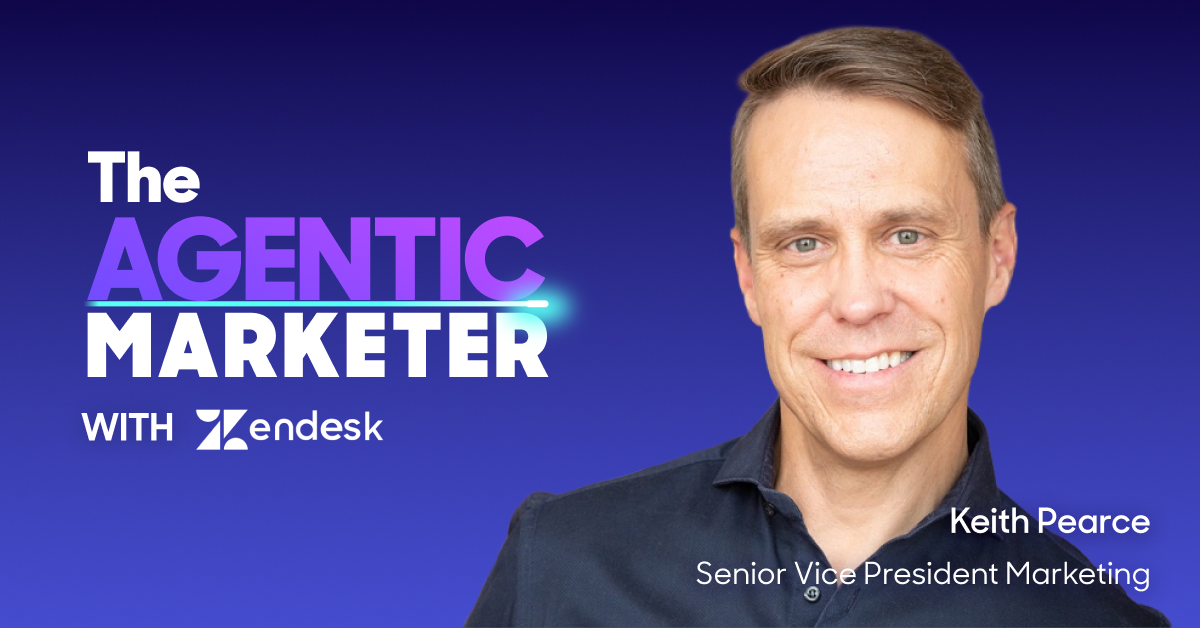


Most teams stop at faster and better. Discover why the agentic marketing maturity curve demands a bigger leap.



This episode of The Agentic Marketer features an interview with Keith Pearce, Senior Vice President Marketing at Zendesk, a leading AI-powered service company that helps businesses deliver better customer experiences through automation and intelligent agents.
Keith shares how Zendesk is embracing agentic marketing to scale impact across product marketing, demand generation, content, and sales motions. He explains what it really means to be an agentic marketer, why the idea of the individual contributor is changing, and how AI agents are enabling marketers to move from simply doing things faster to doing things fundamentally differently.
The conversation explores how Zendesk is using agentic AI across localization, content creation, outbound and inbound motions, and with their AI SDR to improve conversion rates, reduce friction in the buyer journey, and give human teams more time to focus on high-value, strategic work. Keith also dives into how buyer expectations are shifting in the AI era, why earned media and social proof matter more than ever for AEO, and what marketing leaders should be doing now to prepare their teams for what’s next.
Key Takeaways
TRANSCRIPT
Sarah McConnell – Qualified
Okay, Keith. Thank you so much for joining us on another episode of The Agentic Marketer. I'm super excited to have you on the show today to talk about agentic marketing. But before we dive into anything, I'd love for you just to tell me a little bit about yourself and the work that you're doing over at Zendesk.
Keith Pearce – Zendesk
Sure. Well, first of all, thanks for having me. It's great to be here. I love this topic. I love these conversations.
Zendesk is a AI service company. We're kind of agentifying service.
We're about a two billion dollar company. I run product marketing here. And, yeah, it's it's it's a great time to be in in a business that's taking what was manual and applying AI to it and seeing automation rates and savings and happy customers come. So that's kind of the north star we're on.
Sarah McConnell – Qualified
Absolutely. And I love having you on the show because you are obviously working in product marketing at a very AI first company, and here we are talking about, no surprise, AI and agentic. So to kick things off, that term agentic marketing, I know it can mean a lot things to a lot of people. So how do you define that for yourself and your team over at Zendesk?
Keith Pearce – Zendesk
Yeah. It's a good question, Sarah. You know, at at some point in your career as a marketer, you get put in this box.
You're a brand marketer. You're a demand marketer. You're a product marketer. You're.
And you'll hear this notion of being a full stack marketer as you sort of rise in your your marketing career.
And I think what the agentic marketer is is really someone that can navigate across all the functions of marketing using agentic capabilities.
I think the idea that there's an IC, an individual contributor as a marketer, is kind of a thing of the past with agentic. So I think an agentic marketer is learning how to create teams and capabilities with AI That go across the function they may sit in and help them scale and deliver marketing unlike they ever did before. So that's kind of what I think. And as you know, at this recording, what will be a marketer a month or two months or three months from now may have a different definition, but that's kind of what I think is so exciting.
Sarah McConnell – Qualified
Yeah. I do I like that definition. I was I I think of the term I used to hear a lot earlier on my career, like, t shaped marketer where you knew a lot about a lot of different functions of marketing, but then you could go very deep on one, which to your point is usually, like, your function of demand or comms or whatever it might be. But I like the way that you worded this almost like that t shaped marketer becomes the top part of that t is now how you're going to incorporate AI into all of those different functions.
Keith Pearce – Zendesk
That's right.
Sarah McConnell – Qualified
And you're absolutely right. In three months, that could be vastly different when things change. Yeah.
No. Keith, I'm curious. When we think about taking the leap from experimentation of AI, I think a lot of teams still feel like they are very much in an experimentation phase. And, again, harkening back to, like, things move rather quickly in this AI era, everyone kinda feels like they're experimenting. But how do you think these teams need to think about shifting from experimentation into feeling like they're actually leading with AI at the forefront of their marketing?
Keith Pearce – Zendesk
Yeah. I think there's this kind of notion of doing things better, doing things faster, and then doing things different. I think that's kind of the scale of if you think about an agentic marketer's maturity curve, if you will. I think most people are in the doing it faster and starting to do it better.
I think the real leap is to do it different. And I think it's kind of a Henry Henry Ford moment. You know? It wasn't about getting faster or better at producing horse drawn carriages. It was about creating the automobile, right, for him.
And I think that's that's where you see the most kind of progressive things around AI and marketing taking shape.
And I think it's a real seminal moment for marketers. And a lot of and a lot of tech companies, you know, marketers are there to support a sales motion or to be a support mechanism. I think what's cool about AI is if you can get into the different realm, you can really help a company position itself very differently. You can create something very different. Yeah. So I think it's kinda moving up that scale.
Sarah McConnell – Qualified
Yeah. That's really interesting. And as you you talk about that, this always makes me think about, like, traditional marketing as we know it. And, you know, I kinda mentioned, like, an old the t shaped marketer, all these things. Do you think AI fundamentally changes the game of marketing, or do you think it sort of optimizes what we always like, do you think the fundamentals of traditional marketing go away or vastly change? You talk about moving from experimentation to leading is kinda going from testing to, like, actually a different motion. So do you think it's gonna upend what we know as traditional marketing, or or or what's your take on that?
Keith Pearce – Zendesk
Yeah. My take is it's gonna make some things that were were very hard to do, like ABM or scaling content that just took a lot of person power to do, to customize incorporation of intent data to do better, more targeted demand. I think it's gonna make those things actually doable. And I think the interesting thing is we'll come back to those notions of social proof, like those constructs of social proof that the LLMs reward.
And that sort of authentic genuine moments, which we may have thought about fifteen, twenty years ago, like events, right, and real one to one sort of personalized authentic in person experiences is things that we kinda come back to, and we go, that's real. Yeah. And I think customers are gonna clam onto that, and that's where I think marketing has a chance to scale things that were previously hard and kinda hearken back to things that we may have rolled our eyes at. Look.
Let's be honest. Everybody has been in the conversation with the CFO around the line item that sticks out. That's the event line item. It's always the biggest line item.
And you know the conversations there are, like, what's the ROI, you know, of this this kind of event? And I think customers are craving that, especially in a world post COVID, you know, where we were kinda in our offices at home and we kinda miss that people connection. And it's not just going to more trade shows, by the way. Right?
It's it's re being very intentional around where you do in person stuff how you do that really, really well.
Sarah McConnell – Qualified
Yeah. It's always fun to watch those things kinda come back into style. I always use the example of, like, billboards. Like, pre COVID, there were billboards on one zero one, and then suddenly, like, if there was a time in twenty twenty one or twenty two where I asked my CFO if I could put up a billboard, they would have laughed at me and considered me probably pretty bad at my job.
And then suddenly, now we're back to, like, billboards everywhere. So it always seems to be a cyclical thing. And I I tend to agree with you with traditional marketing. Like, I think of intent data, and you you mentioned that as your Yeah.
There's been hard to action off of those things. Like, I've had as a demand gen person, like, I'm always trying to surface intent data to teams, and the feedback is always there's too many different signals coming in. I don't know what to do with them, and it does feel like there's such a real area of opportunity to actually start to utilize some of those things now that have been a part of our stacks for a very long time, but we've maybe been doing mediocre at best. And suddenly, we can actually do those at true scale, which has been kind of unfathomable before this.
Keith Pearce – Zendesk
Totally. Totally. Yeah. Totally agree. I mean, ABM's a great example. Right? I've heard ABM talked about and invested in a lot more than I've seen it really done effectively.
And as you know, what makes it done effectively is how tailored the content and experiences to that company, to that specific account with the specific languages, the specific initiatives. And without agent to capabilities, I I've just not seen it work as well. And so that's a good example of something that actually we can really do ABM this time, and we can do it for more than thirty accounts. We can do it for hundreds of accounts.
So that's that's part of what's exciting.
Sarah McConnell – Qualified
Absolutely. Now I'm curious. Your team over at Zendesk, how are you seeing Agentic AI show up most visibly right now? Like, where are you seeing value from it? Where are you most excited to see it starting to show up within your your organization there at Zendesk?
Keith Pearce – Zendesk
Yeah. I mean, it's it's, initially, it's in that scaling. So localization and translation of assets, it used to be long and, you know, take a long you know, be be very costly. We're seeing that go, you know, much quicker than it ever was, and we're producing in much more languages and geos than we were before.
Some of the content scaling assets. Right? It used to be that you had sort of a handful of people, the really good content people, and you had them loaded up with an editorial calendar of stuff they had to produce. And with content scaling tools, you're seeing that stuff sort of go through the roof.
Sarah McConnell – Qualified
Yep.
Keith Pearce – Zendesk
Really cool stuff with with with creative, you know, with experimentation, with animations. It's not just progressive and animals driving cars. Like, we're seeing, you know, really cool and authentic video content coming to the fore.
You know, when you get down to sort of your inbound and outbound motions with capabilities like agentic SDR, in the outbound, it's you've got three or four cadences now where you may have had one. You've got them totally tailored not just to the person, but to that industry, to the service model that you may have. You can really customize and tailor and test much more aggressively.
And then what used to be, you know, kinda lightweight conversion metrics on the inbound, we're seeing with agentic capabilities that's going, you know, further and for further north because that that volume has been taken off by an intelligent engine. Right? I think some of the things that are the raw materials we have in marketing, the customer proof point, the social proof points. Right?
Reviews, things like the the that is just the raw material of any agentic engine that can kinda help you audience match and find look alikes. Where you're in an underpenetrated with customers with product, Yeah. Agentic tools are great at isolating. Like, Sarah's company has these other three capabilities they could be adding, of Zendesk portfolio, and we could achieve this level.
So those are just a few things, Sarah, but, really, the sky is the limit on where we could go
Sarah McConnell – Qualified
Yeah.
Keith Pearce – Zendesk
From here.
Sarah McConnell – Qualified
Absolutely. Now it sounds like you guys have hired an AI SDR agent over there. Piper, you'll maybe reidentify Piper and Yeah. Have her own persona over there as Zendesk. But I'm always curious.
AI SDR, you know, when we first entered in this category over here, Qualified was a fairly unknown term. People were pretty hesitant at the as as people usually are when a new category starts to sort of pop up and emerge. But what made you lean into an AI SDR? What was something that made you say, like, yeah. This is something I I trust and wanna bring on to our marketing organization.
Keith Pearce – Zendesk
Yeah. I mean, it starts with kind of the economics of SDR. As you know, high churn, high turnover area.
And where especially, you have high volumes and and reach.
We were just looking at how can an agent capability at a quarter of the cost of a human that never needs a break, that works all year, that's not gonna churn, start to handle some of those mundane sort of inbound, start to separate the job seekers and the person that has a trouble ticket they're trying to shoot from somebody who you're trying to sell to.
And, you know, when you looked at what the precedent was, it was just kind of a a bad directed dialogue that wasn't really useful. I mean, just to be frank, it was like, pick these five things you need from us.
It wasn't
Sarah McConnell – Qualified
really useful.
Those five things were. You didn't tell me.
Keith Pearce – Zendesk
That's right. That's right. Like so this that that would those were sort of some of the auspices of let's go to a more agentic capability. Yep. And, you know, I I I started my previous company with an implementation of Piper that was you know, where before the inbound web conversion was about one and a half percent.
And it went four to five x what that was. Okay. And so you can just imagine, you know, how happy we were with that kind of ROI.
Sarah McConnell – Qualified
Yeah. I think oh, no. Go ahead.
Keith Pearce – Zendesk
Yeah. No. Go ahead. Go ahead.
Sarah McConnell – Qualified
One of the things you you touched on there that I always find so interesting that it's so frequently, I think, overlooked in an evaluation of the AI SDR agent. And, you know, we compare it to, like, cost savings with, like, human SDRs. But one of the things that kept standing out to me was, like, the churn factor of it.
Keith Pearce – Zendesk
Yeah.
Sarah McConnell – Qualified
And we kept coming back to, like, we we don't even have that large of an SDR team, like, all things considered.
But when we looked at our SDR team is the good ones tend to move on into a bigger role of the company, which is the whole point of an SDR role.
Keith Pearce – Zendesk
That's right.
Sarah McConnell – Qualified
Like, they want to move into a different role, and the org is just stepping stone. And then the ones that weren't very good either left on you know, they they turned off in their own way. And I was constantly retraining these people over and over and over again, and I would finally get one that was so good and be like, okay. Like, I keep thinking there was a guy at our organization named Brent, and Brent was incredible.
I'd look at his conversations that he was having and be like, how do I clone? I want ten x Yeah. For Brent because he's so good. He's answering these questions.
And to no surprise, Brent's tenure in the SDR role was, like, ten months before he got promoted into another position. And then I have to start over from scratch in training people about the products and the nuances and the intricacies. And that was something that's always hard to quantify the taxation that takes on your team of, like, retraining these SDRs over and over and trusting them with your branding and your messaging that having a scalable AI SDR just makes a huge difference on, like, the team's ability to execute.
Keith Pearce – Zendesk
Totally.
Totally. And, you know, what's interesting is we had some trepidation, as you can imagine, when you're bringing in an agentic function to to work alongside a human function. And the conventional wisdom would be the SDRs are gonna hate this. Yeah.
You know, this thing is gonna take their jobs. And in actual fact, what they found was they were doing more strategic outbound. They had much more time to do research. And the model, just like any agentic model, was getting better with time.
So with every interaction through the web channel, it's getting smarter and better. And when you take things like reviews, like raw content from reviews, and you start to train the engine on that, it gets really, really good. And, look, it's beyond a human's capacity and ability to do that. Right?
So that investment in training the SDR sustains forever and eternity with an agentic. And to your point, in the human, it goes into someone that enters they're a small business rep, and then before you know it, they're, you know, they've got a great sales career going. So, that was a little bit of how we were thinking and and seeing, the feedback from the teams.
Sarah McConnell – Qualified
I really like the way you worded that too because I feel like early days of AI, which that feels like it was eons ago when it was it was a couple years ago, is we kept saying, like, it'll free up their time to do more high value activities. I think we were all skeptical when we first heard that of, like, okay. What does that actually look like in action?
And I feel like we had a similar thing to what you saw is we knew the SDRs would be nervous as they were especially at our own organization. And what we found and then I got to see, like, in action, what does more high value activities look like? And suddenly, they were able to write, like, really good outbound emails to our highly targeted, like, high value accounts. And then all of sudden, we started to see more high quality pipeline that was converting at a higher conversion percentage through the funnel coming from our outbound actions because they were spending more time on it.
They weren't having to split their focus. And I was like, oh, this is what it looks like in action. Like, this is me actually seeing what more high value activity because now they could do the research. They could really hone in on the buying committee at those accounts because they have an AI SDR doing things at scale, which is, like, qualifying people.
You kinda mentioned, like, pushing people off to, oh, it's a support ticket or it's just a tire kicker. They're not actually interested. They're not spending their time on any of those things now. So watching both sides get optimized is is really cool to see in action.
But for you, Keith, I'm curious what metrics we've talked a lot about, like, SDR efficiency, but are there any particular metrics beyond that that you look to to know your AI SDR is performing the way that you want it to?
Keith Pearce – Zendesk
Yeah. I mean, the the conversion metrics, and I talked about it. But that's kind of the first thing you look at is, like, what kind of conversion we're getting, and marketers look at that through the different stages of the funnel as well. So that's a a key point. Like, what is our, you know, our pipe to spend ratios that we're seeing through the different channels?
And, you know, if you're getting, you know, twelve, thirteen, fifteen dollars a pipeline from every dollar you spend, those are good ratios. So so those were some of the metrics we were looking at.
And, you know, the cost per interaction and things like that were all things you know, in SDR orgs, you're looking at, you know, time to ramp, right, and thing and things like that. And so those are always built in for the human.
And with the agentic, it's it's more the human capital that goes into training the engine and making sure that as I I was referring to earlier, all those raw materials are there. Super surprising how technical the agentic SDR can become Yeah. With the right kind of sort of, you know, feature documentation uploaded. And as you know, customers now are super informed. They're getting instant feedback from ChatGPT or Anthropic or whatever it is. So when they come to your digital experience, that's their expectation when they engage with another agentic engine. So that investment in time, which is a continuous feeding, by the way, of the agentic capability, we just saw paying dividends and going beyond.
That's a prospect you should talk to someone to pretty deep feature comparison and analysis around why they should consider us and not someone else. And then as you know, what you end up with is a pretty deep and funnel prospect who's primed for a conversation. And then you have all of that rich history that whoever's making the outbound can consult, and they know exactly where to start Yep. With a customer, which sometimes can be hard to find in our systems. Or you've had that human element that didn't do the wrap up stuff from a call that someone else didn't have the benefit of gleaning when they were doing an outbound. But all so all of that is obviously there.
Sarah McConnell – Qualified
Yeah. Now you mentioned buyers are coming to your website. They're more informed than they've ever been, which I feel like it's been a trend for a while now. But do you think there is a a shift that has maybe already happened or a shift that is going to happen in buyer expectations with this AI era that we as marketers are either under underestimating or, like, really need to be aware of and be thinking about for our future, like, marketing strategies?
Keith Pearce – Zendesk
Yeah. I think it's I think, first of all, if you're not thinking about AEO as a channel and how the search is not just starting from a Gemini summary on Google, but it's starting in in in an LLM organically. And so if you're not thinking about how you're feeding that engine, you know, you're you're gonna be missing a beat, and you're gonna be left out. And what that means, I mentioned the social proof, is those that video content of a customer on why they selected you and not the other person.
Those comparative grids. Right? Those Harvey balls on why you're better. The engines love that stuff.
I've got these stuff that's not behind a paywall that the LLMs can scrape. I mentioned reviews a couple times. It's not just having reviews. It's having a diversity of root reviews.
It's having the right ICPs and personas. These are all things, if you're not thinking about, you're gonna miss in the AEO realm. Yep.
I think the other thing is just leaving room in the budgeting. You know, we're at the end of the year, and most of the budgets are either set or you're being cut, you're like, oh my god. What am I gonna do?
But leaving enough room in your budgets to experiment with some of the tools, would be a really good thing for marketers to be doing as they enter a new year if they're
Sarah McConnell – Qualified
Agree.
Yeah.
Sarah McConnell – Qualified
Now if you were speaking of, know, we're moving into a new year. We're all thinking about strategies or we've done planning. But if someone was listening to this, another a peer or marketing leader peer, and they're thinking about how to really start to adopt AI within marketing organizations, like, what advice would you be giving to other peers that are looking to really start on this agentic journey? Like, where do they get started? That can always feel like the most daunting thing. Like, what would your advice be for them?
Keith Pearce – Zendesk
Yeah. I think it's like going back to that better, faster, different. I think I think if you haven't you know you know, unfortunately, there's some companies that are like, let's isolate who can use AI to this sort of small group people. I would say dive in and give everybody the tools they need to experiment and know you've got an investment curve, which is training the systems. Right? A good content scaling agentic tool, it needs your style guides. It needs your best performing brand assets to learn your brand voice and get better.
So I I'm I'm big on the content scaling tools. Those were the first agentic tools that I started to use.
Long form content was getting better. Long form content was coming organically from some of those channels. I mentioned video assets. You know, so many so many of us go to out of house for big production of assets for shows and things like that. Some of these tools can do a really good job Yeah. Of creating some of those things.
Sarah McConnell – Qualified
Absolutely.
Sarah McConnell – Qualified
Now as a a leader of a team that is obviously like, you're in a a pretty AI forward company. You've used a lot of agentic tools.
What advice are you giving to your team, or what are you thinking about skills that need to be doubled down on in order for marketing teams to thrive right now? Like, is there a particular skill that you're encouraging your team to adopt or a mindset? Like, how are you thinking about encouraging your team to really thrive right now?
Keith Pearce – Zendesk
Yeah. I mean, if you go back to one of my convictions is that you can become a full stack marketer if you know how to use the right agentic tools. That means that doesn't mean you have the right to come tell the demand gen person you're doing your job wrong. Told me your targeting strategy is off.
But what it does mean is, you know, your ability to collaborate and work with others becomes really important.
And there's always a difference to the function and who might own what, but I think you can really accelerate, you know, your launch motions. Right? You can have a campaign brief that's prepared. You can have a targeting strategy that's prepared that's can serve as a starting point to just start to do things much faster.
So that ability to you know, those human values of don't sit in your silo, collaborate, work well cross functionally, and don't be afraid to experiment. You know? You've gotta put experimentation into your mix. You gotta think about that as a budget item that's not small that can help you kinda get to that different that I talked about earlier.
Sarah McConnell – Qualified
Yeah. You mentioned, like, a difference to the the owner of that function, but I do think Yeah. Someone else that was on the podcast recently said a skill they're encouraging is, like, soft skills, which often get overlooked. And I I like that that complements kind of what you said, which is, like, learning to work cross functionally, having those soft skills as everyone becomes a little more capable with AI functionality, and it kinda levels the playing field. It seems like those soft skills and how you work collaboratively with the rest of your team are gonna be things that kinda set you apart that I think often get overlooked when you think about how how your role and team structures might shift in this AI world.
Keith Pearce – Zendesk
Totally.
Sarah McConnell – Qualified
Well, last question for you, Keith, before we go into the lightning round, which are are quick Yeah. Fun questions.
Keith Pearce – Zendesk
Yeah.
Sarah McConnell – Qualified
What do think is something that most b two b orgs are gonna still be getting wrong with AI a year from now? I know it's always hard with a crystal ball to, like, guess the future. But based on what you're seeing trend wise, what's something we should all be looking out for that we could be getting wrong a year from now?
Keith Pearce – Zendesk
Yeah. And it look, moment of self awareness here. In the last couple years, I have sort of poo pooed. Like, if you're not a public company or if you're not coming up with a cure for cancer, what is the value of PR? Like, really?
I think PR is back. Like, I'll admit, like, guilty. Right? I was like, we don't need an agency.
We don't need to spend a lot of money. Why are we just cranking out PRs for sake of PRs? Actually, you're paying the agentic engines off. Yep.
And that's gonna have a return. Like, I'm just saying, like, that's a thing. Yeah. So and it's it's it's earned media in general because it's it's it's that construct of social proof.
It's that credible source of validation for you that the engines love.
Sarah McConnell – Qualified
Yeah.
Sarah McConnell – Qualified
Yeah. Great that you had self reflection that you said, hey. This has come full circle. We had a same moment here at Qualified.
We're like, are, like, what is the effort? Is the juice juice worth the squeeze? Like, are we really getting stuff out of this? And then I in our case, in the last, like, couple of quarters, we started to really, like, crank up the PR engine knowing that it's feeding LLMs and how they're getting referenced, and that was very important.
And all of a sudden, for every product launch, we were paying money to, like, put press releases out on the wire. And the first couple times, I'm like, this feels like such a waste of my budget. Like, is this really working? And then all of a sudden, started to watch, like, our AEO referencing and, like, how we're getting referenced in them. And our AEO traffic is going up and the traffic that and I was like, oh, it is working.
It took a while to see it.
Keith Pearce – Zendesk
Yeah. And and, you know, one of the things I think we've always been afraid little afraid to do is talk about our competitors.
Sarah McConnell – Qualified
Yep.
Keith Pearce – Zendesk
But the engines actually wanna see that comparative grid. Yeah. They wanna hear why somebody chose you over competitor x, y, z. And I know it's not easy to get those testimonies off the ground, but if you can have those conversations with customers, it doesn't need to be the big beautiful thing on stage at your event.
Yep. It can just be a a format like this where you're talking through, hey. What who did you consider and why did you select? That's a gold mine, and you you need to be able and some of it is there's no more putting makeup on the problem.
Like, it used to be your messaging, your campaign go like, we know we're weak in these areas in product.
You're gonna get exposed, and you can you know, being authentic about that. We may not be the right solution for you if you're looking for this, but we are for that. I think that's the stuff we have to be vulnerable as marketers about doing, knowing Absolutely. This agenda feature.
Sarah McConnell – Qualified
Okay. So I have a last few couple questions for you. These are lightning round questions. So there's more more fun, fast answers. The first is, besides ChatGPT, because that tends to be everyone's answer, what was the first AI tool that you experimented with as a marketer?
Keith Pearce – Zendesk
Yeah. I mean, Jasper, the content scaling tool. I'm a big Jasper fan. Before I was using ChatGPT to help me figure out my recipes and, you know, how long to slow cook the pork roast and all that stuff at home.
We were using Jasper. Our style guides, our best performing, you know, brand assets were there. Yep. And it continues to be a great tool.
Sarah McConnell – Qualified
So you were the, I think, second guess in a row that said Jasper is their first tool, and I'm really getting a demo of theirs. Yeah. I used to do a different podcast called GTM AI where I was, like, getting demos of, like, new AI tools. And Jasper is one of the first demos I got, and I remember theirs was, I mean, I'm still talking about it as a stand out one. And it was, like, such a good tool that I think is still a very relevant pertinent tool right now. So I love that that was the the first one that you were experimenting with. Most overrated buzzword that you hear in MarTech right now?
Keith Pearce – Zendesk
I mean, it's it's been the last few years, but ABM. You know? I feel like I think the way agentic is gonna eat SaaS and can eat labor, I think it's gonna eat this notion of ABM.
Sarah McConnell – Qualified
Yep.
Keith Pearce – Zendesk
And I think we're gonna find much smarter ways to do what the promise of ABM was.
Sarah McConnell – Qualified
Find Absolutely. Yeah. Who is a marketer that you think is ahead of the curve on AI right now that you would recommend listeners go follow on LinkedIn?
Keith Pearce – Zendesk
I mean, I I talk I I think more about the companies, Sarah, than individuals because it's hard to sort of see beneath the surface around what's happening.
But when you look at some of the companies whose creative is just jumping off the charts because you know agentic is there you know, I mentioned the the progressive progressive commercials with animals, Coca Cola, and polar bears. Figma's doing some really cool stuff. I love what they're doing.
I'm, you know, I'm not pitching an agency, but Superside has kinda figured out, I think, how to do some really cool creative. So it's most of the creative stuff instead of an individual.
Yep. And it's just a couple of companies that are doing some things really well and really cool and creating sort of pairings that maybe you hadn't thought about You know, that, you know, you can put into your marketing with new visuals and and storytelling ways that are just super cool.
Sarah McConnell – Qualified
Absolutely. Okay. Last question. If you could use AI to automate one part of your life outside of work or if you are already using AI to help automate something, what is it?
Keith Pearce – Zendesk
I mean, I'm a neat freak. I'll tell you. I'm one of those guy like, my closet is all I am a clean like, that is way too much of my weekend is cleaning. Drives my my wife and kids nuts.
I've tried the robot vacuum, you know, whatever. Oh, yeah. Doesn't you know? It's just yeah. Not good.
Sarah McConnell – Qualified
Yeah. Something to help with cleaning. Again, it's so funny. I always ask this question in every answer. I'm like, yeah. I would totally use that.
I do think organization and cleaning, pretty high on my list, especially with an eight month old at home.
Keith Pearce – Zendesk
Yeah.
I mean, if my if if if my some cleaning apparatus could be as good as, like, the AI in my Spotify playlist decision, like, the songs are spot on. Yeah. It's, like, recommendations are spot on. Like, if you could just get something close to that, I don't need the robotic vacuum that gets stuck in a corner for four hours to get turned around.
Sarah McConnell – Qualified
Yeah. Yeah. So Well, Keith, thank you so much for joining us on the show today. It was great to have you, and thank you for sharing all of your insights with us.
Keith Pearce – Zendesk
Happy to do it. Thank you, Sarah. Thanks for having me.
Flexera CMO Leslie Alore shares how agentic AI is reshaping B2B marketing, from content and research to AI SDR agents, buyer expectations, and building modern marketing teams.
.avif)
Hear how Culture Amp CMO Paige O’Neill approaches agentic readiness, AI literacy, and leading marketing teams through AI adoption.
FourKites’ Amanda Dyson breaks down why agentic AI needs human leadership, strong marketers, and intentional setup to deliver real results.
.jpg)
Brightly Software’s Whitney Rosa explains why B2B marketing is shifting from campaign-centric to system-centric, powered by AI agents that automate decisions, optimize in real time, and scale marketing impact.
.jpg)
Learn how Talkspace uses AI SDR agents and agentic marketing to replace static funnels and turn website traffic into qualified pipeline.
.jpg)
Our show The Agentic Marketer interviews today's leading B2B marketers to discover how they're actually using agentic AI day to day to hit their pipeline goals. Learn the 7 things agentic marketers are doing right now to stay ahead of the curve.
Most teams stop at faster and better. Discover why the agentic marketing maturity curve demands a bigger leap.
This episode of The Agentic Marketer features an interview with Keith Pearce, Senior Vice President Marketing at Zendesk, a leading AI-powered service company that helps businesses deliver better customer experiences through automation and intelligent agents.
Keith shares how Zendesk is embracing agentic marketing to scale impact across product marketing, demand generation, content, and sales motions. He explains what it really means to be an agentic marketer, why the idea of the individual contributor is changing, and how AI agents are enabling marketers to move from simply doing things faster to doing things fundamentally differently.
The conversation explores how Zendesk is using agentic AI across localization, content creation, outbound and inbound motions, and with their AI SDR to improve conversion rates, reduce friction in the buyer journey, and give human teams more time to focus on high-value, strategic work. Keith also dives into how buyer expectations are shifting in the AI era, why earned media and social proof matter more than ever for AEO, and what marketing leaders should be doing now to prepare their teams for what’s next.
Key Takeaways
TRANSCRIPT
Sarah McConnell – Qualified
Okay, Keith. Thank you so much for joining us on another episode of The Agentic Marketer. I'm super excited to have you on the show today to talk about agentic marketing. But before we dive into anything, I'd love for you just to tell me a little bit about yourself and the work that you're doing over at Zendesk.
Keith Pearce – Zendesk
Sure. Well, first of all, thanks for having me. It's great to be here. I love this topic. I love these conversations.
Zendesk is a AI service company. We're kind of agentifying service.
We're about a two billion dollar company. I run product marketing here. And, yeah, it's it's it's a great time to be in in a business that's taking what was manual and applying AI to it and seeing automation rates and savings and happy customers come. So that's kind of the north star we're on.
Sarah McConnell – Qualified
Absolutely. And I love having you on the show because you are obviously working in product marketing at a very AI first company, and here we are talking about, no surprise, AI and agentic. So to kick things off, that term agentic marketing, I know it can mean a lot things to a lot of people. So how do you define that for yourself and your team over at Zendesk?
Keith Pearce – Zendesk
Yeah. It's a good question, Sarah. You know, at at some point in your career as a marketer, you get put in this box.
You're a brand marketer. You're a demand marketer. You're a product marketer. You're.
And you'll hear this notion of being a full stack marketer as you sort of rise in your your marketing career.
And I think what the agentic marketer is is really someone that can navigate across all the functions of marketing using agentic capabilities.
I think the idea that there's an IC, an individual contributor as a marketer, is kind of a thing of the past with agentic. So I think an agentic marketer is learning how to create teams and capabilities with AI That go across the function they may sit in and help them scale and deliver marketing unlike they ever did before. So that's kind of what I think. And as you know, at this recording, what will be a marketer a month or two months or three months from now may have a different definition, but that's kind of what I think is so exciting.
Sarah McConnell – Qualified
Yeah. I do I like that definition. I was I I think of the term I used to hear a lot earlier on my career, like, t shaped marketer where you knew a lot about a lot of different functions of marketing, but then you could go very deep on one, which to your point is usually, like, your function of demand or comms or whatever it might be. But I like the way that you worded this almost like that t shaped marketer becomes the top part of that t is now how you're going to incorporate AI into all of those different functions.
Keith Pearce – Zendesk
That's right.
Sarah McConnell – Qualified
And you're absolutely right. In three months, that could be vastly different when things change. Yeah.
No. Keith, I'm curious. When we think about taking the leap from experimentation of AI, I think a lot of teams still feel like they are very much in an experimentation phase. And, again, harkening back to, like, things move rather quickly in this AI era, everyone kinda feels like they're experimenting. But how do you think these teams need to think about shifting from experimentation into feeling like they're actually leading with AI at the forefront of their marketing?
Keith Pearce – Zendesk
Yeah. I think there's this kind of notion of doing things better, doing things faster, and then doing things different. I think that's kind of the scale of if you think about an agentic marketer's maturity curve, if you will. I think most people are in the doing it faster and starting to do it better.
I think the real leap is to do it different. And I think it's kind of a Henry Henry Ford moment. You know? It wasn't about getting faster or better at producing horse drawn carriages. It was about creating the automobile, right, for him.
And I think that's that's where you see the most kind of progressive things around AI and marketing taking shape.
And I think it's a real seminal moment for marketers. And a lot of and a lot of tech companies, you know, marketers are there to support a sales motion or to be a support mechanism. I think what's cool about AI is if you can get into the different realm, you can really help a company position itself very differently. You can create something very different. Yeah. So I think it's kinda moving up that scale.
Sarah McConnell – Qualified
Yeah. That's really interesting. And as you you talk about that, this always makes me think about, like, traditional marketing as we know it. And, you know, I kinda mentioned, like, an old the t shaped marketer, all these things. Do you think AI fundamentally changes the game of marketing, or do you think it sort of optimizes what we always like, do you think the fundamentals of traditional marketing go away or vastly change? You talk about moving from experimentation to leading is kinda going from testing to, like, actually a different motion. So do you think it's gonna upend what we know as traditional marketing, or or or what's your take on that?
Keith Pearce – Zendesk
Yeah. My take is it's gonna make some things that were were very hard to do, like ABM or scaling content that just took a lot of person power to do, to customize incorporation of intent data to do better, more targeted demand. I think it's gonna make those things actually doable. And I think the interesting thing is we'll come back to those notions of social proof, like those constructs of social proof that the LLMs reward.
And that sort of authentic genuine moments, which we may have thought about fifteen, twenty years ago, like events, right, and real one to one sort of personalized authentic in person experiences is things that we kinda come back to, and we go, that's real. Yeah. And I think customers are gonna clam onto that, and that's where I think marketing has a chance to scale things that were previously hard and kinda hearken back to things that we may have rolled our eyes at. Look.
Let's be honest. Everybody has been in the conversation with the CFO around the line item that sticks out. That's the event line item. It's always the biggest line item.
And you know the conversations there are, like, what's the ROI, you know, of this this kind of event? And I think customers are craving that, especially in a world post COVID, you know, where we were kinda in our offices at home and we kinda miss that people connection. And it's not just going to more trade shows, by the way. Right?
It's it's re being very intentional around where you do in person stuff how you do that really, really well.
Sarah McConnell – Qualified
Yeah. It's always fun to watch those things kinda come back into style. I always use the example of, like, billboards. Like, pre COVID, there were billboards on one zero one, and then suddenly, like, if there was a time in twenty twenty one or twenty two where I asked my CFO if I could put up a billboard, they would have laughed at me and considered me probably pretty bad at my job.
And then suddenly, now we're back to, like, billboards everywhere. So it always seems to be a cyclical thing. And I I tend to agree with you with traditional marketing. Like, I think of intent data, and you you mentioned that as your Yeah.
There's been hard to action off of those things. Like, I've had as a demand gen person, like, I'm always trying to surface intent data to teams, and the feedback is always there's too many different signals coming in. I don't know what to do with them, and it does feel like there's such a real area of opportunity to actually start to utilize some of those things now that have been a part of our stacks for a very long time, but we've maybe been doing mediocre at best. And suddenly, we can actually do those at true scale, which has been kind of unfathomable before this.
Keith Pearce – Zendesk
Totally. Totally. Yeah. Totally agree. I mean, ABM's a great example. Right? I've heard ABM talked about and invested in a lot more than I've seen it really done effectively.
And as you know, what makes it done effectively is how tailored the content and experiences to that company, to that specific account with the specific languages, the specific initiatives. And without agent to capabilities, I I've just not seen it work as well. And so that's a good example of something that actually we can really do ABM this time, and we can do it for more than thirty accounts. We can do it for hundreds of accounts.
So that's that's part of what's exciting.
Sarah McConnell – Qualified
Absolutely. Now I'm curious. Your team over at Zendesk, how are you seeing Agentic AI show up most visibly right now? Like, where are you seeing value from it? Where are you most excited to see it starting to show up within your your organization there at Zendesk?
Keith Pearce – Zendesk
Yeah. I mean, it's it's, initially, it's in that scaling. So localization and translation of assets, it used to be long and, you know, take a long you know, be be very costly. We're seeing that go, you know, much quicker than it ever was, and we're producing in much more languages and geos than we were before.
Some of the content scaling assets. Right? It used to be that you had sort of a handful of people, the really good content people, and you had them loaded up with an editorial calendar of stuff they had to produce. And with content scaling tools, you're seeing that stuff sort of go through the roof.
Sarah McConnell – Qualified
Yep.
Keith Pearce – Zendesk
Really cool stuff with with with creative, you know, with experimentation, with animations. It's not just progressive and animals driving cars. Like, we're seeing, you know, really cool and authentic video content coming to the fore.
You know, when you get down to sort of your inbound and outbound motions with capabilities like agentic SDR, in the outbound, it's you've got three or four cadences now where you may have had one. You've got them totally tailored not just to the person, but to that industry, to the service model that you may have. You can really customize and tailor and test much more aggressively.
And then what used to be, you know, kinda lightweight conversion metrics on the inbound, we're seeing with agentic capabilities that's going, you know, further and for further north because that that volume has been taken off by an intelligent engine. Right? I think some of the things that are the raw materials we have in marketing, the customer proof point, the social proof points. Right?
Reviews, things like the the that is just the raw material of any agentic engine that can kinda help you audience match and find look alikes. Where you're in an underpenetrated with customers with product, Yeah. Agentic tools are great at isolating. Like, Sarah's company has these other three capabilities they could be adding, of Zendesk portfolio, and we could achieve this level.
So those are just a few things, Sarah, but, really, the sky is the limit on where we could go
Sarah McConnell – Qualified
Yeah.
Keith Pearce – Zendesk
From here.
Sarah McConnell – Qualified
Absolutely. Now it sounds like you guys have hired an AI SDR agent over there. Piper, you'll maybe reidentify Piper and Yeah. Have her own persona over there as Zendesk. But I'm always curious.
AI SDR, you know, when we first entered in this category over here, Qualified was a fairly unknown term. People were pretty hesitant at the as as people usually are when a new category starts to sort of pop up and emerge. But what made you lean into an AI SDR? What was something that made you say, like, yeah. This is something I I trust and wanna bring on to our marketing organization.
Keith Pearce – Zendesk
Yeah. I mean, it starts with kind of the economics of SDR. As you know, high churn, high turnover area.
And where especially, you have high volumes and and reach.
We were just looking at how can an agent capability at a quarter of the cost of a human that never needs a break, that works all year, that's not gonna churn, start to handle some of those mundane sort of inbound, start to separate the job seekers and the person that has a trouble ticket they're trying to shoot from somebody who you're trying to sell to.
And, you know, when you looked at what the precedent was, it was just kind of a a bad directed dialogue that wasn't really useful. I mean, just to be frank, it was like, pick these five things you need from us.
It wasn't
Sarah McConnell – Qualified
really useful.
Those five things were. You didn't tell me.
Keith Pearce – Zendesk
That's right. That's right. Like so this that that would those were sort of some of the auspices of let's go to a more agentic capability. Yep. And, you know, I I I started my previous company with an implementation of Piper that was you know, where before the inbound web conversion was about one and a half percent.
And it went four to five x what that was. Okay. And so you can just imagine, you know, how happy we were with that kind of ROI.
Sarah McConnell – Qualified
Yeah. I think oh, no. Go ahead.
Keith Pearce – Zendesk
Yeah. No. Go ahead. Go ahead.
Sarah McConnell – Qualified
One of the things you you touched on there that I always find so interesting that it's so frequently, I think, overlooked in an evaluation of the AI SDR agent. And, you know, we compare it to, like, cost savings with, like, human SDRs. But one of the things that kept standing out to me was, like, the churn factor of it.
Keith Pearce – Zendesk
Yeah.
Sarah McConnell – Qualified
And we kept coming back to, like, we we don't even have that large of an SDR team, like, all things considered.
But when we looked at our SDR team is the good ones tend to move on into a bigger role of the company, which is the whole point of an SDR role.
Keith Pearce – Zendesk
That's right.
Sarah McConnell – Qualified
Like, they want to move into a different role, and the org is just stepping stone. And then the ones that weren't very good either left on you know, they they turned off in their own way. And I was constantly retraining these people over and over and over again, and I would finally get one that was so good and be like, okay. Like, I keep thinking there was a guy at our organization named Brent, and Brent was incredible.
I'd look at his conversations that he was having and be like, how do I clone? I want ten x Yeah. For Brent because he's so good. He's answering these questions.
And to no surprise, Brent's tenure in the SDR role was, like, ten months before he got promoted into another position. And then I have to start over from scratch in training people about the products and the nuances and the intricacies. And that was something that's always hard to quantify the taxation that takes on your team of, like, retraining these SDRs over and over and trusting them with your branding and your messaging that having a scalable AI SDR just makes a huge difference on, like, the team's ability to execute.
Keith Pearce – Zendesk
Totally.
Totally. And, you know, what's interesting is we had some trepidation, as you can imagine, when you're bringing in an agentic function to to work alongside a human function. And the conventional wisdom would be the SDRs are gonna hate this. Yeah.
You know, this thing is gonna take their jobs. And in actual fact, what they found was they were doing more strategic outbound. They had much more time to do research. And the model, just like any agentic model, was getting better with time.
So with every interaction through the web channel, it's getting smarter and better. And when you take things like reviews, like raw content from reviews, and you start to train the engine on that, it gets really, really good. And, look, it's beyond a human's capacity and ability to do that. Right?
So that investment in training the SDR sustains forever and eternity with an agentic. And to your point, in the human, it goes into someone that enters they're a small business rep, and then before you know it, they're, you know, they've got a great sales career going. So, that was a little bit of how we were thinking and and seeing, the feedback from the teams.
Sarah McConnell – Qualified
I really like the way you worded that too because I feel like early days of AI, which that feels like it was eons ago when it was it was a couple years ago, is we kept saying, like, it'll free up their time to do more high value activities. I think we were all skeptical when we first heard that of, like, okay. What does that actually look like in action?
And I feel like we had a similar thing to what you saw is we knew the SDRs would be nervous as they were especially at our own organization. And what we found and then I got to see, like, in action, what does more high value activities look like? And suddenly, they were able to write, like, really good outbound emails to our highly targeted, like, high value accounts. And then all of sudden, we started to see more high quality pipeline that was converting at a higher conversion percentage through the funnel coming from our outbound actions because they were spending more time on it.
They weren't having to split their focus. And I was like, oh, this is what it looks like in action. Like, this is me actually seeing what more high value activity because now they could do the research. They could really hone in on the buying committee at those accounts because they have an AI SDR doing things at scale, which is, like, qualifying people.
You kinda mentioned, like, pushing people off to, oh, it's a support ticket or it's just a tire kicker. They're not actually interested. They're not spending their time on any of those things now. So watching both sides get optimized is is really cool to see in action.
But for you, Keith, I'm curious what metrics we've talked a lot about, like, SDR efficiency, but are there any particular metrics beyond that that you look to to know your AI SDR is performing the way that you want it to?
Keith Pearce – Zendesk
Yeah. I mean, the the conversion metrics, and I talked about it. But that's kind of the first thing you look at is, like, what kind of conversion we're getting, and marketers look at that through the different stages of the funnel as well. So that's a a key point. Like, what is our, you know, our pipe to spend ratios that we're seeing through the different channels?
And, you know, if you're getting, you know, twelve, thirteen, fifteen dollars a pipeline from every dollar you spend, those are good ratios. So so those were some of the metrics we were looking at.
And, you know, the cost per interaction and things like that were all things you know, in SDR orgs, you're looking at, you know, time to ramp, right, and thing and things like that. And so those are always built in for the human.
And with the agentic, it's it's more the human capital that goes into training the engine and making sure that as I I was referring to earlier, all those raw materials are there. Super surprising how technical the agentic SDR can become Yeah. With the right kind of sort of, you know, feature documentation uploaded. And as you know, customers now are super informed. They're getting instant feedback from ChatGPT or Anthropic or whatever it is. So when they come to your digital experience, that's their expectation when they engage with another agentic engine. So that investment in time, which is a continuous feeding, by the way, of the agentic capability, we just saw paying dividends and going beyond.
That's a prospect you should talk to someone to pretty deep feature comparison and analysis around why they should consider us and not someone else. And then as you know, what you end up with is a pretty deep and funnel prospect who's primed for a conversation. And then you have all of that rich history that whoever's making the outbound can consult, and they know exactly where to start Yep. With a customer, which sometimes can be hard to find in our systems. Or you've had that human element that didn't do the wrap up stuff from a call that someone else didn't have the benefit of gleaning when they were doing an outbound. But all so all of that is obviously there.
Sarah McConnell – Qualified
Yeah. Now you mentioned buyers are coming to your website. They're more informed than they've ever been, which I feel like it's been a trend for a while now. But do you think there is a a shift that has maybe already happened or a shift that is going to happen in buyer expectations with this AI era that we as marketers are either under underestimating or, like, really need to be aware of and be thinking about for our future, like, marketing strategies?
Keith Pearce – Zendesk
Yeah. I think it's I think, first of all, if you're not thinking about AEO as a channel and how the search is not just starting from a Gemini summary on Google, but it's starting in in in an LLM organically. And so if you're not thinking about how you're feeding that engine, you know, you're you're gonna be missing a beat, and you're gonna be left out. And what that means, I mentioned the social proof, is those that video content of a customer on why they selected you and not the other person.
Those comparative grids. Right? Those Harvey balls on why you're better. The engines love that stuff.
I've got these stuff that's not behind a paywall that the LLMs can scrape. I mentioned reviews a couple times. It's not just having reviews. It's having a diversity of root reviews.
It's having the right ICPs and personas. These are all things, if you're not thinking about, you're gonna miss in the AEO realm. Yep.
I think the other thing is just leaving room in the budgeting. You know, we're at the end of the year, and most of the budgets are either set or you're being cut, you're like, oh my god. What am I gonna do?
But leaving enough room in your budgets to experiment with some of the tools, would be a really good thing for marketers to be doing as they enter a new year if they're
Sarah McConnell – Qualified
Agree.
Yeah.
Sarah McConnell – Qualified
Now if you were speaking of, know, we're moving into a new year. We're all thinking about strategies or we've done planning. But if someone was listening to this, another a peer or marketing leader peer, and they're thinking about how to really start to adopt AI within marketing organizations, like, what advice would you be giving to other peers that are looking to really start on this agentic journey? Like, where do they get started? That can always feel like the most daunting thing. Like, what would your advice be for them?
Keith Pearce – Zendesk
Yeah. I think it's like going back to that better, faster, different. I think I think if you haven't you know you know, unfortunately, there's some companies that are like, let's isolate who can use AI to this sort of small group people. I would say dive in and give everybody the tools they need to experiment and know you've got an investment curve, which is training the systems. Right? A good content scaling agentic tool, it needs your style guides. It needs your best performing brand assets to learn your brand voice and get better.
So I I'm I'm big on the content scaling tools. Those were the first agentic tools that I started to use.
Long form content was getting better. Long form content was coming organically from some of those channels. I mentioned video assets. You know, so many so many of us go to out of house for big production of assets for shows and things like that. Some of these tools can do a really good job Yeah. Of creating some of those things.
Sarah McConnell – Qualified
Absolutely.
Sarah McConnell – Qualified
Now as a a leader of a team that is obviously like, you're in a a pretty AI forward company. You've used a lot of agentic tools.
What advice are you giving to your team, or what are you thinking about skills that need to be doubled down on in order for marketing teams to thrive right now? Like, is there a particular skill that you're encouraging your team to adopt or a mindset? Like, how are you thinking about encouraging your team to really thrive right now?
Keith Pearce – Zendesk
Yeah. I mean, if you go back to one of my convictions is that you can become a full stack marketer if you know how to use the right agentic tools. That means that doesn't mean you have the right to come tell the demand gen person you're doing your job wrong. Told me your targeting strategy is off.
But what it does mean is, you know, your ability to collaborate and work with others becomes really important.
And there's always a difference to the function and who might own what, but I think you can really accelerate, you know, your launch motions. Right? You can have a campaign brief that's prepared. You can have a targeting strategy that's prepared that's can serve as a starting point to just start to do things much faster.
So that ability to you know, those human values of don't sit in your silo, collaborate, work well cross functionally, and don't be afraid to experiment. You know? You've gotta put experimentation into your mix. You gotta think about that as a budget item that's not small that can help you kinda get to that different that I talked about earlier.
Sarah McConnell – Qualified
Yeah. You mentioned, like, a difference to the the owner of that function, but I do think Yeah. Someone else that was on the podcast recently said a skill they're encouraging is, like, soft skills, which often get overlooked. And I I like that that complements kind of what you said, which is, like, learning to work cross functionally, having those soft skills as everyone becomes a little more capable with AI functionality, and it kinda levels the playing field. It seems like those soft skills and how you work collaboratively with the rest of your team are gonna be things that kinda set you apart that I think often get overlooked when you think about how how your role and team structures might shift in this AI world.
Keith Pearce – Zendesk
Totally.
Sarah McConnell – Qualified
Well, last question for you, Keith, before we go into the lightning round, which are are quick Yeah. Fun questions.
Keith Pearce – Zendesk
Yeah.
Sarah McConnell – Qualified
What do think is something that most b two b orgs are gonna still be getting wrong with AI a year from now? I know it's always hard with a crystal ball to, like, guess the future. But based on what you're seeing trend wise, what's something we should all be looking out for that we could be getting wrong a year from now?
Keith Pearce – Zendesk
Yeah. And it look, moment of self awareness here. In the last couple years, I have sort of poo pooed. Like, if you're not a public company or if you're not coming up with a cure for cancer, what is the value of PR? Like, really?
I think PR is back. Like, I'll admit, like, guilty. Right? I was like, we don't need an agency.
We don't need to spend a lot of money. Why are we just cranking out PRs for sake of PRs? Actually, you're paying the agentic engines off. Yep.
And that's gonna have a return. Like, I'm just saying, like, that's a thing. Yeah. So and it's it's it's earned media in general because it's it's it's that construct of social proof.
It's that credible source of validation for you that the engines love.
Sarah McConnell – Qualified
Yeah.
Sarah McConnell – Qualified
Yeah. Great that you had self reflection that you said, hey. This has come full circle. We had a same moment here at Qualified.
We're like, are, like, what is the effort? Is the juice juice worth the squeeze? Like, are we really getting stuff out of this? And then I in our case, in the last, like, couple of quarters, we started to really, like, crank up the PR engine knowing that it's feeding LLMs and how they're getting referenced, and that was very important.
And all of a sudden, for every product launch, we were paying money to, like, put press releases out on the wire. And the first couple times, I'm like, this feels like such a waste of my budget. Like, is this really working? And then all of a sudden, started to watch, like, our AEO referencing and, like, how we're getting referenced in them. And our AEO traffic is going up and the traffic that and I was like, oh, it is working.
It took a while to see it.
Keith Pearce – Zendesk
Yeah. And and, you know, one of the things I think we've always been afraid little afraid to do is talk about our competitors.
Sarah McConnell – Qualified
Yep.
Keith Pearce – Zendesk
But the engines actually wanna see that comparative grid. Yeah. They wanna hear why somebody chose you over competitor x, y, z. And I know it's not easy to get those testimonies off the ground, but if you can have those conversations with customers, it doesn't need to be the big beautiful thing on stage at your event.
Yep. It can just be a a format like this where you're talking through, hey. What who did you consider and why did you select? That's a gold mine, and you you need to be able and some of it is there's no more putting makeup on the problem.
Like, it used to be your messaging, your campaign go like, we know we're weak in these areas in product.
You're gonna get exposed, and you can you know, being authentic about that. We may not be the right solution for you if you're looking for this, but we are for that. I think that's the stuff we have to be vulnerable as marketers about doing, knowing Absolutely. This agenda feature.
Sarah McConnell – Qualified
Okay. So I have a last few couple questions for you. These are lightning round questions. So there's more more fun, fast answers. The first is, besides ChatGPT, because that tends to be everyone's answer, what was the first AI tool that you experimented with as a marketer?
Keith Pearce – Zendesk
Yeah. I mean, Jasper, the content scaling tool. I'm a big Jasper fan. Before I was using ChatGPT to help me figure out my recipes and, you know, how long to slow cook the pork roast and all that stuff at home.
We were using Jasper. Our style guides, our best performing, you know, brand assets were there. Yep. And it continues to be a great tool.
Sarah McConnell – Qualified
So you were the, I think, second guess in a row that said Jasper is their first tool, and I'm really getting a demo of theirs. Yeah. I used to do a different podcast called GTM AI where I was, like, getting demos of, like, new AI tools. And Jasper is one of the first demos I got, and I remember theirs was, I mean, I'm still talking about it as a stand out one. And it was, like, such a good tool that I think is still a very relevant pertinent tool right now. So I love that that was the the first one that you were experimenting with. Most overrated buzzword that you hear in MarTech right now?
Keith Pearce – Zendesk
I mean, it's it's been the last few years, but ABM. You know? I feel like I think the way agentic is gonna eat SaaS and can eat labor, I think it's gonna eat this notion of ABM.
Sarah McConnell – Qualified
Yep.
Keith Pearce – Zendesk
And I think we're gonna find much smarter ways to do what the promise of ABM was.
Sarah McConnell – Qualified
Find Absolutely. Yeah. Who is a marketer that you think is ahead of the curve on AI right now that you would recommend listeners go follow on LinkedIn?
Keith Pearce – Zendesk
I mean, I I talk I I think more about the companies, Sarah, than individuals because it's hard to sort of see beneath the surface around what's happening.
But when you look at some of the companies whose creative is just jumping off the charts because you know agentic is there you know, I mentioned the the progressive progressive commercials with animals, Coca Cola, and polar bears. Figma's doing some really cool stuff. I love what they're doing.
I'm, you know, I'm not pitching an agency, but Superside has kinda figured out, I think, how to do some really cool creative. So it's most of the creative stuff instead of an individual.
Yep. And it's just a couple of companies that are doing some things really well and really cool and creating sort of pairings that maybe you hadn't thought about You know, that, you know, you can put into your marketing with new visuals and and storytelling ways that are just super cool.
Sarah McConnell – Qualified
Absolutely. Okay. Last question. If you could use AI to automate one part of your life outside of work or if you are already using AI to help automate something, what is it?
Keith Pearce – Zendesk
I mean, I'm a neat freak. I'll tell you. I'm one of those guy like, my closet is all I am a clean like, that is way too much of my weekend is cleaning. Drives my my wife and kids nuts.
I've tried the robot vacuum, you know, whatever. Oh, yeah. Doesn't you know? It's just yeah. Not good.
Sarah McConnell – Qualified
Yeah. Something to help with cleaning. Again, it's so funny. I always ask this question in every answer. I'm like, yeah. I would totally use that.
I do think organization and cleaning, pretty high on my list, especially with an eight month old at home.
Keith Pearce – Zendesk
Yeah.
I mean, if my if if if my some cleaning apparatus could be as good as, like, the AI in my Spotify playlist decision, like, the songs are spot on. Yeah. It's, like, recommendations are spot on. Like, if you could just get something close to that, I don't need the robotic vacuum that gets stuck in a corner for four hours to get turned around.
Sarah McConnell – Qualified
Yeah. Yeah. So Well, Keith, thank you so much for joining us on the show today. It was great to have you, and thank you for sharing all of your insights with us.
Keith Pearce – Zendesk
Happy to do it. Thank you, Sarah. Thanks for having me.
Most teams stop at faster and better. Discover why the agentic marketing maturity curve demands a bigger leap.
This episode of The Agentic Marketer features an interview with Keith Pearce, Senior Vice President Marketing at Zendesk, a leading AI-powered service company that helps businesses deliver better customer experiences through automation and intelligent agents.
Keith shares how Zendesk is embracing agentic marketing to scale impact across product marketing, demand generation, content, and sales motions. He explains what it really means to be an agentic marketer, why the idea of the individual contributor is changing, and how AI agents are enabling marketers to move from simply doing things faster to doing things fundamentally differently.
The conversation explores how Zendesk is using agentic AI across localization, content creation, outbound and inbound motions, and with their AI SDR to improve conversion rates, reduce friction in the buyer journey, and give human teams more time to focus on high-value, strategic work. Keith also dives into how buyer expectations are shifting in the AI era, why earned media and social proof matter more than ever for AEO, and what marketing leaders should be doing now to prepare their teams for what’s next.
Key Takeaways
TRANSCRIPT
Sarah McConnell – Qualified
Okay, Keith. Thank you so much for joining us on another episode of The Agentic Marketer. I'm super excited to have you on the show today to talk about agentic marketing. But before we dive into anything, I'd love for you just to tell me a little bit about yourself and the work that you're doing over at Zendesk.
Keith Pearce – Zendesk
Sure. Well, first of all, thanks for having me. It's great to be here. I love this topic. I love these conversations.
Zendesk is a AI service company. We're kind of agentifying service.
We're about a two billion dollar company. I run product marketing here. And, yeah, it's it's it's a great time to be in in a business that's taking what was manual and applying AI to it and seeing automation rates and savings and happy customers come. So that's kind of the north star we're on.
Sarah McConnell – Qualified
Absolutely. And I love having you on the show because you are obviously working in product marketing at a very AI first company, and here we are talking about, no surprise, AI and agentic. So to kick things off, that term agentic marketing, I know it can mean a lot things to a lot of people. So how do you define that for yourself and your team over at Zendesk?
Keith Pearce – Zendesk
Yeah. It's a good question, Sarah. You know, at at some point in your career as a marketer, you get put in this box.
You're a brand marketer. You're a demand marketer. You're a product marketer. You're.
And you'll hear this notion of being a full stack marketer as you sort of rise in your your marketing career.
And I think what the agentic marketer is is really someone that can navigate across all the functions of marketing using agentic capabilities.
I think the idea that there's an IC, an individual contributor as a marketer, is kind of a thing of the past with agentic. So I think an agentic marketer is learning how to create teams and capabilities with AI That go across the function they may sit in and help them scale and deliver marketing unlike they ever did before. So that's kind of what I think. And as you know, at this recording, what will be a marketer a month or two months or three months from now may have a different definition, but that's kind of what I think is so exciting.
Sarah McConnell – Qualified
Yeah. I do I like that definition. I was I I think of the term I used to hear a lot earlier on my career, like, t shaped marketer where you knew a lot about a lot of different functions of marketing, but then you could go very deep on one, which to your point is usually, like, your function of demand or comms or whatever it might be. But I like the way that you worded this almost like that t shaped marketer becomes the top part of that t is now how you're going to incorporate AI into all of those different functions.
Keith Pearce – Zendesk
That's right.
Sarah McConnell – Qualified
And you're absolutely right. In three months, that could be vastly different when things change. Yeah.
No. Keith, I'm curious. When we think about taking the leap from experimentation of AI, I think a lot of teams still feel like they are very much in an experimentation phase. And, again, harkening back to, like, things move rather quickly in this AI era, everyone kinda feels like they're experimenting. But how do you think these teams need to think about shifting from experimentation into feeling like they're actually leading with AI at the forefront of their marketing?
Keith Pearce – Zendesk
Yeah. I think there's this kind of notion of doing things better, doing things faster, and then doing things different. I think that's kind of the scale of if you think about an agentic marketer's maturity curve, if you will. I think most people are in the doing it faster and starting to do it better.
I think the real leap is to do it different. And I think it's kind of a Henry Henry Ford moment. You know? It wasn't about getting faster or better at producing horse drawn carriages. It was about creating the automobile, right, for him.
And I think that's that's where you see the most kind of progressive things around AI and marketing taking shape.
And I think it's a real seminal moment for marketers. And a lot of and a lot of tech companies, you know, marketers are there to support a sales motion or to be a support mechanism. I think what's cool about AI is if you can get into the different realm, you can really help a company position itself very differently. You can create something very different. Yeah. So I think it's kinda moving up that scale.
Sarah McConnell – Qualified
Yeah. That's really interesting. And as you you talk about that, this always makes me think about, like, traditional marketing as we know it. And, you know, I kinda mentioned, like, an old the t shaped marketer, all these things. Do you think AI fundamentally changes the game of marketing, or do you think it sort of optimizes what we always like, do you think the fundamentals of traditional marketing go away or vastly change? You talk about moving from experimentation to leading is kinda going from testing to, like, actually a different motion. So do you think it's gonna upend what we know as traditional marketing, or or or what's your take on that?
Keith Pearce – Zendesk
Yeah. My take is it's gonna make some things that were were very hard to do, like ABM or scaling content that just took a lot of person power to do, to customize incorporation of intent data to do better, more targeted demand. I think it's gonna make those things actually doable. And I think the interesting thing is we'll come back to those notions of social proof, like those constructs of social proof that the LLMs reward.
And that sort of authentic genuine moments, which we may have thought about fifteen, twenty years ago, like events, right, and real one to one sort of personalized authentic in person experiences is things that we kinda come back to, and we go, that's real. Yeah. And I think customers are gonna clam onto that, and that's where I think marketing has a chance to scale things that were previously hard and kinda hearken back to things that we may have rolled our eyes at. Look.
Let's be honest. Everybody has been in the conversation with the CFO around the line item that sticks out. That's the event line item. It's always the biggest line item.
And you know the conversations there are, like, what's the ROI, you know, of this this kind of event? And I think customers are craving that, especially in a world post COVID, you know, where we were kinda in our offices at home and we kinda miss that people connection. And it's not just going to more trade shows, by the way. Right?
It's it's re being very intentional around where you do in person stuff how you do that really, really well.
Sarah McConnell – Qualified
Yeah. It's always fun to watch those things kinda come back into style. I always use the example of, like, billboards. Like, pre COVID, there were billboards on one zero one, and then suddenly, like, if there was a time in twenty twenty one or twenty two where I asked my CFO if I could put up a billboard, they would have laughed at me and considered me probably pretty bad at my job.
And then suddenly, now we're back to, like, billboards everywhere. So it always seems to be a cyclical thing. And I I tend to agree with you with traditional marketing. Like, I think of intent data, and you you mentioned that as your Yeah.
There's been hard to action off of those things. Like, I've had as a demand gen person, like, I'm always trying to surface intent data to teams, and the feedback is always there's too many different signals coming in. I don't know what to do with them, and it does feel like there's such a real area of opportunity to actually start to utilize some of those things now that have been a part of our stacks for a very long time, but we've maybe been doing mediocre at best. And suddenly, we can actually do those at true scale, which has been kind of unfathomable before this.
Keith Pearce – Zendesk
Totally. Totally. Yeah. Totally agree. I mean, ABM's a great example. Right? I've heard ABM talked about and invested in a lot more than I've seen it really done effectively.
And as you know, what makes it done effectively is how tailored the content and experiences to that company, to that specific account with the specific languages, the specific initiatives. And without agent to capabilities, I I've just not seen it work as well. And so that's a good example of something that actually we can really do ABM this time, and we can do it for more than thirty accounts. We can do it for hundreds of accounts.
So that's that's part of what's exciting.
Sarah McConnell – Qualified
Absolutely. Now I'm curious. Your team over at Zendesk, how are you seeing Agentic AI show up most visibly right now? Like, where are you seeing value from it? Where are you most excited to see it starting to show up within your your organization there at Zendesk?
Keith Pearce – Zendesk
Yeah. I mean, it's it's, initially, it's in that scaling. So localization and translation of assets, it used to be long and, you know, take a long you know, be be very costly. We're seeing that go, you know, much quicker than it ever was, and we're producing in much more languages and geos than we were before.
Some of the content scaling assets. Right? It used to be that you had sort of a handful of people, the really good content people, and you had them loaded up with an editorial calendar of stuff they had to produce. And with content scaling tools, you're seeing that stuff sort of go through the roof.
Sarah McConnell – Qualified
Yep.
Keith Pearce – Zendesk
Really cool stuff with with with creative, you know, with experimentation, with animations. It's not just progressive and animals driving cars. Like, we're seeing, you know, really cool and authentic video content coming to the fore.
You know, when you get down to sort of your inbound and outbound motions with capabilities like agentic SDR, in the outbound, it's you've got three or four cadences now where you may have had one. You've got them totally tailored not just to the person, but to that industry, to the service model that you may have. You can really customize and tailor and test much more aggressively.
And then what used to be, you know, kinda lightweight conversion metrics on the inbound, we're seeing with agentic capabilities that's going, you know, further and for further north because that that volume has been taken off by an intelligent engine. Right? I think some of the things that are the raw materials we have in marketing, the customer proof point, the social proof points. Right?
Reviews, things like the the that is just the raw material of any agentic engine that can kinda help you audience match and find look alikes. Where you're in an underpenetrated with customers with product, Yeah. Agentic tools are great at isolating. Like, Sarah's company has these other three capabilities they could be adding, of Zendesk portfolio, and we could achieve this level.
So those are just a few things, Sarah, but, really, the sky is the limit on where we could go
Sarah McConnell – Qualified
Yeah.
Keith Pearce – Zendesk
From here.
Sarah McConnell – Qualified
Absolutely. Now it sounds like you guys have hired an AI SDR agent over there. Piper, you'll maybe reidentify Piper and Yeah. Have her own persona over there as Zendesk. But I'm always curious.
AI SDR, you know, when we first entered in this category over here, Qualified was a fairly unknown term. People were pretty hesitant at the as as people usually are when a new category starts to sort of pop up and emerge. But what made you lean into an AI SDR? What was something that made you say, like, yeah. This is something I I trust and wanna bring on to our marketing organization.
Keith Pearce – Zendesk
Yeah. I mean, it starts with kind of the economics of SDR. As you know, high churn, high turnover area.
And where especially, you have high volumes and and reach.
We were just looking at how can an agent capability at a quarter of the cost of a human that never needs a break, that works all year, that's not gonna churn, start to handle some of those mundane sort of inbound, start to separate the job seekers and the person that has a trouble ticket they're trying to shoot from somebody who you're trying to sell to.
And, you know, when you looked at what the precedent was, it was just kind of a a bad directed dialogue that wasn't really useful. I mean, just to be frank, it was like, pick these five things you need from us.
It wasn't
Sarah McConnell – Qualified
really useful.
Those five things were. You didn't tell me.
Keith Pearce – Zendesk
That's right. That's right. Like so this that that would those were sort of some of the auspices of let's go to a more agentic capability. Yep. And, you know, I I I started my previous company with an implementation of Piper that was you know, where before the inbound web conversion was about one and a half percent.
And it went four to five x what that was. Okay. And so you can just imagine, you know, how happy we were with that kind of ROI.
Sarah McConnell – Qualified
Yeah. I think oh, no. Go ahead.
Keith Pearce – Zendesk
Yeah. No. Go ahead. Go ahead.
Sarah McConnell – Qualified
One of the things you you touched on there that I always find so interesting that it's so frequently, I think, overlooked in an evaluation of the AI SDR agent. And, you know, we compare it to, like, cost savings with, like, human SDRs. But one of the things that kept standing out to me was, like, the churn factor of it.
Keith Pearce – Zendesk
Yeah.
Sarah McConnell – Qualified
And we kept coming back to, like, we we don't even have that large of an SDR team, like, all things considered.
But when we looked at our SDR team is the good ones tend to move on into a bigger role of the company, which is the whole point of an SDR role.
Keith Pearce – Zendesk
That's right.
Sarah McConnell – Qualified
Like, they want to move into a different role, and the org is just stepping stone. And then the ones that weren't very good either left on you know, they they turned off in their own way. And I was constantly retraining these people over and over and over again, and I would finally get one that was so good and be like, okay. Like, I keep thinking there was a guy at our organization named Brent, and Brent was incredible.
I'd look at his conversations that he was having and be like, how do I clone? I want ten x Yeah. For Brent because he's so good. He's answering these questions.
And to no surprise, Brent's tenure in the SDR role was, like, ten months before he got promoted into another position. And then I have to start over from scratch in training people about the products and the nuances and the intricacies. And that was something that's always hard to quantify the taxation that takes on your team of, like, retraining these SDRs over and over and trusting them with your branding and your messaging that having a scalable AI SDR just makes a huge difference on, like, the team's ability to execute.
Keith Pearce – Zendesk
Totally.
Totally. And, you know, what's interesting is we had some trepidation, as you can imagine, when you're bringing in an agentic function to to work alongside a human function. And the conventional wisdom would be the SDRs are gonna hate this. Yeah.
You know, this thing is gonna take their jobs. And in actual fact, what they found was they were doing more strategic outbound. They had much more time to do research. And the model, just like any agentic model, was getting better with time.
So with every interaction through the web channel, it's getting smarter and better. And when you take things like reviews, like raw content from reviews, and you start to train the engine on that, it gets really, really good. And, look, it's beyond a human's capacity and ability to do that. Right?
So that investment in training the SDR sustains forever and eternity with an agentic. And to your point, in the human, it goes into someone that enters they're a small business rep, and then before you know it, they're, you know, they've got a great sales career going. So, that was a little bit of how we were thinking and and seeing, the feedback from the teams.
Sarah McConnell – Qualified
I really like the way you worded that too because I feel like early days of AI, which that feels like it was eons ago when it was it was a couple years ago, is we kept saying, like, it'll free up their time to do more high value activities. I think we were all skeptical when we first heard that of, like, okay. What does that actually look like in action?
And I feel like we had a similar thing to what you saw is we knew the SDRs would be nervous as they were especially at our own organization. And what we found and then I got to see, like, in action, what does more high value activities look like? And suddenly, they were able to write, like, really good outbound emails to our highly targeted, like, high value accounts. And then all of sudden, we started to see more high quality pipeline that was converting at a higher conversion percentage through the funnel coming from our outbound actions because they were spending more time on it.
They weren't having to split their focus. And I was like, oh, this is what it looks like in action. Like, this is me actually seeing what more high value activity because now they could do the research. They could really hone in on the buying committee at those accounts because they have an AI SDR doing things at scale, which is, like, qualifying people.
You kinda mentioned, like, pushing people off to, oh, it's a support ticket or it's just a tire kicker. They're not actually interested. They're not spending their time on any of those things now. So watching both sides get optimized is is really cool to see in action.
But for you, Keith, I'm curious what metrics we've talked a lot about, like, SDR efficiency, but are there any particular metrics beyond that that you look to to know your AI SDR is performing the way that you want it to?
Keith Pearce – Zendesk
Yeah. I mean, the the conversion metrics, and I talked about it. But that's kind of the first thing you look at is, like, what kind of conversion we're getting, and marketers look at that through the different stages of the funnel as well. So that's a a key point. Like, what is our, you know, our pipe to spend ratios that we're seeing through the different channels?
And, you know, if you're getting, you know, twelve, thirteen, fifteen dollars a pipeline from every dollar you spend, those are good ratios. So so those were some of the metrics we were looking at.
And, you know, the cost per interaction and things like that were all things you know, in SDR orgs, you're looking at, you know, time to ramp, right, and thing and things like that. And so those are always built in for the human.
And with the agentic, it's it's more the human capital that goes into training the engine and making sure that as I I was referring to earlier, all those raw materials are there. Super surprising how technical the agentic SDR can become Yeah. With the right kind of sort of, you know, feature documentation uploaded. And as you know, customers now are super informed. They're getting instant feedback from ChatGPT or Anthropic or whatever it is. So when they come to your digital experience, that's their expectation when they engage with another agentic engine. So that investment in time, which is a continuous feeding, by the way, of the agentic capability, we just saw paying dividends and going beyond.
That's a prospect you should talk to someone to pretty deep feature comparison and analysis around why they should consider us and not someone else. And then as you know, what you end up with is a pretty deep and funnel prospect who's primed for a conversation. And then you have all of that rich history that whoever's making the outbound can consult, and they know exactly where to start Yep. With a customer, which sometimes can be hard to find in our systems. Or you've had that human element that didn't do the wrap up stuff from a call that someone else didn't have the benefit of gleaning when they were doing an outbound. But all so all of that is obviously there.
Sarah McConnell – Qualified
Yeah. Now you mentioned buyers are coming to your website. They're more informed than they've ever been, which I feel like it's been a trend for a while now. But do you think there is a a shift that has maybe already happened or a shift that is going to happen in buyer expectations with this AI era that we as marketers are either under underestimating or, like, really need to be aware of and be thinking about for our future, like, marketing strategies?
Keith Pearce – Zendesk
Yeah. I think it's I think, first of all, if you're not thinking about AEO as a channel and how the search is not just starting from a Gemini summary on Google, but it's starting in in in an LLM organically. And so if you're not thinking about how you're feeding that engine, you know, you're you're gonna be missing a beat, and you're gonna be left out. And what that means, I mentioned the social proof, is those that video content of a customer on why they selected you and not the other person.
Those comparative grids. Right? Those Harvey balls on why you're better. The engines love that stuff.
I've got these stuff that's not behind a paywall that the LLMs can scrape. I mentioned reviews a couple times. It's not just having reviews. It's having a diversity of root reviews.
It's having the right ICPs and personas. These are all things, if you're not thinking about, you're gonna miss in the AEO realm. Yep.
I think the other thing is just leaving room in the budgeting. You know, we're at the end of the year, and most of the budgets are either set or you're being cut, you're like, oh my god. What am I gonna do?
But leaving enough room in your budgets to experiment with some of the tools, would be a really good thing for marketers to be doing as they enter a new year if they're
Sarah McConnell – Qualified
Agree.
Yeah.
Sarah McConnell – Qualified
Now if you were speaking of, know, we're moving into a new year. We're all thinking about strategies or we've done planning. But if someone was listening to this, another a peer or marketing leader peer, and they're thinking about how to really start to adopt AI within marketing organizations, like, what advice would you be giving to other peers that are looking to really start on this agentic journey? Like, where do they get started? That can always feel like the most daunting thing. Like, what would your advice be for them?
Keith Pearce – Zendesk
Yeah. I think it's like going back to that better, faster, different. I think I think if you haven't you know you know, unfortunately, there's some companies that are like, let's isolate who can use AI to this sort of small group people. I would say dive in and give everybody the tools they need to experiment and know you've got an investment curve, which is training the systems. Right? A good content scaling agentic tool, it needs your style guides. It needs your best performing brand assets to learn your brand voice and get better.
So I I'm I'm big on the content scaling tools. Those were the first agentic tools that I started to use.
Long form content was getting better. Long form content was coming organically from some of those channels. I mentioned video assets. You know, so many so many of us go to out of house for big production of assets for shows and things like that. Some of these tools can do a really good job Yeah. Of creating some of those things.
Sarah McConnell – Qualified
Absolutely.
Sarah McConnell – Qualified
Now as a a leader of a team that is obviously like, you're in a a pretty AI forward company. You've used a lot of agentic tools.
What advice are you giving to your team, or what are you thinking about skills that need to be doubled down on in order for marketing teams to thrive right now? Like, is there a particular skill that you're encouraging your team to adopt or a mindset? Like, how are you thinking about encouraging your team to really thrive right now?
Keith Pearce – Zendesk
Yeah. I mean, if you go back to one of my convictions is that you can become a full stack marketer if you know how to use the right agentic tools. That means that doesn't mean you have the right to come tell the demand gen person you're doing your job wrong. Told me your targeting strategy is off.
But what it does mean is, you know, your ability to collaborate and work with others becomes really important.
And there's always a difference to the function and who might own what, but I think you can really accelerate, you know, your launch motions. Right? You can have a campaign brief that's prepared. You can have a targeting strategy that's prepared that's can serve as a starting point to just start to do things much faster.
So that ability to you know, those human values of don't sit in your silo, collaborate, work well cross functionally, and don't be afraid to experiment. You know? You've gotta put experimentation into your mix. You gotta think about that as a budget item that's not small that can help you kinda get to that different that I talked about earlier.
Sarah McConnell – Qualified
Yeah. You mentioned, like, a difference to the the owner of that function, but I do think Yeah. Someone else that was on the podcast recently said a skill they're encouraging is, like, soft skills, which often get overlooked. And I I like that that complements kind of what you said, which is, like, learning to work cross functionally, having those soft skills as everyone becomes a little more capable with AI functionality, and it kinda levels the playing field. It seems like those soft skills and how you work collaboratively with the rest of your team are gonna be things that kinda set you apart that I think often get overlooked when you think about how how your role and team structures might shift in this AI world.
Keith Pearce – Zendesk
Totally.
Sarah McConnell – Qualified
Well, last question for you, Keith, before we go into the lightning round, which are are quick Yeah. Fun questions.
Keith Pearce – Zendesk
Yeah.
Sarah McConnell – Qualified
What do think is something that most b two b orgs are gonna still be getting wrong with AI a year from now? I know it's always hard with a crystal ball to, like, guess the future. But based on what you're seeing trend wise, what's something we should all be looking out for that we could be getting wrong a year from now?
Keith Pearce – Zendesk
Yeah. And it look, moment of self awareness here. In the last couple years, I have sort of poo pooed. Like, if you're not a public company or if you're not coming up with a cure for cancer, what is the value of PR? Like, really?
I think PR is back. Like, I'll admit, like, guilty. Right? I was like, we don't need an agency.
We don't need to spend a lot of money. Why are we just cranking out PRs for sake of PRs? Actually, you're paying the agentic engines off. Yep.
And that's gonna have a return. Like, I'm just saying, like, that's a thing. Yeah. So and it's it's it's earned media in general because it's it's it's that construct of social proof.
It's that credible source of validation for you that the engines love.
Sarah McConnell – Qualified
Yeah.
Sarah McConnell – Qualified
Yeah. Great that you had self reflection that you said, hey. This has come full circle. We had a same moment here at Qualified.
We're like, are, like, what is the effort? Is the juice juice worth the squeeze? Like, are we really getting stuff out of this? And then I in our case, in the last, like, couple of quarters, we started to really, like, crank up the PR engine knowing that it's feeding LLMs and how they're getting referenced, and that was very important.
And all of a sudden, for every product launch, we were paying money to, like, put press releases out on the wire. And the first couple times, I'm like, this feels like such a waste of my budget. Like, is this really working? And then all of a sudden, started to watch, like, our AEO referencing and, like, how we're getting referenced in them. And our AEO traffic is going up and the traffic that and I was like, oh, it is working.
It took a while to see it.
Keith Pearce – Zendesk
Yeah. And and, you know, one of the things I think we've always been afraid little afraid to do is talk about our competitors.
Sarah McConnell – Qualified
Yep.
Keith Pearce – Zendesk
But the engines actually wanna see that comparative grid. Yeah. They wanna hear why somebody chose you over competitor x, y, z. And I know it's not easy to get those testimonies off the ground, but if you can have those conversations with customers, it doesn't need to be the big beautiful thing on stage at your event.
Yep. It can just be a a format like this where you're talking through, hey. What who did you consider and why did you select? That's a gold mine, and you you need to be able and some of it is there's no more putting makeup on the problem.
Like, it used to be your messaging, your campaign go like, we know we're weak in these areas in product.
You're gonna get exposed, and you can you know, being authentic about that. We may not be the right solution for you if you're looking for this, but we are for that. I think that's the stuff we have to be vulnerable as marketers about doing, knowing Absolutely. This agenda feature.
Sarah McConnell – Qualified
Okay. So I have a last few couple questions for you. These are lightning round questions. So there's more more fun, fast answers. The first is, besides ChatGPT, because that tends to be everyone's answer, what was the first AI tool that you experimented with as a marketer?
Keith Pearce – Zendesk
Yeah. I mean, Jasper, the content scaling tool. I'm a big Jasper fan. Before I was using ChatGPT to help me figure out my recipes and, you know, how long to slow cook the pork roast and all that stuff at home.
We were using Jasper. Our style guides, our best performing, you know, brand assets were there. Yep. And it continues to be a great tool.
Sarah McConnell – Qualified
So you were the, I think, second guess in a row that said Jasper is their first tool, and I'm really getting a demo of theirs. Yeah. I used to do a different podcast called GTM AI where I was, like, getting demos of, like, new AI tools. And Jasper is one of the first demos I got, and I remember theirs was, I mean, I'm still talking about it as a stand out one. And it was, like, such a good tool that I think is still a very relevant pertinent tool right now. So I love that that was the the first one that you were experimenting with. Most overrated buzzword that you hear in MarTech right now?
Keith Pearce – Zendesk
I mean, it's it's been the last few years, but ABM. You know? I feel like I think the way agentic is gonna eat SaaS and can eat labor, I think it's gonna eat this notion of ABM.
Sarah McConnell – Qualified
Yep.
Keith Pearce – Zendesk
And I think we're gonna find much smarter ways to do what the promise of ABM was.
Sarah McConnell – Qualified
Find Absolutely. Yeah. Who is a marketer that you think is ahead of the curve on AI right now that you would recommend listeners go follow on LinkedIn?
Keith Pearce – Zendesk
I mean, I I talk I I think more about the companies, Sarah, than individuals because it's hard to sort of see beneath the surface around what's happening.
But when you look at some of the companies whose creative is just jumping off the charts because you know agentic is there you know, I mentioned the the progressive progressive commercials with animals, Coca Cola, and polar bears. Figma's doing some really cool stuff. I love what they're doing.
I'm, you know, I'm not pitching an agency, but Superside has kinda figured out, I think, how to do some really cool creative. So it's most of the creative stuff instead of an individual.
Yep. And it's just a couple of companies that are doing some things really well and really cool and creating sort of pairings that maybe you hadn't thought about You know, that, you know, you can put into your marketing with new visuals and and storytelling ways that are just super cool.
Sarah McConnell – Qualified
Absolutely. Okay. Last question. If you could use AI to automate one part of your life outside of work or if you are already using AI to help automate something, what is it?
Keith Pearce – Zendesk
I mean, I'm a neat freak. I'll tell you. I'm one of those guy like, my closet is all I am a clean like, that is way too much of my weekend is cleaning. Drives my my wife and kids nuts.
I've tried the robot vacuum, you know, whatever. Oh, yeah. Doesn't you know? It's just yeah. Not good.
Sarah McConnell – Qualified
Yeah. Something to help with cleaning. Again, it's so funny. I always ask this question in every answer. I'm like, yeah. I would totally use that.
I do think organization and cleaning, pretty high on my list, especially with an eight month old at home.
Keith Pearce – Zendesk
Yeah.
I mean, if my if if if my some cleaning apparatus could be as good as, like, the AI in my Spotify playlist decision, like, the songs are spot on. Yeah. It's, like, recommendations are spot on. Like, if you could just get something close to that, I don't need the robotic vacuum that gets stuck in a corner for four hours to get turned around.
Sarah McConnell – Qualified
Yeah. Yeah. So Well, Keith, thank you so much for joining us on the show today. It was great to have you, and thank you for sharing all of your insights with us.
Keith Pearce – Zendesk
Happy to do it. Thank you, Sarah. Thanks for having me.
Most teams stop at faster and better. Discover why the agentic marketing maturity curve demands a bigger leap.
This episode of The Agentic Marketer features an interview with Keith Pearce, Senior Vice President Marketing at Zendesk, a leading AI-powered service company that helps businesses deliver better customer experiences through automation and intelligent agents.
Keith shares how Zendesk is embracing agentic marketing to scale impact across product marketing, demand generation, content, and sales motions. He explains what it really means to be an agentic marketer, why the idea of the individual contributor is changing, and how AI agents are enabling marketers to move from simply doing things faster to doing things fundamentally differently.
The conversation explores how Zendesk is using agentic AI across localization, content creation, outbound and inbound motions, and with their AI SDR to improve conversion rates, reduce friction in the buyer journey, and give human teams more time to focus on high-value, strategic work. Keith also dives into how buyer expectations are shifting in the AI era, why earned media and social proof matter more than ever for AEO, and what marketing leaders should be doing now to prepare their teams for what’s next.
Key Takeaways
TRANSCRIPT
Sarah McConnell – Qualified
Okay, Keith. Thank you so much for joining us on another episode of The Agentic Marketer. I'm super excited to have you on the show today to talk about agentic marketing. But before we dive into anything, I'd love for you just to tell me a little bit about yourself and the work that you're doing over at Zendesk.
Keith Pearce – Zendesk
Sure. Well, first of all, thanks for having me. It's great to be here. I love this topic. I love these conversations.
Zendesk is a AI service company. We're kind of agentifying service.
We're about a two billion dollar company. I run product marketing here. And, yeah, it's it's it's a great time to be in in a business that's taking what was manual and applying AI to it and seeing automation rates and savings and happy customers come. So that's kind of the north star we're on.
Sarah McConnell – Qualified
Absolutely. And I love having you on the show because you are obviously working in product marketing at a very AI first company, and here we are talking about, no surprise, AI and agentic. So to kick things off, that term agentic marketing, I know it can mean a lot things to a lot of people. So how do you define that for yourself and your team over at Zendesk?
Keith Pearce – Zendesk
Yeah. It's a good question, Sarah. You know, at at some point in your career as a marketer, you get put in this box.
You're a brand marketer. You're a demand marketer. You're a product marketer. You're.
And you'll hear this notion of being a full stack marketer as you sort of rise in your your marketing career.
And I think what the agentic marketer is is really someone that can navigate across all the functions of marketing using agentic capabilities.
I think the idea that there's an IC, an individual contributor as a marketer, is kind of a thing of the past with agentic. So I think an agentic marketer is learning how to create teams and capabilities with AI That go across the function they may sit in and help them scale and deliver marketing unlike they ever did before. So that's kind of what I think. And as you know, at this recording, what will be a marketer a month or two months or three months from now may have a different definition, but that's kind of what I think is so exciting.
Sarah McConnell – Qualified
Yeah. I do I like that definition. I was I I think of the term I used to hear a lot earlier on my career, like, t shaped marketer where you knew a lot about a lot of different functions of marketing, but then you could go very deep on one, which to your point is usually, like, your function of demand or comms or whatever it might be. But I like the way that you worded this almost like that t shaped marketer becomes the top part of that t is now how you're going to incorporate AI into all of those different functions.
Keith Pearce – Zendesk
That's right.
Sarah McConnell – Qualified
And you're absolutely right. In three months, that could be vastly different when things change. Yeah.
No. Keith, I'm curious. When we think about taking the leap from experimentation of AI, I think a lot of teams still feel like they are very much in an experimentation phase. And, again, harkening back to, like, things move rather quickly in this AI era, everyone kinda feels like they're experimenting. But how do you think these teams need to think about shifting from experimentation into feeling like they're actually leading with AI at the forefront of their marketing?
Keith Pearce – Zendesk
Yeah. I think there's this kind of notion of doing things better, doing things faster, and then doing things different. I think that's kind of the scale of if you think about an agentic marketer's maturity curve, if you will. I think most people are in the doing it faster and starting to do it better.
I think the real leap is to do it different. And I think it's kind of a Henry Henry Ford moment. You know? It wasn't about getting faster or better at producing horse drawn carriages. It was about creating the automobile, right, for him.
And I think that's that's where you see the most kind of progressive things around AI and marketing taking shape.
And I think it's a real seminal moment for marketers. And a lot of and a lot of tech companies, you know, marketers are there to support a sales motion or to be a support mechanism. I think what's cool about AI is if you can get into the different realm, you can really help a company position itself very differently. You can create something very different. Yeah. So I think it's kinda moving up that scale.
Sarah McConnell – Qualified
Yeah. That's really interesting. And as you you talk about that, this always makes me think about, like, traditional marketing as we know it. And, you know, I kinda mentioned, like, an old the t shaped marketer, all these things. Do you think AI fundamentally changes the game of marketing, or do you think it sort of optimizes what we always like, do you think the fundamentals of traditional marketing go away or vastly change? You talk about moving from experimentation to leading is kinda going from testing to, like, actually a different motion. So do you think it's gonna upend what we know as traditional marketing, or or or what's your take on that?
Keith Pearce – Zendesk
Yeah. My take is it's gonna make some things that were were very hard to do, like ABM or scaling content that just took a lot of person power to do, to customize incorporation of intent data to do better, more targeted demand. I think it's gonna make those things actually doable. And I think the interesting thing is we'll come back to those notions of social proof, like those constructs of social proof that the LLMs reward.
And that sort of authentic genuine moments, which we may have thought about fifteen, twenty years ago, like events, right, and real one to one sort of personalized authentic in person experiences is things that we kinda come back to, and we go, that's real. Yeah. And I think customers are gonna clam onto that, and that's where I think marketing has a chance to scale things that were previously hard and kinda hearken back to things that we may have rolled our eyes at. Look.
Let's be honest. Everybody has been in the conversation with the CFO around the line item that sticks out. That's the event line item. It's always the biggest line item.
And you know the conversations there are, like, what's the ROI, you know, of this this kind of event? And I think customers are craving that, especially in a world post COVID, you know, where we were kinda in our offices at home and we kinda miss that people connection. And it's not just going to more trade shows, by the way. Right?
It's it's re being very intentional around where you do in person stuff how you do that really, really well.
Sarah McConnell – Qualified
Yeah. It's always fun to watch those things kinda come back into style. I always use the example of, like, billboards. Like, pre COVID, there were billboards on one zero one, and then suddenly, like, if there was a time in twenty twenty one or twenty two where I asked my CFO if I could put up a billboard, they would have laughed at me and considered me probably pretty bad at my job.
And then suddenly, now we're back to, like, billboards everywhere. So it always seems to be a cyclical thing. And I I tend to agree with you with traditional marketing. Like, I think of intent data, and you you mentioned that as your Yeah.
There's been hard to action off of those things. Like, I've had as a demand gen person, like, I'm always trying to surface intent data to teams, and the feedback is always there's too many different signals coming in. I don't know what to do with them, and it does feel like there's such a real area of opportunity to actually start to utilize some of those things now that have been a part of our stacks for a very long time, but we've maybe been doing mediocre at best. And suddenly, we can actually do those at true scale, which has been kind of unfathomable before this.
Keith Pearce – Zendesk
Totally. Totally. Yeah. Totally agree. I mean, ABM's a great example. Right? I've heard ABM talked about and invested in a lot more than I've seen it really done effectively.
And as you know, what makes it done effectively is how tailored the content and experiences to that company, to that specific account with the specific languages, the specific initiatives. And without agent to capabilities, I I've just not seen it work as well. And so that's a good example of something that actually we can really do ABM this time, and we can do it for more than thirty accounts. We can do it for hundreds of accounts.
So that's that's part of what's exciting.
Sarah McConnell – Qualified
Absolutely. Now I'm curious. Your team over at Zendesk, how are you seeing Agentic AI show up most visibly right now? Like, where are you seeing value from it? Where are you most excited to see it starting to show up within your your organization there at Zendesk?
Keith Pearce – Zendesk
Yeah. I mean, it's it's, initially, it's in that scaling. So localization and translation of assets, it used to be long and, you know, take a long you know, be be very costly. We're seeing that go, you know, much quicker than it ever was, and we're producing in much more languages and geos than we were before.
Some of the content scaling assets. Right? It used to be that you had sort of a handful of people, the really good content people, and you had them loaded up with an editorial calendar of stuff they had to produce. And with content scaling tools, you're seeing that stuff sort of go through the roof.
Sarah McConnell – Qualified
Yep.
Keith Pearce – Zendesk
Really cool stuff with with with creative, you know, with experimentation, with animations. It's not just progressive and animals driving cars. Like, we're seeing, you know, really cool and authentic video content coming to the fore.
You know, when you get down to sort of your inbound and outbound motions with capabilities like agentic SDR, in the outbound, it's you've got three or four cadences now where you may have had one. You've got them totally tailored not just to the person, but to that industry, to the service model that you may have. You can really customize and tailor and test much more aggressively.
And then what used to be, you know, kinda lightweight conversion metrics on the inbound, we're seeing with agentic capabilities that's going, you know, further and for further north because that that volume has been taken off by an intelligent engine. Right? I think some of the things that are the raw materials we have in marketing, the customer proof point, the social proof points. Right?
Reviews, things like the the that is just the raw material of any agentic engine that can kinda help you audience match and find look alikes. Where you're in an underpenetrated with customers with product, Yeah. Agentic tools are great at isolating. Like, Sarah's company has these other three capabilities they could be adding, of Zendesk portfolio, and we could achieve this level.
So those are just a few things, Sarah, but, really, the sky is the limit on where we could go
Sarah McConnell – Qualified
Yeah.
Keith Pearce – Zendesk
From here.
Sarah McConnell – Qualified
Absolutely. Now it sounds like you guys have hired an AI SDR agent over there. Piper, you'll maybe reidentify Piper and Yeah. Have her own persona over there as Zendesk. But I'm always curious.
AI SDR, you know, when we first entered in this category over here, Qualified was a fairly unknown term. People were pretty hesitant at the as as people usually are when a new category starts to sort of pop up and emerge. But what made you lean into an AI SDR? What was something that made you say, like, yeah. This is something I I trust and wanna bring on to our marketing organization.
Keith Pearce – Zendesk
Yeah. I mean, it starts with kind of the economics of SDR. As you know, high churn, high turnover area.
And where especially, you have high volumes and and reach.
We were just looking at how can an agent capability at a quarter of the cost of a human that never needs a break, that works all year, that's not gonna churn, start to handle some of those mundane sort of inbound, start to separate the job seekers and the person that has a trouble ticket they're trying to shoot from somebody who you're trying to sell to.
And, you know, when you looked at what the precedent was, it was just kind of a a bad directed dialogue that wasn't really useful. I mean, just to be frank, it was like, pick these five things you need from us.
It wasn't
Sarah McConnell – Qualified
really useful.
Those five things were. You didn't tell me.
Keith Pearce – Zendesk
That's right. That's right. Like so this that that would those were sort of some of the auspices of let's go to a more agentic capability. Yep. And, you know, I I I started my previous company with an implementation of Piper that was you know, where before the inbound web conversion was about one and a half percent.
And it went four to five x what that was. Okay. And so you can just imagine, you know, how happy we were with that kind of ROI.
Sarah McConnell – Qualified
Yeah. I think oh, no. Go ahead.
Keith Pearce – Zendesk
Yeah. No. Go ahead. Go ahead.
Sarah McConnell – Qualified
One of the things you you touched on there that I always find so interesting that it's so frequently, I think, overlooked in an evaluation of the AI SDR agent. And, you know, we compare it to, like, cost savings with, like, human SDRs. But one of the things that kept standing out to me was, like, the churn factor of it.
Keith Pearce – Zendesk
Yeah.
Sarah McConnell – Qualified
And we kept coming back to, like, we we don't even have that large of an SDR team, like, all things considered.
But when we looked at our SDR team is the good ones tend to move on into a bigger role of the company, which is the whole point of an SDR role.
Keith Pearce – Zendesk
That's right.
Sarah McConnell – Qualified
Like, they want to move into a different role, and the org is just stepping stone. And then the ones that weren't very good either left on you know, they they turned off in their own way. And I was constantly retraining these people over and over and over again, and I would finally get one that was so good and be like, okay. Like, I keep thinking there was a guy at our organization named Brent, and Brent was incredible.
I'd look at his conversations that he was having and be like, how do I clone? I want ten x Yeah. For Brent because he's so good. He's answering these questions.
And to no surprise, Brent's tenure in the SDR role was, like, ten months before he got promoted into another position. And then I have to start over from scratch in training people about the products and the nuances and the intricacies. And that was something that's always hard to quantify the taxation that takes on your team of, like, retraining these SDRs over and over and trusting them with your branding and your messaging that having a scalable AI SDR just makes a huge difference on, like, the team's ability to execute.
Keith Pearce – Zendesk
Totally.
Totally. And, you know, what's interesting is we had some trepidation, as you can imagine, when you're bringing in an agentic function to to work alongside a human function. And the conventional wisdom would be the SDRs are gonna hate this. Yeah.
You know, this thing is gonna take their jobs. And in actual fact, what they found was they were doing more strategic outbound. They had much more time to do research. And the model, just like any agentic model, was getting better with time.
So with every interaction through the web channel, it's getting smarter and better. And when you take things like reviews, like raw content from reviews, and you start to train the engine on that, it gets really, really good. And, look, it's beyond a human's capacity and ability to do that. Right?
So that investment in training the SDR sustains forever and eternity with an agentic. And to your point, in the human, it goes into someone that enters they're a small business rep, and then before you know it, they're, you know, they've got a great sales career going. So, that was a little bit of how we were thinking and and seeing, the feedback from the teams.
Sarah McConnell – Qualified
I really like the way you worded that too because I feel like early days of AI, which that feels like it was eons ago when it was it was a couple years ago, is we kept saying, like, it'll free up their time to do more high value activities. I think we were all skeptical when we first heard that of, like, okay. What does that actually look like in action?
And I feel like we had a similar thing to what you saw is we knew the SDRs would be nervous as they were especially at our own organization. And what we found and then I got to see, like, in action, what does more high value activities look like? And suddenly, they were able to write, like, really good outbound emails to our highly targeted, like, high value accounts. And then all of sudden, we started to see more high quality pipeline that was converting at a higher conversion percentage through the funnel coming from our outbound actions because they were spending more time on it.
They weren't having to split their focus. And I was like, oh, this is what it looks like in action. Like, this is me actually seeing what more high value activity because now they could do the research. They could really hone in on the buying committee at those accounts because they have an AI SDR doing things at scale, which is, like, qualifying people.
You kinda mentioned, like, pushing people off to, oh, it's a support ticket or it's just a tire kicker. They're not actually interested. They're not spending their time on any of those things now. So watching both sides get optimized is is really cool to see in action.
But for you, Keith, I'm curious what metrics we've talked a lot about, like, SDR efficiency, but are there any particular metrics beyond that that you look to to know your AI SDR is performing the way that you want it to?
Keith Pearce – Zendesk
Yeah. I mean, the the conversion metrics, and I talked about it. But that's kind of the first thing you look at is, like, what kind of conversion we're getting, and marketers look at that through the different stages of the funnel as well. So that's a a key point. Like, what is our, you know, our pipe to spend ratios that we're seeing through the different channels?
And, you know, if you're getting, you know, twelve, thirteen, fifteen dollars a pipeline from every dollar you spend, those are good ratios. So so those were some of the metrics we were looking at.
And, you know, the cost per interaction and things like that were all things you know, in SDR orgs, you're looking at, you know, time to ramp, right, and thing and things like that. And so those are always built in for the human.
And with the agentic, it's it's more the human capital that goes into training the engine and making sure that as I I was referring to earlier, all those raw materials are there. Super surprising how technical the agentic SDR can become Yeah. With the right kind of sort of, you know, feature documentation uploaded. And as you know, customers now are super informed. They're getting instant feedback from ChatGPT or Anthropic or whatever it is. So when they come to your digital experience, that's their expectation when they engage with another agentic engine. So that investment in time, which is a continuous feeding, by the way, of the agentic capability, we just saw paying dividends and going beyond.
That's a prospect you should talk to someone to pretty deep feature comparison and analysis around why they should consider us and not someone else. And then as you know, what you end up with is a pretty deep and funnel prospect who's primed for a conversation. And then you have all of that rich history that whoever's making the outbound can consult, and they know exactly where to start Yep. With a customer, which sometimes can be hard to find in our systems. Or you've had that human element that didn't do the wrap up stuff from a call that someone else didn't have the benefit of gleaning when they were doing an outbound. But all so all of that is obviously there.
Sarah McConnell – Qualified
Yeah. Now you mentioned buyers are coming to your website. They're more informed than they've ever been, which I feel like it's been a trend for a while now. But do you think there is a a shift that has maybe already happened or a shift that is going to happen in buyer expectations with this AI era that we as marketers are either under underestimating or, like, really need to be aware of and be thinking about for our future, like, marketing strategies?
Keith Pearce – Zendesk
Yeah. I think it's I think, first of all, if you're not thinking about AEO as a channel and how the search is not just starting from a Gemini summary on Google, but it's starting in in in an LLM organically. And so if you're not thinking about how you're feeding that engine, you know, you're you're gonna be missing a beat, and you're gonna be left out. And what that means, I mentioned the social proof, is those that video content of a customer on why they selected you and not the other person.
Those comparative grids. Right? Those Harvey balls on why you're better. The engines love that stuff.
I've got these stuff that's not behind a paywall that the LLMs can scrape. I mentioned reviews a couple times. It's not just having reviews. It's having a diversity of root reviews.
It's having the right ICPs and personas. These are all things, if you're not thinking about, you're gonna miss in the AEO realm. Yep.
I think the other thing is just leaving room in the budgeting. You know, we're at the end of the year, and most of the budgets are either set or you're being cut, you're like, oh my god. What am I gonna do?
But leaving enough room in your budgets to experiment with some of the tools, would be a really good thing for marketers to be doing as they enter a new year if they're
Sarah McConnell – Qualified
Agree.
Yeah.
Sarah McConnell – Qualified
Now if you were speaking of, know, we're moving into a new year. We're all thinking about strategies or we've done planning. But if someone was listening to this, another a peer or marketing leader peer, and they're thinking about how to really start to adopt AI within marketing organizations, like, what advice would you be giving to other peers that are looking to really start on this agentic journey? Like, where do they get started? That can always feel like the most daunting thing. Like, what would your advice be for them?
Keith Pearce – Zendesk
Yeah. I think it's like going back to that better, faster, different. I think I think if you haven't you know you know, unfortunately, there's some companies that are like, let's isolate who can use AI to this sort of small group people. I would say dive in and give everybody the tools they need to experiment and know you've got an investment curve, which is training the systems. Right? A good content scaling agentic tool, it needs your style guides. It needs your best performing brand assets to learn your brand voice and get better.
So I I'm I'm big on the content scaling tools. Those were the first agentic tools that I started to use.
Long form content was getting better. Long form content was coming organically from some of those channels. I mentioned video assets. You know, so many so many of us go to out of house for big production of assets for shows and things like that. Some of these tools can do a really good job Yeah. Of creating some of those things.
Sarah McConnell – Qualified
Absolutely.
Sarah McConnell – Qualified
Now as a a leader of a team that is obviously like, you're in a a pretty AI forward company. You've used a lot of agentic tools.
What advice are you giving to your team, or what are you thinking about skills that need to be doubled down on in order for marketing teams to thrive right now? Like, is there a particular skill that you're encouraging your team to adopt or a mindset? Like, how are you thinking about encouraging your team to really thrive right now?
Keith Pearce – Zendesk
Yeah. I mean, if you go back to one of my convictions is that you can become a full stack marketer if you know how to use the right agentic tools. That means that doesn't mean you have the right to come tell the demand gen person you're doing your job wrong. Told me your targeting strategy is off.
But what it does mean is, you know, your ability to collaborate and work with others becomes really important.
And there's always a difference to the function and who might own what, but I think you can really accelerate, you know, your launch motions. Right? You can have a campaign brief that's prepared. You can have a targeting strategy that's prepared that's can serve as a starting point to just start to do things much faster.
So that ability to you know, those human values of don't sit in your silo, collaborate, work well cross functionally, and don't be afraid to experiment. You know? You've gotta put experimentation into your mix. You gotta think about that as a budget item that's not small that can help you kinda get to that different that I talked about earlier.
Sarah McConnell – Qualified
Yeah. You mentioned, like, a difference to the the owner of that function, but I do think Yeah. Someone else that was on the podcast recently said a skill they're encouraging is, like, soft skills, which often get overlooked. And I I like that that complements kind of what you said, which is, like, learning to work cross functionally, having those soft skills as everyone becomes a little more capable with AI functionality, and it kinda levels the playing field. It seems like those soft skills and how you work collaboratively with the rest of your team are gonna be things that kinda set you apart that I think often get overlooked when you think about how how your role and team structures might shift in this AI world.
Keith Pearce – Zendesk
Totally.
Sarah McConnell – Qualified
Well, last question for you, Keith, before we go into the lightning round, which are are quick Yeah. Fun questions.
Keith Pearce – Zendesk
Yeah.
Sarah McConnell – Qualified
What do think is something that most b two b orgs are gonna still be getting wrong with AI a year from now? I know it's always hard with a crystal ball to, like, guess the future. But based on what you're seeing trend wise, what's something we should all be looking out for that we could be getting wrong a year from now?
Keith Pearce – Zendesk
Yeah. And it look, moment of self awareness here. In the last couple years, I have sort of poo pooed. Like, if you're not a public company or if you're not coming up with a cure for cancer, what is the value of PR? Like, really?
I think PR is back. Like, I'll admit, like, guilty. Right? I was like, we don't need an agency.
We don't need to spend a lot of money. Why are we just cranking out PRs for sake of PRs? Actually, you're paying the agentic engines off. Yep.
And that's gonna have a return. Like, I'm just saying, like, that's a thing. Yeah. So and it's it's it's earned media in general because it's it's it's that construct of social proof.
It's that credible source of validation for you that the engines love.
Sarah McConnell – Qualified
Yeah.
Sarah McConnell – Qualified
Yeah. Great that you had self reflection that you said, hey. This has come full circle. We had a same moment here at Qualified.
We're like, are, like, what is the effort? Is the juice juice worth the squeeze? Like, are we really getting stuff out of this? And then I in our case, in the last, like, couple of quarters, we started to really, like, crank up the PR engine knowing that it's feeding LLMs and how they're getting referenced, and that was very important.
And all of a sudden, for every product launch, we were paying money to, like, put press releases out on the wire. And the first couple times, I'm like, this feels like such a waste of my budget. Like, is this really working? And then all of a sudden, started to watch, like, our AEO referencing and, like, how we're getting referenced in them. And our AEO traffic is going up and the traffic that and I was like, oh, it is working.
It took a while to see it.
Keith Pearce – Zendesk
Yeah. And and, you know, one of the things I think we've always been afraid little afraid to do is talk about our competitors.
Sarah McConnell – Qualified
Yep.
Keith Pearce – Zendesk
But the engines actually wanna see that comparative grid. Yeah. They wanna hear why somebody chose you over competitor x, y, z. And I know it's not easy to get those testimonies off the ground, but if you can have those conversations with customers, it doesn't need to be the big beautiful thing on stage at your event.
Yep. It can just be a a format like this where you're talking through, hey. What who did you consider and why did you select? That's a gold mine, and you you need to be able and some of it is there's no more putting makeup on the problem.
Like, it used to be your messaging, your campaign go like, we know we're weak in these areas in product.
You're gonna get exposed, and you can you know, being authentic about that. We may not be the right solution for you if you're looking for this, but we are for that. I think that's the stuff we have to be vulnerable as marketers about doing, knowing Absolutely. This agenda feature.
Sarah McConnell – Qualified
Okay. So I have a last few couple questions for you. These are lightning round questions. So there's more more fun, fast answers. The first is, besides ChatGPT, because that tends to be everyone's answer, what was the first AI tool that you experimented with as a marketer?
Keith Pearce – Zendesk
Yeah. I mean, Jasper, the content scaling tool. I'm a big Jasper fan. Before I was using ChatGPT to help me figure out my recipes and, you know, how long to slow cook the pork roast and all that stuff at home.
We were using Jasper. Our style guides, our best performing, you know, brand assets were there. Yep. And it continues to be a great tool.
Sarah McConnell – Qualified
So you were the, I think, second guess in a row that said Jasper is their first tool, and I'm really getting a demo of theirs. Yeah. I used to do a different podcast called GTM AI where I was, like, getting demos of, like, new AI tools. And Jasper is one of the first demos I got, and I remember theirs was, I mean, I'm still talking about it as a stand out one. And it was, like, such a good tool that I think is still a very relevant pertinent tool right now. So I love that that was the the first one that you were experimenting with. Most overrated buzzword that you hear in MarTech right now?
Keith Pearce – Zendesk
I mean, it's it's been the last few years, but ABM. You know? I feel like I think the way agentic is gonna eat SaaS and can eat labor, I think it's gonna eat this notion of ABM.
Sarah McConnell – Qualified
Yep.
Keith Pearce – Zendesk
And I think we're gonna find much smarter ways to do what the promise of ABM was.
Sarah McConnell – Qualified
Find Absolutely. Yeah. Who is a marketer that you think is ahead of the curve on AI right now that you would recommend listeners go follow on LinkedIn?
Keith Pearce – Zendesk
I mean, I I talk I I think more about the companies, Sarah, than individuals because it's hard to sort of see beneath the surface around what's happening.
But when you look at some of the companies whose creative is just jumping off the charts because you know agentic is there you know, I mentioned the the progressive progressive commercials with animals, Coca Cola, and polar bears. Figma's doing some really cool stuff. I love what they're doing.
I'm, you know, I'm not pitching an agency, but Superside has kinda figured out, I think, how to do some really cool creative. So it's most of the creative stuff instead of an individual.
Yep. And it's just a couple of companies that are doing some things really well and really cool and creating sort of pairings that maybe you hadn't thought about You know, that, you know, you can put into your marketing with new visuals and and storytelling ways that are just super cool.
Sarah McConnell – Qualified
Absolutely. Okay. Last question. If you could use AI to automate one part of your life outside of work or if you are already using AI to help automate something, what is it?
Keith Pearce – Zendesk
I mean, I'm a neat freak. I'll tell you. I'm one of those guy like, my closet is all I am a clean like, that is way too much of my weekend is cleaning. Drives my my wife and kids nuts.
I've tried the robot vacuum, you know, whatever. Oh, yeah. Doesn't you know? It's just yeah. Not good.
Sarah McConnell – Qualified
Yeah. Something to help with cleaning. Again, it's so funny. I always ask this question in every answer. I'm like, yeah. I would totally use that.
I do think organization and cleaning, pretty high on my list, especially with an eight month old at home.
Keith Pearce – Zendesk
Yeah.
I mean, if my if if if my some cleaning apparatus could be as good as, like, the AI in my Spotify playlist decision, like, the songs are spot on. Yeah. It's, like, recommendations are spot on. Like, if you could just get something close to that, I don't need the robotic vacuum that gets stuck in a corner for four hours to get turned around.
Sarah McConnell – Qualified
Yeah. Yeah. So Well, Keith, thank you so much for joining us on the show today. It was great to have you, and thank you for sharing all of your insights with us.
Keith Pearce – Zendesk
Happy to do it. Thank you, Sarah. Thanks for having me.
Discover how we can help you convert more prospects into pipeline–right from your website.

Stay up to date with weekly drops of fresh B2B marketing and sales content.




.svg)


