Episode 13 | Culture Amp on the CMO’s role in agentic readiness and AI literacy
Hear how Culture Amp CMO Paige O’Neill approaches agentic readiness, AI literacy, and leading marketing teams through AI adoption.

Sarah Casteel
No items found.
.avif)


Hear how Culture Amp CMO Paige O’Neill approaches agentic readiness, AI literacy, and leading marketing teams through AI adoption.



This episode of The Agentic Marketer features an interview with Paige O’Neill, CMO at Culture Amp, a leading employee experience platform helping organizations build high-performing, engaged teams.
Paige shares how she is thinking about agentic marketing, AI literacy, and the responsibility marketing leaders have to prepare their teams for an AI-first future. She breaks down how Culture Amp is moving beyond one-off AI experiments toward more integrated workflows, particularly across demand generation and the SDR organization, where AI is already driving measurable pipeline impact.
Throughout the conversation, Paige discusses how AI SDRs are working alongside human teams to qualify leads, improve conversion rates, and help marketing and sales focus on higher-value work. She also offers a candid perspective on leadership, data readiness, and why AI adoption is as much a cultural challenge as it is a technical one.
Key takeaways
TRANSCRIPT
Sarah McConnell – Qualified
Okay, thank you everyone for joining us today on another episode of The Agentic Marketer. Today I’m joined by Paige, the CMO at Culture Amp. Paige, can you tell me a little bit about yourself and the work that you’re doing over at Culture Amp to get us started?
Paige O’Neill – Culture Amp
Yeah, thanks so much for having me. Excited to be here. I’ve been the CMO at Culture Amp for about four months now, so relatively new in the role. And Culture Amp is in the HR tech space. And our mission is to make the world of work a better place to be, which I think is a fantastic mission, what drew me to the company. So we helped HR professionals understand kind of where to hone in with their employees for engagement or performance and really how to make a sustained workplace of high performance.
Sarah McConnell – Qualified
Amazing. Okay, so we’re here. Obviously, the podcast is titled The Agentic Marketer. Agentic marketing is a fairly new term, though I feel like it’s taken off in the last, I don’t know, two quarters or so. But for you, Paige, how are you defining the term agentic marketing? What does that mean to you and the team over at Culture Amp?
Paige O’Neill – Culture Amp
Yeah, I mean, for me, when I think about agentic marketing, it’s marketing teams leveraging AI, whether that’s an agent or just AI technology, to be able to automate, streamline, optimize, plan, execute marketing programs. And I think that we’re currently in the process of moving from it being more ad hoc tasks to being more integrated workflows. And so I think that we’re all kind of at the beginning of what’s going to be possible.
Sarah McConnell – Qualified
Yep, I totally agree with you. You kind of mentioned it’s going from ad hoc tasks to the integrated workflows. And I think the process of getting from viewing agentic marketing or just AI agents in general as one-off tasks to that workflow, that’s really moving from this experimentation into integrating it. So Paige, I’d love to hear from you. Like, how have you made that leap between experimentation and one-off tasks into now feeling like agentic AI is really integrated in your workflow over at Culture Amp?
Paige O’Neill – Culture Amp
Yeah. And I don’t know that we’ve fully made the leap. I don’t know if many companies have fully made the leap. But yeah, I think that, I mean, I think it’s important for everybody to understand that, you know, we’re all, it’s some, whether we’re advanced in our experimentation or whether we’ve got integrated workflows or whether we’ve just got a bunch of agents or working on in a bunch of different isolated tasks, it’s all experimentation at this point.
Sarah McConnell – Qualified
Yeah, I don’t think anyone has.
Paige O’Neill – Culture Amp
There really is very little expertise happening. It’s really just us all trying to figure it out. But at Culture Amp, I was very excited to walk into a team that, from my perspective, was pretty far ahead, particularly in our demand generation, our digital marketing, and our SDR organization. The organization has implemented multiple technologies, obviously Qualified, but we’ve got other tech in our stack as well, like Outreach, 6sense, ZoomInfo, and we’re leveraging the AI capabilities of all of those.
And I think in particular, you know, our SDR organization has been really energized by how they are able to leverage AI to better qualify top-of-funnel pipeline, spend less time qualifying lower intent leads and having those move at a higher percentage through the system, be able to auto-assign ICP leads in more efficient ways, and just fast-start their workflow so that they know from the get-go that when they’re engaging with a lead, it’s going to be much more highly qualified.
Sarah McConnell – Qualified
Yeah, I really liked that example. And I’m curious from, you said you walked into a pretty sophisticated org. You guys have a lot of tools that have AI integrated into them. And I think that’s, as a marketer, been such a nice thing. I think early days, it did feel like experimentation more because the tools were just starting to release these AI functionalities and they didn’t have agents yet within them. And now I think a lot of our tools that some of us are already lucky enough to have in our tech stacks are evolving and adding these things.
How did your leadership team approach AI? Like it sounds like you have a pretty supportive leadership team, but I’m always curious to hear from leaders. Cause you hear some people say like, no, it was kind of a, I guess a tough ask of our leadership team. But it sounds like does Culture Amp have a pretty supportive culture of like, yeah, you should be playing with AI, learning, and using it on a day-to-day basis?
Paige O’Neill – Culture Amp
Yeah. And I would say that they, we’ve taken it even a step further than that. We’ve put out a mandate that we expect our employees to be learning about AI. And the company a couple of months ago did a, it was a four-part training series where we brought in professionals on various topics, led company seminars across different areas to kind of get people to a base level of understanding about AI across the employee population.
And then just from my perspective as a marketing leader, I feel like it’s the CMO’s responsibility to make sure that our teams are getting trained up on AI and to drive that culture of curiosity, of experimentation, but also of making sure that we’re mapping that to business results and mapping it back to business strategy and connecting the dots between the two.
So I think when you approach it with those things in mind, first of all, there’s an expectation. We’re in a world where AI is coming into every department’s workflow. We all need to be able to understand how to use it. Otherwise, our options in the future are going to be severely limited. And then we also need to tie it back to tangible business results and set some goals and metrics for that.
Sarah McConnell – Qualified
I totally agree. Now you kind of mentioned some different areas within your organization that you have AI, particularly in your marketing team that’s showing up today, but I want to dig in a little bit more. Where have you seen it most visibly on your team or wherever you’ve seen the most success or value as you’ve implemented agentic marketing, whether it’s demand gen, you mentioned your SDR org, content? Where do you feel like you’re seeing the most value there?
Paige O’Neill – Culture Amp
Yeah, and we’ve got a project going right now where we’re looking at every department in marketing. We’re understanding what their baseline is, and then we’re setting specific projects that we think are going to be the biggest opportunity to get benefit. And as I mentioned, some orgs are further ahead than others. And in particular, our demand generation, our SDR organization in particular, I think is very far ahead of what I’ve seen for other organizations.
We, of course, have an AI SDR that we’re leveraging. And that SDR, the thing that I think is interesting about it is, you know, it’s not replacing anything that the SDRs are doing per se. It might be replacing some tasks that are lower value, but it’s working alongside them to help them understand how to better qualify leads, to give them leads that are more qualified, to make sure that we’re operating within our ICP.
And it’s also taking some of the lower intent leads, and we’ve set up automated workflows where it can qualify those leads and either set them down a nurture path if they’re not quite ready yet or convert them more quickly and then send them over to the SDRs for the correct routing process. Those are a couple of areas that we’re excited about.
We’re also piloting a number of other initiatives to set up workflows. We’ve got a lot of agents running around the company. I think a lot of companies are coming into this agent proliferation mode. So now we’re trying to get them to talk to each other and integrate workflows.
And so I’m excited about that, moving into that phase. But we’ve seen significant benefits too, in particular, our low intent leads and being able to increase the conversion rates of those leads pretty significantly. And so that’s been a big add to our pipe.
Sarah McConnell – Qualified
Yeah, and you’ve kind of touched on this a little bit, but one of my questions is around how your AI SDR is working, whether it’s alongside your team, is a replacement, or is it like assisting your team? So it sounds like you guys have really set up a structure within your organization where they are working side by side. And it seems like it’s been well adopted by your team or your SDR team doesn’t view it as a negative instead of positive, since it’s doing a lot of that pre-qualification for them that tends to take a lot of time without a ton of results for SDRs. Is that right?
Paige O’Neill – Culture Amp
Yeah, it’s absolutely right. And we would say the answer is we’re looking at it in multiple ways. It’s exactly as you said. It’s a replacement for activities that the SDRs don’t really want to do or we don’t want them to prioritize, like the low intent leads.
So we’ve set up an automated workflow for the AI SDR to handle those low intent leads, converse with them back and forth via email, and then eventually route them in a way that makes sense. And in any case, if there’s a question, it flags it and you get human intervention at that point.
And so that’s a workflow that we’ve automated and is often running. And as I mentioned, it’s significantly increased the conversion of those lower intent leads.
The other thing that we’re leveraging it for is working alongside the SDRs to suggest content, to flag areas where SDRs might be working on something that’s outside our ICP, to help write emails and pre-populate those email fields so that the SDRs aren’t working with a blank slate.
And I just coming off, I spent a day with the SDR team in London last week, and they’re excited about all of the possibilities that they see. We’ve got a number of pilots in place to take it even further.
And they feel like the company is investing in technology to help them do their jobs. They’re seeing the efficacy of the leads in the qualification process improve. They’re seeing that convert to more pipeline dollars and bigger pipeline dollars, especially as one of our goals is to continue to move upstream into the enterprise. And we all know those leads are harder to come by. So it’s that much more important that they get that qualification criteria right, and the AI technology is helping them with that.
Sarah McConnell – Qualified
Amazing. My last question in particular about your AI SDR, you mentioned conversion was a big point of measurement. How do you measure success? Is it truly conversions? Is that how you’re looking at this and saying like, yes, this is working or it isn’t?
Paige O’Neill – Culture Amp
Yeah, it’s so within in particular with the low intent pipeline, it was the conversion rates of that pipeline. And looking at, you know, we saw double digit conversion increases when we leverage the AI workflow.
So that was a big measure. But ultimately for us, it comes down to opportunity dollar value opportunity and pipeline. Marketing at Culture Amp is driving 80 to 90 percent of the revenue of the company from our leads, which is a little bit atypical.
And so we’re all about pipeline and revenue and that’s our ultimate measure. But getting those conversion rates up and making sure that we’re playing within, if we’re not playing within a high intent suspect or prospect base, that we’ve got the right cadence to set up for the low intent to prove that we can nurture them and turn them into high intent.
Sarah McConnell – Qualified
Now shifting a little bit away from what you’re currently doing at Culture Amp and just your take as a CMO in this era and from a company that is obviously adopting this very well. The first question I have for you is around other use cases you’re seeing for marketing AI agents. Is there anything from a use case perspective that you’re seeing out there or hearing from peers that you’re excited about that you think is not quite there yet or is coming or maybe a use case that you don’t currently have on your team but you’re looking towards getting?
The realm of possibility seems endless. So I’m curious what use cases for agentic marketing is getting you the most excited.
Paige O’Neill – Culture Amp
Yeah. And I mentioned this just very briefly a little earlier. The thing that’s most exciting to me is moving from this era where we’ve got these individual projects or you’ve got manual asks that you’re making of AI or maybe a team has created an agent to do a specific use case, moving beyond that to starting to integrate the agents, having workflows across different tech stacks, different technologies that work together to orchestrate something from start to finish.
And we’re not, we’ve approached that a little bit with some of the workflows that we have around the low intent leads, but I’m hearing use cases from other companies and other CMOs and operations directors that are pretty exciting.
I mean, things like, you know, the AI can proactively monitor the pipeline and then flag when a deal is stalled and then auto inject content or make suggestions to either the SDR or the AE to help get that pipeline unstuck. Or being able to make sure that you’ve got the right alignment within your ICP and to flag if something’s going to skew and then auto adjust content based on what’s working or not within your ICP.
So I’ve heard some case studies along those lines where, again, it’s connecting the dots between all these disparate technologies that we have and getting those workflows set up and moving from, you know, we’re not just creating content with AI, we’re orchestrating things to happen across the business that drive results.
And so I think we’re moving, a lot of people are still testing this out and are on their individual projects, which is completely fine. But there are use cases that are moving to really unify these threads together. And I think that’s where the real potential takes off.
Sarah McConnell – Qualified
Yeah, I think that’s where I also get the most excited. I feel the same way in that there’s a lot of disparate use cases that are happening. And I’ve heard other guests talk about campaign orchestration from start to finish. But I love, from a demand gen perspective, what you’re talking about, like pipeline management from start to finish. Like where are things getting stuck? How can you help provide content?
There are ways it feels like to do that now with very disparate technology, but it doesn’t feel integrated. It doesn’t feel like it is an orchestrated workflow. So knowing that we’re not quite there yet, maybe some teams are, but knowing how fast this AI era is moving, it feels like we’re going to be there before we know it. And I think there’s so much opportunity there that I also, again, being in demand gen and dealing with pipeline day in and day out, get very, very excited about.
Paige O’Neill – Culture Amp
Yeah. It just, I mean, and obviously it all goes back to the data, right? I mean, I’m seeing the topic of data, not that it ever stopped rearing its head, but it’s certainly rearing its head a bit now. Because as we start to try to connect the dots on all these things and take it from individual asks to integrated workflows, we still have to deal with our data, right?
Sarah McConnell – Qualified
Yep. Yes. And all of a sudden data becomes like paramount to how good, and it never, to your point, it never wasn’t. Like I don’t think there was ever a time in my career where I said, like, you need mediocre data. Like you always want the most clean data to inform all these signals. Like that’s never changed.
But it has been interesting, particularly with Qualified. I’m always on the front end of using our product. And I always share this example of when we onboarded our AI SDR, Piper the AI SDR, and we were testing and she ingests all the information on your website, all of this, all these data points.
And we started testing her responses. It was flagged to me really quickly that, oh my gosh, there’s all these things on our website that are pretty outdated that before it didn’t really matter. They kind of just got lost in the ether of like, no one’s going to find these on our website. The traffic is really low. I’m not even going to worry about it.
And now all of a sudden I’m like, I really need to either clean these up or get rid of them or tell the agent not to use these things. But knowing that these agents have such a vast amount of data at their fingertips and disposal and they can use those where before our human SDRs weren’t really going to remember those things. They barely remember the stuff you gave them that’s from two weeks ago, let alone something you published two years ago, that it all has to be very, very clean.
So I think data has always been important, but now is incredibly important. And I feel like it can make or break how your agents are performing. I do think.
Paige O’Neill – Culture Amp
Yeah, I think we went through a brief delusional phase where we thought, wow, now we don’t have to worry about data because AI is just going to fix it for us. But that’s not going to happen.
Sarah McConnell – Qualified
Yeah. No, not at all. Now, Paige, you kind of talked about a little bit that you really feel this urge as a leader to be using AI on a very consistent basis. You feel like you need to lead from the forefront as someone that is curious.
If you’re talking to peers in the industry, how do you think CMOs need to lead differently in this AI-first era beyond being curious and being hands-on with it? Is there anything that you feel like as a leader you really need to shift in your mindset to make sure that your team is set up for success with AI and agents?
Paige O’Neill – Culture Amp
Yeah, it’s a good question. I kind of hinted at this earlier where I think the, I think, I don’t know if it’s a shift in mindset, but I really do feel like we have a responsibility that leaders, not just CMOs, but leaders, C-suite, have a responsibility to make sure that the employees who happen to be on our watch right now are getting trained for AI.
I also think that we have a responsibility to set a tone or a cadence that the company should provide training and should provide room to explore. But there should also be an expectation that employees are taking control of their own educational process.
So, you know, if an employee is sitting in an environment where leadership isn’t stepping in to help you get trained, you have a responsibility also to train yourself. It’s got to be a two-way street and a meeting together because I think our careers are going to depend on our AI literacy. They are. I think they already do to a large extent.
So I think one of the mindset shifts that I’ve heard others talk about that I agree with is I think there’s more of a mindset that there really aren’t, at least right now, experts in various AI phases per se for the most part.
And so we’re really looking for a person to come into the organization that’s curious and wants to be experimenting. And I think that’s a relatively new criteria that’s come in over the last year or so when we think about how are we going to make sure we’ve got the right skill set in the organization as we go through these transformations.
And so I think that’s something that I’m certainly mindful of. Who are the people on the team that are really curious? Who are the ones that went off and built an agent in their own time and came and wanted to share it with the team? Those are the skill sets that we need to have going forward. And I think we have to be mindful to make sure we’re bringing those into the organization.
Sarah McConnell – Qualified
Absolutely. And speaking of the organization, with this emergence of AI agents, I’ve heard sort of differing opinions on how is that impacting your org chart. Meaning, do you view them as a part of your org chart? Do you think they sit separately? Are you viewing your org chart as more of there’s people that are managing this AI?
So in general, as a CMO, how do you think agentic AI is impacting org charts, and how are you planning ahead for that?
Paige O’Neill – Culture Amp
Yeah. And I don’t think, I think it’s not one size fits all, right? I think that I’ve talked to many CMOs or seen presentations in CMO groups where there are, you know, they’ve got 20 AI agents on the org chart and they’re considering them to be a teammate. And I think that’s a perfectly valid way to think about it.
I haven’t gone that far yet. I’m more, you know, my last two organizations where AI has really been a consideration. I’m more thinking about what are the areas that we’re leaning into that we think we can optimize by use of AI. And does that evolve to be a teammate? I don’t know, maybe over time.
I also just want to be mindful that we’re also in this climate where marketing budgets have been shrinking. We’ve got fewer people on the marketing team. There’s a mindset. I’ve talked to many startup CMOs that are thinking, we don’t need to hire as many people as we used to.
So I’m also mindful that are we just putting AI agents on charts to make ourselves feel good about smaller teams? I don’t want to get into that game with myself. So I’m not really thinking about it as an org chart at this point.
Sarah McConnell – Qualified
Okay, so to wrap things up, we like to wrap things with what I call our lightning round. So it’s fast questions with fast answers just to get some hot, fast takes on agentic AI.
So the first one is, what was the first AI tool that you tested out as a marketer that wasn’t ChatGPT, since that tends to be everyone’s first response?
Paige O’Neill – Culture Amp
I was going to say ChatGPT. I played around with Jasper. I played around with Jasper pretty early. Yeah, pretty early. I played around with that pretty early.
Sarah McConnell – Qualified
Which is a valid answer. And it was most people’s first tool. That’s great. Jasper was the first thing we did. Yeah. I used to host a different podcast called GTM AI where we would have people come on. This was years ago. I say years like it was eons ago, but it’s two years ago, which with AI does feel like years and years ago.
But we had teams come on and show their new AI functionality and their tools. It was very cool. And Jasper was one of the first teams that we had on.
And I still remember doing that interview afterwards and being like, I need this tool. This is incredible. So I do feel like that was a good one early on, that they had a very good grasp. They had it really figured out. I feel like it was very enterprise ready.
Okay, most overrated buzzword in martech right now.
Paige O’Neill – Culture Amp
I think it’s AI-powered. I think AI-powered is kind of like cloud-based, right? Like everything is AI-powered. If everything is AI-powered, then nothing is nothing in everything. So just like we stopped saying cloud-based, I think we’re pretty quickly going to have to stop saying AI-powered.
Sarah McConnell – Qualified
Ooh, I like that one.
Yeah, I’m going to do like a word cloud that makes me sound really old, but of all the answers that people give, and I think the main one would be AI-powered. We’ve gotten that answer a lot where people are like, yeah, this has been outplayed. Everything is AI-powered now. We’ll move on to the next buzzword.
Okay, a marketer who people should follow that you think is ahead of the curve on AI.
Paige O’Neill – Culture Amp
I’d say Lisa Adams. Her content is amazing, and she’s just putting it all out there for, you know, for a service to the community. It’s incredible content.
Sarah McConnell – Qualified
Yes. Yeah, Lisa’s amazing. I had her on a summit that we did a year or two ago, and she was one of my favorite sessions. She was incredible.
And I agree. I follow Lisa on LinkedIn, and she is always sharing really tactical, hands-on examples. It isn’t just fluff. So plus one to following Lisa.
Okay, Paige, last question. If you could automate one part of your life outside of work with AI, what would it be?
Paige O’Neill – Culture Amp
Figuring out what to have for dinner every night. I mean, yeah. I think there’s a Geico commercial that says nobody told us that we had to figure out what to have for dinner for the rest of our lives. So can we automate that?
Sarah McConnell – Qualified
For the rest of our lives. Yeah, I think we had another guest on that had a very similar answer. My response was, and lunch. Like, I said about dinner, but then I realized, yeah, I have to figure out dinner for the rest of my life, but lunch too. You may have to figure out what I’m eating for lunch every day.
So yes, if there is, to everyone who’s listening to this, if you ever find any sort of AI that helps with any sort of meal planning, lunch or dinner, tell me and Paige. I’m very interested.
Paige O’Neill – Culture Amp
Yeah, yeah.
Paige O’Neill – Culture Amp
Yeah. And then go to the grocery store and then come home and then while you’re at it, go ahead and cook it for me and serve it up. Yeah.
Sarah McConnell – Qualified
That would be amazing. That is the dream. The full orchestration from the grocery store to kitchen and dinner would be fantastic. And clean up.
Okay, Paige, well, thank you so much for joining us on The Agentic Marketer podcast. It was so great to get your insights. I really appreciate you taking the time.
Paige O’Neill – Culture Amp
Thanks so much for having me. It was fun.
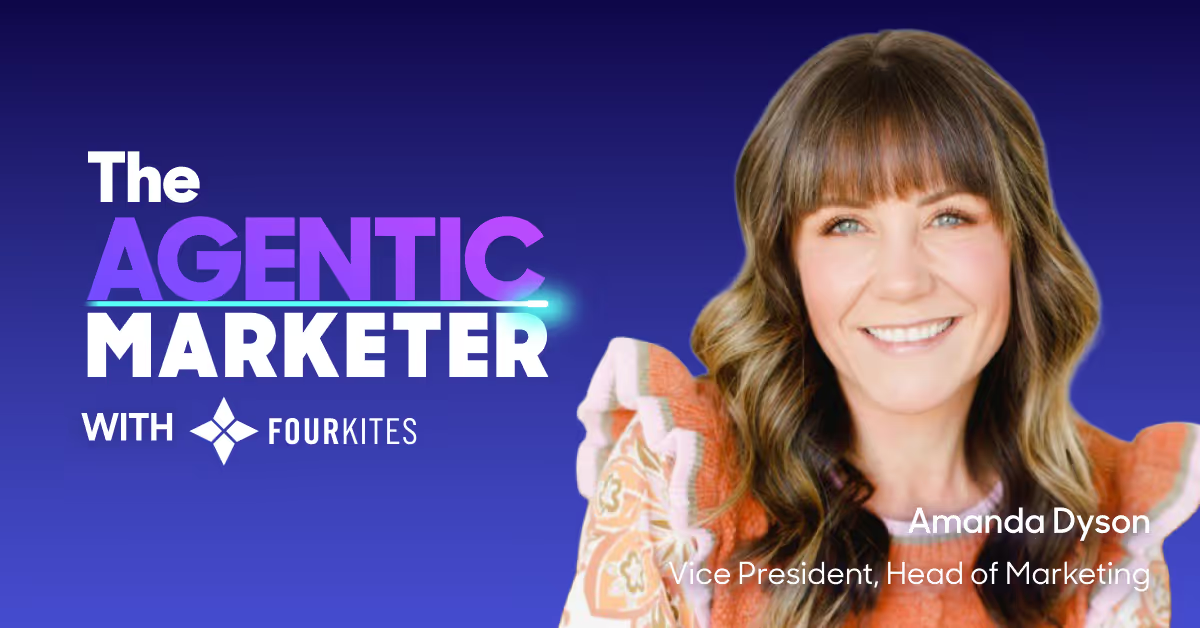
FourKites’ Amanda Dyson breaks down why agentic AI needs human leadership, strong marketers, and intentional setup to deliver real results.
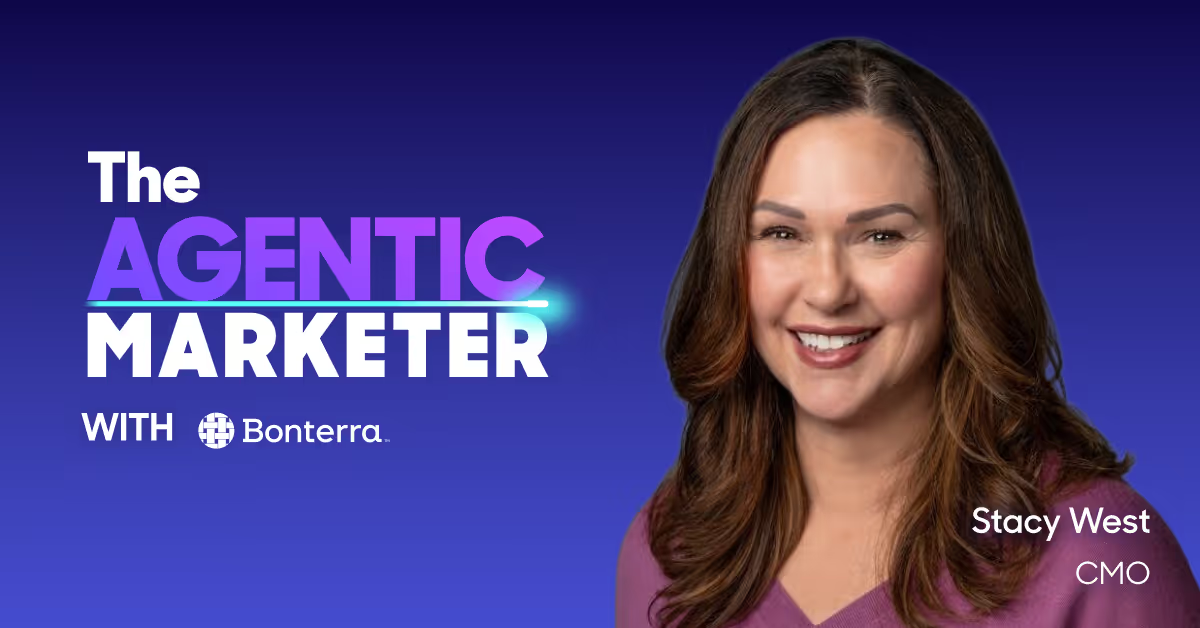
Bonterra CMO Stacy West shares how agentic AI helps marketing teams move beyond basic automation to expand capacity and drive real impact.

Discover how Emburse drives real AI adoption by creating a culture of experimentation. Heidi Wurpel shares why giving teams “permission to play” accelerates agentic marketing.
.jpg)
Brightly Software’s Whitney Rosa explains why B2B marketing is shifting from campaign-centric to system-centric, powered by AI agents that automate decisions, optimize in real time, and scale marketing impact.
.jpg)
Learn how Talkspace uses AI SDR agents and agentic marketing to replace static funnels and turn website traffic into qualified pipeline.
.jpg)
Our show The Agentic Marketer interviews today's leading B2B marketers to discover how they're actually using agentic AI day to day to hit their pipeline goals. Learn the 7 things agentic marketers are doing right now to stay ahead of the curve.
Hear how Culture Amp CMO Paige O’Neill approaches agentic readiness, AI literacy, and leading marketing teams through AI adoption.
This episode of The Agentic Marketer features an interview with Paige O’Neill, CMO at Culture Amp, a leading employee experience platform helping organizations build high-performing, engaged teams.
Paige shares how she is thinking about agentic marketing, AI literacy, and the responsibility marketing leaders have to prepare their teams for an AI-first future. She breaks down how Culture Amp is moving beyond one-off AI experiments toward more integrated workflows, particularly across demand generation and the SDR organization, where AI is already driving measurable pipeline impact.
Throughout the conversation, Paige discusses how AI SDRs are working alongside human teams to qualify leads, improve conversion rates, and help marketing and sales focus on higher-value work. She also offers a candid perspective on leadership, data readiness, and why AI adoption is as much a cultural challenge as it is a technical one.
Key takeaways
TRANSCRIPT
Sarah McConnell – Qualified
Okay, thank you everyone for joining us today on another episode of The Agentic Marketer. Today I’m joined by Paige, the CMO at Culture Amp. Paige, can you tell me a little bit about yourself and the work that you’re doing over at Culture Amp to get us started?
Paige O’Neill – Culture Amp
Yeah, thanks so much for having me. Excited to be here. I’ve been the CMO at Culture Amp for about four months now, so relatively new in the role. And Culture Amp is in the HR tech space. And our mission is to make the world of work a better place to be, which I think is a fantastic mission, what drew me to the company. So we helped HR professionals understand kind of where to hone in with their employees for engagement or performance and really how to make a sustained workplace of high performance.
Sarah McConnell – Qualified
Amazing. Okay, so we’re here. Obviously, the podcast is titled The Agentic Marketer. Agentic marketing is a fairly new term, though I feel like it’s taken off in the last, I don’t know, two quarters or so. But for you, Paige, how are you defining the term agentic marketing? What does that mean to you and the team over at Culture Amp?
Paige O’Neill – Culture Amp
Yeah, I mean, for me, when I think about agentic marketing, it’s marketing teams leveraging AI, whether that’s an agent or just AI technology, to be able to automate, streamline, optimize, plan, execute marketing programs. And I think that we’re currently in the process of moving from it being more ad hoc tasks to being more integrated workflows. And so I think that we’re all kind of at the beginning of what’s going to be possible.
Sarah McConnell – Qualified
Yep, I totally agree with you. You kind of mentioned it’s going from ad hoc tasks to the integrated workflows. And I think the process of getting from viewing agentic marketing or just AI agents in general as one-off tasks to that workflow, that’s really moving from this experimentation into integrating it. So Paige, I’d love to hear from you. Like, how have you made that leap between experimentation and one-off tasks into now feeling like agentic AI is really integrated in your workflow over at Culture Amp?
Paige O’Neill – Culture Amp
Yeah. And I don’t know that we’ve fully made the leap. I don’t know if many companies have fully made the leap. But yeah, I think that, I mean, I think it’s important for everybody to understand that, you know, we’re all, it’s some, whether we’re advanced in our experimentation or whether we’ve got integrated workflows or whether we’ve just got a bunch of agents or working on in a bunch of different isolated tasks, it’s all experimentation at this point.
Sarah McConnell – Qualified
Yeah, I don’t think anyone has.
Paige O’Neill – Culture Amp
There really is very little expertise happening. It’s really just us all trying to figure it out. But at Culture Amp, I was very excited to walk into a team that, from my perspective, was pretty far ahead, particularly in our demand generation, our digital marketing, and our SDR organization. The organization has implemented multiple technologies, obviously Qualified, but we’ve got other tech in our stack as well, like Outreach, 6sense, ZoomInfo, and we’re leveraging the AI capabilities of all of those.
And I think in particular, you know, our SDR organization has been really energized by how they are able to leverage AI to better qualify top-of-funnel pipeline, spend less time qualifying lower intent leads and having those move at a higher percentage through the system, be able to auto-assign ICP leads in more efficient ways, and just fast-start their workflow so that they know from the get-go that when they’re engaging with a lead, it’s going to be much more highly qualified.
Sarah McConnell – Qualified
Yeah, I really liked that example. And I’m curious from, you said you walked into a pretty sophisticated org. You guys have a lot of tools that have AI integrated into them. And I think that’s, as a marketer, been such a nice thing. I think early days, it did feel like experimentation more because the tools were just starting to release these AI functionalities and they didn’t have agents yet within them. And now I think a lot of our tools that some of us are already lucky enough to have in our tech stacks are evolving and adding these things.
How did your leadership team approach AI? Like it sounds like you have a pretty supportive leadership team, but I’m always curious to hear from leaders. Cause you hear some people say like, no, it was kind of a, I guess a tough ask of our leadership team. But it sounds like does Culture Amp have a pretty supportive culture of like, yeah, you should be playing with AI, learning, and using it on a day-to-day basis?
Paige O’Neill – Culture Amp
Yeah. And I would say that they, we’ve taken it even a step further than that. We’ve put out a mandate that we expect our employees to be learning about AI. And the company a couple of months ago did a, it was a four-part training series where we brought in professionals on various topics, led company seminars across different areas to kind of get people to a base level of understanding about AI across the employee population.
And then just from my perspective as a marketing leader, I feel like it’s the CMO’s responsibility to make sure that our teams are getting trained up on AI and to drive that culture of curiosity, of experimentation, but also of making sure that we’re mapping that to business results and mapping it back to business strategy and connecting the dots between the two.
So I think when you approach it with those things in mind, first of all, there’s an expectation. We’re in a world where AI is coming into every department’s workflow. We all need to be able to understand how to use it. Otherwise, our options in the future are going to be severely limited. And then we also need to tie it back to tangible business results and set some goals and metrics for that.
Sarah McConnell – Qualified
I totally agree. Now you kind of mentioned some different areas within your organization that you have AI, particularly in your marketing team that’s showing up today, but I want to dig in a little bit more. Where have you seen it most visibly on your team or wherever you’ve seen the most success or value as you’ve implemented agentic marketing, whether it’s demand gen, you mentioned your SDR org, content? Where do you feel like you’re seeing the most value there?
Paige O’Neill – Culture Amp
Yeah, and we’ve got a project going right now where we’re looking at every department in marketing. We’re understanding what their baseline is, and then we’re setting specific projects that we think are going to be the biggest opportunity to get benefit. And as I mentioned, some orgs are further ahead than others. And in particular, our demand generation, our SDR organization in particular, I think is very far ahead of what I’ve seen for other organizations.
We, of course, have an AI SDR that we’re leveraging. And that SDR, the thing that I think is interesting about it is, you know, it’s not replacing anything that the SDRs are doing per se. It might be replacing some tasks that are lower value, but it’s working alongside them to help them understand how to better qualify leads, to give them leads that are more qualified, to make sure that we’re operating within our ICP.
And it’s also taking some of the lower intent leads, and we’ve set up automated workflows where it can qualify those leads and either set them down a nurture path if they’re not quite ready yet or convert them more quickly and then send them over to the SDRs for the correct routing process. Those are a couple of areas that we’re excited about.
We’re also piloting a number of other initiatives to set up workflows. We’ve got a lot of agents running around the company. I think a lot of companies are coming into this agent proliferation mode. So now we’re trying to get them to talk to each other and integrate workflows.
And so I’m excited about that, moving into that phase. But we’ve seen significant benefits too, in particular, our low intent leads and being able to increase the conversion rates of those leads pretty significantly. And so that’s been a big add to our pipe.
Sarah McConnell – Qualified
Yeah, and you’ve kind of touched on this a little bit, but one of my questions is around how your AI SDR is working, whether it’s alongside your team, is a replacement, or is it like assisting your team? So it sounds like you guys have really set up a structure within your organization where they are working side by side. And it seems like it’s been well adopted by your team or your SDR team doesn’t view it as a negative instead of positive, since it’s doing a lot of that pre-qualification for them that tends to take a lot of time without a ton of results for SDRs. Is that right?
Paige O’Neill – Culture Amp
Yeah, it’s absolutely right. And we would say the answer is we’re looking at it in multiple ways. It’s exactly as you said. It’s a replacement for activities that the SDRs don’t really want to do or we don’t want them to prioritize, like the low intent leads.
So we’ve set up an automated workflow for the AI SDR to handle those low intent leads, converse with them back and forth via email, and then eventually route them in a way that makes sense. And in any case, if there’s a question, it flags it and you get human intervention at that point.
And so that’s a workflow that we’ve automated and is often running. And as I mentioned, it’s significantly increased the conversion of those lower intent leads.
The other thing that we’re leveraging it for is working alongside the SDRs to suggest content, to flag areas where SDRs might be working on something that’s outside our ICP, to help write emails and pre-populate those email fields so that the SDRs aren’t working with a blank slate.
And I just coming off, I spent a day with the SDR team in London last week, and they’re excited about all of the possibilities that they see. We’ve got a number of pilots in place to take it even further.
And they feel like the company is investing in technology to help them do their jobs. They’re seeing the efficacy of the leads in the qualification process improve. They’re seeing that convert to more pipeline dollars and bigger pipeline dollars, especially as one of our goals is to continue to move upstream into the enterprise. And we all know those leads are harder to come by. So it’s that much more important that they get that qualification criteria right, and the AI technology is helping them with that.
Sarah McConnell – Qualified
Amazing. My last question in particular about your AI SDR, you mentioned conversion was a big point of measurement. How do you measure success? Is it truly conversions? Is that how you’re looking at this and saying like, yes, this is working or it isn’t?
Paige O’Neill – Culture Amp
Yeah, it’s so within in particular with the low intent pipeline, it was the conversion rates of that pipeline. And looking at, you know, we saw double digit conversion increases when we leverage the AI workflow.
So that was a big measure. But ultimately for us, it comes down to opportunity dollar value opportunity and pipeline. Marketing at Culture Amp is driving 80 to 90 percent of the revenue of the company from our leads, which is a little bit atypical.
And so we’re all about pipeline and revenue and that’s our ultimate measure. But getting those conversion rates up and making sure that we’re playing within, if we’re not playing within a high intent suspect or prospect base, that we’ve got the right cadence to set up for the low intent to prove that we can nurture them and turn them into high intent.
Sarah McConnell – Qualified
Now shifting a little bit away from what you’re currently doing at Culture Amp and just your take as a CMO in this era and from a company that is obviously adopting this very well. The first question I have for you is around other use cases you’re seeing for marketing AI agents. Is there anything from a use case perspective that you’re seeing out there or hearing from peers that you’re excited about that you think is not quite there yet or is coming or maybe a use case that you don’t currently have on your team but you’re looking towards getting?
The realm of possibility seems endless. So I’m curious what use cases for agentic marketing is getting you the most excited.
Paige O’Neill – Culture Amp
Yeah. And I mentioned this just very briefly a little earlier. The thing that’s most exciting to me is moving from this era where we’ve got these individual projects or you’ve got manual asks that you’re making of AI or maybe a team has created an agent to do a specific use case, moving beyond that to starting to integrate the agents, having workflows across different tech stacks, different technologies that work together to orchestrate something from start to finish.
And we’re not, we’ve approached that a little bit with some of the workflows that we have around the low intent leads, but I’m hearing use cases from other companies and other CMOs and operations directors that are pretty exciting.
I mean, things like, you know, the AI can proactively monitor the pipeline and then flag when a deal is stalled and then auto inject content or make suggestions to either the SDR or the AE to help get that pipeline unstuck. Or being able to make sure that you’ve got the right alignment within your ICP and to flag if something’s going to skew and then auto adjust content based on what’s working or not within your ICP.
So I’ve heard some case studies along those lines where, again, it’s connecting the dots between all these disparate technologies that we have and getting those workflows set up and moving from, you know, we’re not just creating content with AI, we’re orchestrating things to happen across the business that drive results.
And so I think we’re moving, a lot of people are still testing this out and are on their individual projects, which is completely fine. But there are use cases that are moving to really unify these threads together. And I think that’s where the real potential takes off.
Sarah McConnell – Qualified
Yeah, I think that’s where I also get the most excited. I feel the same way in that there’s a lot of disparate use cases that are happening. And I’ve heard other guests talk about campaign orchestration from start to finish. But I love, from a demand gen perspective, what you’re talking about, like pipeline management from start to finish. Like where are things getting stuck? How can you help provide content?
There are ways it feels like to do that now with very disparate technology, but it doesn’t feel integrated. It doesn’t feel like it is an orchestrated workflow. So knowing that we’re not quite there yet, maybe some teams are, but knowing how fast this AI era is moving, it feels like we’re going to be there before we know it. And I think there’s so much opportunity there that I also, again, being in demand gen and dealing with pipeline day in and day out, get very, very excited about.
Paige O’Neill – Culture Amp
Yeah. It just, I mean, and obviously it all goes back to the data, right? I mean, I’m seeing the topic of data, not that it ever stopped rearing its head, but it’s certainly rearing its head a bit now. Because as we start to try to connect the dots on all these things and take it from individual asks to integrated workflows, we still have to deal with our data, right?
Sarah McConnell – Qualified
Yep. Yes. And all of a sudden data becomes like paramount to how good, and it never, to your point, it never wasn’t. Like I don’t think there was ever a time in my career where I said, like, you need mediocre data. Like you always want the most clean data to inform all these signals. Like that’s never changed.
But it has been interesting, particularly with Qualified. I’m always on the front end of using our product. And I always share this example of when we onboarded our AI SDR, Piper the AI SDR, and we were testing and she ingests all the information on your website, all of this, all these data points.
And we started testing her responses. It was flagged to me really quickly that, oh my gosh, there’s all these things on our website that are pretty outdated that before it didn’t really matter. They kind of just got lost in the ether of like, no one’s going to find these on our website. The traffic is really low. I’m not even going to worry about it.
And now all of a sudden I’m like, I really need to either clean these up or get rid of them or tell the agent not to use these things. But knowing that these agents have such a vast amount of data at their fingertips and disposal and they can use those where before our human SDRs weren’t really going to remember those things. They barely remember the stuff you gave them that’s from two weeks ago, let alone something you published two years ago, that it all has to be very, very clean.
So I think data has always been important, but now is incredibly important. And I feel like it can make or break how your agents are performing. I do think.
Paige O’Neill – Culture Amp
Yeah, I think we went through a brief delusional phase where we thought, wow, now we don’t have to worry about data because AI is just going to fix it for us. But that’s not going to happen.
Sarah McConnell – Qualified
Yeah. No, not at all. Now, Paige, you kind of talked about a little bit that you really feel this urge as a leader to be using AI on a very consistent basis. You feel like you need to lead from the forefront as someone that is curious.
If you’re talking to peers in the industry, how do you think CMOs need to lead differently in this AI-first era beyond being curious and being hands-on with it? Is there anything that you feel like as a leader you really need to shift in your mindset to make sure that your team is set up for success with AI and agents?
Paige O’Neill – Culture Amp
Yeah, it’s a good question. I kind of hinted at this earlier where I think the, I think, I don’t know if it’s a shift in mindset, but I really do feel like we have a responsibility that leaders, not just CMOs, but leaders, C-suite, have a responsibility to make sure that the employees who happen to be on our watch right now are getting trained for AI.
I also think that we have a responsibility to set a tone or a cadence that the company should provide training and should provide room to explore. But there should also be an expectation that employees are taking control of their own educational process.
So, you know, if an employee is sitting in an environment where leadership isn’t stepping in to help you get trained, you have a responsibility also to train yourself. It’s got to be a two-way street and a meeting together because I think our careers are going to depend on our AI literacy. They are. I think they already do to a large extent.
So I think one of the mindset shifts that I’ve heard others talk about that I agree with is I think there’s more of a mindset that there really aren’t, at least right now, experts in various AI phases per se for the most part.
And so we’re really looking for a person to come into the organization that’s curious and wants to be experimenting. And I think that’s a relatively new criteria that’s come in over the last year or so when we think about how are we going to make sure we’ve got the right skill set in the organization as we go through these transformations.
And so I think that’s something that I’m certainly mindful of. Who are the people on the team that are really curious? Who are the ones that went off and built an agent in their own time and came and wanted to share it with the team? Those are the skill sets that we need to have going forward. And I think we have to be mindful to make sure we’re bringing those into the organization.
Sarah McConnell – Qualified
Absolutely. And speaking of the organization, with this emergence of AI agents, I’ve heard sort of differing opinions on how is that impacting your org chart. Meaning, do you view them as a part of your org chart? Do you think they sit separately? Are you viewing your org chart as more of there’s people that are managing this AI?
So in general, as a CMO, how do you think agentic AI is impacting org charts, and how are you planning ahead for that?
Paige O’Neill – Culture Amp
Yeah. And I don’t think, I think it’s not one size fits all, right? I think that I’ve talked to many CMOs or seen presentations in CMO groups where there are, you know, they’ve got 20 AI agents on the org chart and they’re considering them to be a teammate. And I think that’s a perfectly valid way to think about it.
I haven’t gone that far yet. I’m more, you know, my last two organizations where AI has really been a consideration. I’m more thinking about what are the areas that we’re leaning into that we think we can optimize by use of AI. And does that evolve to be a teammate? I don’t know, maybe over time.
I also just want to be mindful that we’re also in this climate where marketing budgets have been shrinking. We’ve got fewer people on the marketing team. There’s a mindset. I’ve talked to many startup CMOs that are thinking, we don’t need to hire as many people as we used to.
So I’m also mindful that are we just putting AI agents on charts to make ourselves feel good about smaller teams? I don’t want to get into that game with myself. So I’m not really thinking about it as an org chart at this point.
Sarah McConnell – Qualified
Okay, so to wrap things up, we like to wrap things with what I call our lightning round. So it’s fast questions with fast answers just to get some hot, fast takes on agentic AI.
So the first one is, what was the first AI tool that you tested out as a marketer that wasn’t ChatGPT, since that tends to be everyone’s first response?
Paige O’Neill – Culture Amp
I was going to say ChatGPT. I played around with Jasper. I played around with Jasper pretty early. Yeah, pretty early. I played around with that pretty early.
Sarah McConnell – Qualified
Which is a valid answer. And it was most people’s first tool. That’s great. Jasper was the first thing we did. Yeah. I used to host a different podcast called GTM AI where we would have people come on. This was years ago. I say years like it was eons ago, but it’s two years ago, which with AI does feel like years and years ago.
But we had teams come on and show their new AI functionality and their tools. It was very cool. And Jasper was one of the first teams that we had on.
And I still remember doing that interview afterwards and being like, I need this tool. This is incredible. So I do feel like that was a good one early on, that they had a very good grasp. They had it really figured out. I feel like it was very enterprise ready.
Okay, most overrated buzzword in martech right now.
Paige O’Neill – Culture Amp
I think it’s AI-powered. I think AI-powered is kind of like cloud-based, right? Like everything is AI-powered. If everything is AI-powered, then nothing is nothing in everything. So just like we stopped saying cloud-based, I think we’re pretty quickly going to have to stop saying AI-powered.
Sarah McConnell – Qualified
Ooh, I like that one.
Yeah, I’m going to do like a word cloud that makes me sound really old, but of all the answers that people give, and I think the main one would be AI-powered. We’ve gotten that answer a lot where people are like, yeah, this has been outplayed. Everything is AI-powered now. We’ll move on to the next buzzword.
Okay, a marketer who people should follow that you think is ahead of the curve on AI.
Paige O’Neill – Culture Amp
I’d say Lisa Adams. Her content is amazing, and she’s just putting it all out there for, you know, for a service to the community. It’s incredible content.
Sarah McConnell – Qualified
Yes. Yeah, Lisa’s amazing. I had her on a summit that we did a year or two ago, and she was one of my favorite sessions. She was incredible.
And I agree. I follow Lisa on LinkedIn, and she is always sharing really tactical, hands-on examples. It isn’t just fluff. So plus one to following Lisa.
Okay, Paige, last question. If you could automate one part of your life outside of work with AI, what would it be?
Paige O’Neill – Culture Amp
Figuring out what to have for dinner every night. I mean, yeah. I think there’s a Geico commercial that says nobody told us that we had to figure out what to have for dinner for the rest of our lives. So can we automate that?
Sarah McConnell – Qualified
For the rest of our lives. Yeah, I think we had another guest on that had a very similar answer. My response was, and lunch. Like, I said about dinner, but then I realized, yeah, I have to figure out dinner for the rest of my life, but lunch too. You may have to figure out what I’m eating for lunch every day.
So yes, if there is, to everyone who’s listening to this, if you ever find any sort of AI that helps with any sort of meal planning, lunch or dinner, tell me and Paige. I’m very interested.
Paige O’Neill – Culture Amp
Yeah, yeah.
Paige O’Neill – Culture Amp
Yeah. And then go to the grocery store and then come home and then while you’re at it, go ahead and cook it for me and serve it up. Yeah.
Sarah McConnell – Qualified
That would be amazing. That is the dream. The full orchestration from the grocery store to kitchen and dinner would be fantastic. And clean up.
Okay, Paige, well, thank you so much for joining us on The Agentic Marketer podcast. It was so great to get your insights. I really appreciate you taking the time.
Paige O’Neill – Culture Amp
Thanks so much for having me. It was fun.
Hear how Culture Amp CMO Paige O’Neill approaches agentic readiness, AI literacy, and leading marketing teams through AI adoption.
This episode of The Agentic Marketer features an interview with Paige O’Neill, CMO at Culture Amp, a leading employee experience platform helping organizations build high-performing, engaged teams.
Paige shares how she is thinking about agentic marketing, AI literacy, and the responsibility marketing leaders have to prepare their teams for an AI-first future. She breaks down how Culture Amp is moving beyond one-off AI experiments toward more integrated workflows, particularly across demand generation and the SDR organization, where AI is already driving measurable pipeline impact.
Throughout the conversation, Paige discusses how AI SDRs are working alongside human teams to qualify leads, improve conversion rates, and help marketing and sales focus on higher-value work. She also offers a candid perspective on leadership, data readiness, and why AI adoption is as much a cultural challenge as it is a technical one.
Key takeaways
TRANSCRIPT
Sarah McConnell – Qualified
Okay, thank you everyone for joining us today on another episode of The Agentic Marketer. Today I’m joined by Paige, the CMO at Culture Amp. Paige, can you tell me a little bit about yourself and the work that you’re doing over at Culture Amp to get us started?
Paige O’Neill – Culture Amp
Yeah, thanks so much for having me. Excited to be here. I’ve been the CMO at Culture Amp for about four months now, so relatively new in the role. And Culture Amp is in the HR tech space. And our mission is to make the world of work a better place to be, which I think is a fantastic mission, what drew me to the company. So we helped HR professionals understand kind of where to hone in with their employees for engagement or performance and really how to make a sustained workplace of high performance.
Sarah McConnell – Qualified
Amazing. Okay, so we’re here. Obviously, the podcast is titled The Agentic Marketer. Agentic marketing is a fairly new term, though I feel like it’s taken off in the last, I don’t know, two quarters or so. But for you, Paige, how are you defining the term agentic marketing? What does that mean to you and the team over at Culture Amp?
Paige O’Neill – Culture Amp
Yeah, I mean, for me, when I think about agentic marketing, it’s marketing teams leveraging AI, whether that’s an agent or just AI technology, to be able to automate, streamline, optimize, plan, execute marketing programs. And I think that we’re currently in the process of moving from it being more ad hoc tasks to being more integrated workflows. And so I think that we’re all kind of at the beginning of what’s going to be possible.
Sarah McConnell – Qualified
Yep, I totally agree with you. You kind of mentioned it’s going from ad hoc tasks to the integrated workflows. And I think the process of getting from viewing agentic marketing or just AI agents in general as one-off tasks to that workflow, that’s really moving from this experimentation into integrating it. So Paige, I’d love to hear from you. Like, how have you made that leap between experimentation and one-off tasks into now feeling like agentic AI is really integrated in your workflow over at Culture Amp?
Paige O’Neill – Culture Amp
Yeah. And I don’t know that we’ve fully made the leap. I don’t know if many companies have fully made the leap. But yeah, I think that, I mean, I think it’s important for everybody to understand that, you know, we’re all, it’s some, whether we’re advanced in our experimentation or whether we’ve got integrated workflows or whether we’ve just got a bunch of agents or working on in a bunch of different isolated tasks, it’s all experimentation at this point.
Sarah McConnell – Qualified
Yeah, I don’t think anyone has.
Paige O’Neill – Culture Amp
There really is very little expertise happening. It’s really just us all trying to figure it out. But at Culture Amp, I was very excited to walk into a team that, from my perspective, was pretty far ahead, particularly in our demand generation, our digital marketing, and our SDR organization. The organization has implemented multiple technologies, obviously Qualified, but we’ve got other tech in our stack as well, like Outreach, 6sense, ZoomInfo, and we’re leveraging the AI capabilities of all of those.
And I think in particular, you know, our SDR organization has been really energized by how they are able to leverage AI to better qualify top-of-funnel pipeline, spend less time qualifying lower intent leads and having those move at a higher percentage through the system, be able to auto-assign ICP leads in more efficient ways, and just fast-start their workflow so that they know from the get-go that when they’re engaging with a lead, it’s going to be much more highly qualified.
Sarah McConnell – Qualified
Yeah, I really liked that example. And I’m curious from, you said you walked into a pretty sophisticated org. You guys have a lot of tools that have AI integrated into them. And I think that’s, as a marketer, been such a nice thing. I think early days, it did feel like experimentation more because the tools were just starting to release these AI functionalities and they didn’t have agents yet within them. And now I think a lot of our tools that some of us are already lucky enough to have in our tech stacks are evolving and adding these things.
How did your leadership team approach AI? Like it sounds like you have a pretty supportive leadership team, but I’m always curious to hear from leaders. Cause you hear some people say like, no, it was kind of a, I guess a tough ask of our leadership team. But it sounds like does Culture Amp have a pretty supportive culture of like, yeah, you should be playing with AI, learning, and using it on a day-to-day basis?
Paige O’Neill – Culture Amp
Yeah. And I would say that they, we’ve taken it even a step further than that. We’ve put out a mandate that we expect our employees to be learning about AI. And the company a couple of months ago did a, it was a four-part training series where we brought in professionals on various topics, led company seminars across different areas to kind of get people to a base level of understanding about AI across the employee population.
And then just from my perspective as a marketing leader, I feel like it’s the CMO’s responsibility to make sure that our teams are getting trained up on AI and to drive that culture of curiosity, of experimentation, but also of making sure that we’re mapping that to business results and mapping it back to business strategy and connecting the dots between the two.
So I think when you approach it with those things in mind, first of all, there’s an expectation. We’re in a world where AI is coming into every department’s workflow. We all need to be able to understand how to use it. Otherwise, our options in the future are going to be severely limited. And then we also need to tie it back to tangible business results and set some goals and metrics for that.
Sarah McConnell – Qualified
I totally agree. Now you kind of mentioned some different areas within your organization that you have AI, particularly in your marketing team that’s showing up today, but I want to dig in a little bit more. Where have you seen it most visibly on your team or wherever you’ve seen the most success or value as you’ve implemented agentic marketing, whether it’s demand gen, you mentioned your SDR org, content? Where do you feel like you’re seeing the most value there?
Paige O’Neill – Culture Amp
Yeah, and we’ve got a project going right now where we’re looking at every department in marketing. We’re understanding what their baseline is, and then we’re setting specific projects that we think are going to be the biggest opportunity to get benefit. And as I mentioned, some orgs are further ahead than others. And in particular, our demand generation, our SDR organization in particular, I think is very far ahead of what I’ve seen for other organizations.
We, of course, have an AI SDR that we’re leveraging. And that SDR, the thing that I think is interesting about it is, you know, it’s not replacing anything that the SDRs are doing per se. It might be replacing some tasks that are lower value, but it’s working alongside them to help them understand how to better qualify leads, to give them leads that are more qualified, to make sure that we’re operating within our ICP.
And it’s also taking some of the lower intent leads, and we’ve set up automated workflows where it can qualify those leads and either set them down a nurture path if they’re not quite ready yet or convert them more quickly and then send them over to the SDRs for the correct routing process. Those are a couple of areas that we’re excited about.
We’re also piloting a number of other initiatives to set up workflows. We’ve got a lot of agents running around the company. I think a lot of companies are coming into this agent proliferation mode. So now we’re trying to get them to talk to each other and integrate workflows.
And so I’m excited about that, moving into that phase. But we’ve seen significant benefits too, in particular, our low intent leads and being able to increase the conversion rates of those leads pretty significantly. And so that’s been a big add to our pipe.
Sarah McConnell – Qualified
Yeah, and you’ve kind of touched on this a little bit, but one of my questions is around how your AI SDR is working, whether it’s alongside your team, is a replacement, or is it like assisting your team? So it sounds like you guys have really set up a structure within your organization where they are working side by side. And it seems like it’s been well adopted by your team or your SDR team doesn’t view it as a negative instead of positive, since it’s doing a lot of that pre-qualification for them that tends to take a lot of time without a ton of results for SDRs. Is that right?
Paige O’Neill – Culture Amp
Yeah, it’s absolutely right. And we would say the answer is we’re looking at it in multiple ways. It’s exactly as you said. It’s a replacement for activities that the SDRs don’t really want to do or we don’t want them to prioritize, like the low intent leads.
So we’ve set up an automated workflow for the AI SDR to handle those low intent leads, converse with them back and forth via email, and then eventually route them in a way that makes sense. And in any case, if there’s a question, it flags it and you get human intervention at that point.
And so that’s a workflow that we’ve automated and is often running. And as I mentioned, it’s significantly increased the conversion of those lower intent leads.
The other thing that we’re leveraging it for is working alongside the SDRs to suggest content, to flag areas where SDRs might be working on something that’s outside our ICP, to help write emails and pre-populate those email fields so that the SDRs aren’t working with a blank slate.
And I just coming off, I spent a day with the SDR team in London last week, and they’re excited about all of the possibilities that they see. We’ve got a number of pilots in place to take it even further.
And they feel like the company is investing in technology to help them do their jobs. They’re seeing the efficacy of the leads in the qualification process improve. They’re seeing that convert to more pipeline dollars and bigger pipeline dollars, especially as one of our goals is to continue to move upstream into the enterprise. And we all know those leads are harder to come by. So it’s that much more important that they get that qualification criteria right, and the AI technology is helping them with that.
Sarah McConnell – Qualified
Amazing. My last question in particular about your AI SDR, you mentioned conversion was a big point of measurement. How do you measure success? Is it truly conversions? Is that how you’re looking at this and saying like, yes, this is working or it isn’t?
Paige O’Neill – Culture Amp
Yeah, it’s so within in particular with the low intent pipeline, it was the conversion rates of that pipeline. And looking at, you know, we saw double digit conversion increases when we leverage the AI workflow.
So that was a big measure. But ultimately for us, it comes down to opportunity dollar value opportunity and pipeline. Marketing at Culture Amp is driving 80 to 90 percent of the revenue of the company from our leads, which is a little bit atypical.
And so we’re all about pipeline and revenue and that’s our ultimate measure. But getting those conversion rates up and making sure that we’re playing within, if we’re not playing within a high intent suspect or prospect base, that we’ve got the right cadence to set up for the low intent to prove that we can nurture them and turn them into high intent.
Sarah McConnell – Qualified
Now shifting a little bit away from what you’re currently doing at Culture Amp and just your take as a CMO in this era and from a company that is obviously adopting this very well. The first question I have for you is around other use cases you’re seeing for marketing AI agents. Is there anything from a use case perspective that you’re seeing out there or hearing from peers that you’re excited about that you think is not quite there yet or is coming or maybe a use case that you don’t currently have on your team but you’re looking towards getting?
The realm of possibility seems endless. So I’m curious what use cases for agentic marketing is getting you the most excited.
Paige O’Neill – Culture Amp
Yeah. And I mentioned this just very briefly a little earlier. The thing that’s most exciting to me is moving from this era where we’ve got these individual projects or you’ve got manual asks that you’re making of AI or maybe a team has created an agent to do a specific use case, moving beyond that to starting to integrate the agents, having workflows across different tech stacks, different technologies that work together to orchestrate something from start to finish.
And we’re not, we’ve approached that a little bit with some of the workflows that we have around the low intent leads, but I’m hearing use cases from other companies and other CMOs and operations directors that are pretty exciting.
I mean, things like, you know, the AI can proactively monitor the pipeline and then flag when a deal is stalled and then auto inject content or make suggestions to either the SDR or the AE to help get that pipeline unstuck. Or being able to make sure that you’ve got the right alignment within your ICP and to flag if something’s going to skew and then auto adjust content based on what’s working or not within your ICP.
So I’ve heard some case studies along those lines where, again, it’s connecting the dots between all these disparate technologies that we have and getting those workflows set up and moving from, you know, we’re not just creating content with AI, we’re orchestrating things to happen across the business that drive results.
And so I think we’re moving, a lot of people are still testing this out and are on their individual projects, which is completely fine. But there are use cases that are moving to really unify these threads together. And I think that’s where the real potential takes off.
Sarah McConnell – Qualified
Yeah, I think that’s where I also get the most excited. I feel the same way in that there’s a lot of disparate use cases that are happening. And I’ve heard other guests talk about campaign orchestration from start to finish. But I love, from a demand gen perspective, what you’re talking about, like pipeline management from start to finish. Like where are things getting stuck? How can you help provide content?
There are ways it feels like to do that now with very disparate technology, but it doesn’t feel integrated. It doesn’t feel like it is an orchestrated workflow. So knowing that we’re not quite there yet, maybe some teams are, but knowing how fast this AI era is moving, it feels like we’re going to be there before we know it. And I think there’s so much opportunity there that I also, again, being in demand gen and dealing with pipeline day in and day out, get very, very excited about.
Paige O’Neill – Culture Amp
Yeah. It just, I mean, and obviously it all goes back to the data, right? I mean, I’m seeing the topic of data, not that it ever stopped rearing its head, but it’s certainly rearing its head a bit now. Because as we start to try to connect the dots on all these things and take it from individual asks to integrated workflows, we still have to deal with our data, right?
Sarah McConnell – Qualified
Yep. Yes. And all of a sudden data becomes like paramount to how good, and it never, to your point, it never wasn’t. Like I don’t think there was ever a time in my career where I said, like, you need mediocre data. Like you always want the most clean data to inform all these signals. Like that’s never changed.
But it has been interesting, particularly with Qualified. I’m always on the front end of using our product. And I always share this example of when we onboarded our AI SDR, Piper the AI SDR, and we were testing and she ingests all the information on your website, all of this, all these data points.
And we started testing her responses. It was flagged to me really quickly that, oh my gosh, there’s all these things on our website that are pretty outdated that before it didn’t really matter. They kind of just got lost in the ether of like, no one’s going to find these on our website. The traffic is really low. I’m not even going to worry about it.
And now all of a sudden I’m like, I really need to either clean these up or get rid of them or tell the agent not to use these things. But knowing that these agents have such a vast amount of data at their fingertips and disposal and they can use those where before our human SDRs weren’t really going to remember those things. They barely remember the stuff you gave them that’s from two weeks ago, let alone something you published two years ago, that it all has to be very, very clean.
So I think data has always been important, but now is incredibly important. And I feel like it can make or break how your agents are performing. I do think.
Paige O’Neill – Culture Amp
Yeah, I think we went through a brief delusional phase where we thought, wow, now we don’t have to worry about data because AI is just going to fix it for us. But that’s not going to happen.
Sarah McConnell – Qualified
Yeah. No, not at all. Now, Paige, you kind of talked about a little bit that you really feel this urge as a leader to be using AI on a very consistent basis. You feel like you need to lead from the forefront as someone that is curious.
If you’re talking to peers in the industry, how do you think CMOs need to lead differently in this AI-first era beyond being curious and being hands-on with it? Is there anything that you feel like as a leader you really need to shift in your mindset to make sure that your team is set up for success with AI and agents?
Paige O’Neill – Culture Amp
Yeah, it’s a good question. I kind of hinted at this earlier where I think the, I think, I don’t know if it’s a shift in mindset, but I really do feel like we have a responsibility that leaders, not just CMOs, but leaders, C-suite, have a responsibility to make sure that the employees who happen to be on our watch right now are getting trained for AI.
I also think that we have a responsibility to set a tone or a cadence that the company should provide training and should provide room to explore. But there should also be an expectation that employees are taking control of their own educational process.
So, you know, if an employee is sitting in an environment where leadership isn’t stepping in to help you get trained, you have a responsibility also to train yourself. It’s got to be a two-way street and a meeting together because I think our careers are going to depend on our AI literacy. They are. I think they already do to a large extent.
So I think one of the mindset shifts that I’ve heard others talk about that I agree with is I think there’s more of a mindset that there really aren’t, at least right now, experts in various AI phases per se for the most part.
And so we’re really looking for a person to come into the organization that’s curious and wants to be experimenting. And I think that’s a relatively new criteria that’s come in over the last year or so when we think about how are we going to make sure we’ve got the right skill set in the organization as we go through these transformations.
And so I think that’s something that I’m certainly mindful of. Who are the people on the team that are really curious? Who are the ones that went off and built an agent in their own time and came and wanted to share it with the team? Those are the skill sets that we need to have going forward. And I think we have to be mindful to make sure we’re bringing those into the organization.
Sarah McConnell – Qualified
Absolutely. And speaking of the organization, with this emergence of AI agents, I’ve heard sort of differing opinions on how is that impacting your org chart. Meaning, do you view them as a part of your org chart? Do you think they sit separately? Are you viewing your org chart as more of there’s people that are managing this AI?
So in general, as a CMO, how do you think agentic AI is impacting org charts, and how are you planning ahead for that?
Paige O’Neill – Culture Amp
Yeah. And I don’t think, I think it’s not one size fits all, right? I think that I’ve talked to many CMOs or seen presentations in CMO groups where there are, you know, they’ve got 20 AI agents on the org chart and they’re considering them to be a teammate. And I think that’s a perfectly valid way to think about it.
I haven’t gone that far yet. I’m more, you know, my last two organizations where AI has really been a consideration. I’m more thinking about what are the areas that we’re leaning into that we think we can optimize by use of AI. And does that evolve to be a teammate? I don’t know, maybe over time.
I also just want to be mindful that we’re also in this climate where marketing budgets have been shrinking. We’ve got fewer people on the marketing team. There’s a mindset. I’ve talked to many startup CMOs that are thinking, we don’t need to hire as many people as we used to.
So I’m also mindful that are we just putting AI agents on charts to make ourselves feel good about smaller teams? I don’t want to get into that game with myself. So I’m not really thinking about it as an org chart at this point.
Sarah McConnell – Qualified
Okay, so to wrap things up, we like to wrap things with what I call our lightning round. So it’s fast questions with fast answers just to get some hot, fast takes on agentic AI.
So the first one is, what was the first AI tool that you tested out as a marketer that wasn’t ChatGPT, since that tends to be everyone’s first response?
Paige O’Neill – Culture Amp
I was going to say ChatGPT. I played around with Jasper. I played around with Jasper pretty early. Yeah, pretty early. I played around with that pretty early.
Sarah McConnell – Qualified
Which is a valid answer. And it was most people’s first tool. That’s great. Jasper was the first thing we did. Yeah. I used to host a different podcast called GTM AI where we would have people come on. This was years ago. I say years like it was eons ago, but it’s two years ago, which with AI does feel like years and years ago.
But we had teams come on and show their new AI functionality and their tools. It was very cool. And Jasper was one of the first teams that we had on.
And I still remember doing that interview afterwards and being like, I need this tool. This is incredible. So I do feel like that was a good one early on, that they had a very good grasp. They had it really figured out. I feel like it was very enterprise ready.
Okay, most overrated buzzword in martech right now.
Paige O’Neill – Culture Amp
I think it’s AI-powered. I think AI-powered is kind of like cloud-based, right? Like everything is AI-powered. If everything is AI-powered, then nothing is nothing in everything. So just like we stopped saying cloud-based, I think we’re pretty quickly going to have to stop saying AI-powered.
Sarah McConnell – Qualified
Ooh, I like that one.
Yeah, I’m going to do like a word cloud that makes me sound really old, but of all the answers that people give, and I think the main one would be AI-powered. We’ve gotten that answer a lot where people are like, yeah, this has been outplayed. Everything is AI-powered now. We’ll move on to the next buzzword.
Okay, a marketer who people should follow that you think is ahead of the curve on AI.
Paige O’Neill – Culture Amp
I’d say Lisa Adams. Her content is amazing, and she’s just putting it all out there for, you know, for a service to the community. It’s incredible content.
Sarah McConnell – Qualified
Yes. Yeah, Lisa’s amazing. I had her on a summit that we did a year or two ago, and she was one of my favorite sessions. She was incredible.
And I agree. I follow Lisa on LinkedIn, and she is always sharing really tactical, hands-on examples. It isn’t just fluff. So plus one to following Lisa.
Okay, Paige, last question. If you could automate one part of your life outside of work with AI, what would it be?
Paige O’Neill – Culture Amp
Figuring out what to have for dinner every night. I mean, yeah. I think there’s a Geico commercial that says nobody told us that we had to figure out what to have for dinner for the rest of our lives. So can we automate that?
Sarah McConnell – Qualified
For the rest of our lives. Yeah, I think we had another guest on that had a very similar answer. My response was, and lunch. Like, I said about dinner, but then I realized, yeah, I have to figure out dinner for the rest of my life, but lunch too. You may have to figure out what I’m eating for lunch every day.
So yes, if there is, to everyone who’s listening to this, if you ever find any sort of AI that helps with any sort of meal planning, lunch or dinner, tell me and Paige. I’m very interested.
Paige O’Neill – Culture Amp
Yeah, yeah.
Paige O’Neill – Culture Amp
Yeah. And then go to the grocery store and then come home and then while you’re at it, go ahead and cook it for me and serve it up. Yeah.
Sarah McConnell – Qualified
That would be amazing. That is the dream. The full orchestration from the grocery store to kitchen and dinner would be fantastic. And clean up.
Okay, Paige, well, thank you so much for joining us on The Agentic Marketer podcast. It was so great to get your insights. I really appreciate you taking the time.
Paige O’Neill – Culture Amp
Thanks so much for having me. It was fun.
Hear how Culture Amp CMO Paige O’Neill approaches agentic readiness, AI literacy, and leading marketing teams through AI adoption.
This episode of The Agentic Marketer features an interview with Paige O’Neill, CMO at Culture Amp, a leading employee experience platform helping organizations build high-performing, engaged teams.
Paige shares how she is thinking about agentic marketing, AI literacy, and the responsibility marketing leaders have to prepare their teams for an AI-first future. She breaks down how Culture Amp is moving beyond one-off AI experiments toward more integrated workflows, particularly across demand generation and the SDR organization, where AI is already driving measurable pipeline impact.
Throughout the conversation, Paige discusses how AI SDRs are working alongside human teams to qualify leads, improve conversion rates, and help marketing and sales focus on higher-value work. She also offers a candid perspective on leadership, data readiness, and why AI adoption is as much a cultural challenge as it is a technical one.
Key takeaways
TRANSCRIPT
Sarah McConnell – Qualified
Okay, thank you everyone for joining us today on another episode of The Agentic Marketer. Today I’m joined by Paige, the CMO at Culture Amp. Paige, can you tell me a little bit about yourself and the work that you’re doing over at Culture Amp to get us started?
Paige O’Neill – Culture Amp
Yeah, thanks so much for having me. Excited to be here. I’ve been the CMO at Culture Amp for about four months now, so relatively new in the role. And Culture Amp is in the HR tech space. And our mission is to make the world of work a better place to be, which I think is a fantastic mission, what drew me to the company. So we helped HR professionals understand kind of where to hone in with their employees for engagement or performance and really how to make a sustained workplace of high performance.
Sarah McConnell – Qualified
Amazing. Okay, so we’re here. Obviously, the podcast is titled The Agentic Marketer. Agentic marketing is a fairly new term, though I feel like it’s taken off in the last, I don’t know, two quarters or so. But for you, Paige, how are you defining the term agentic marketing? What does that mean to you and the team over at Culture Amp?
Paige O’Neill – Culture Amp
Yeah, I mean, for me, when I think about agentic marketing, it’s marketing teams leveraging AI, whether that’s an agent or just AI technology, to be able to automate, streamline, optimize, plan, execute marketing programs. And I think that we’re currently in the process of moving from it being more ad hoc tasks to being more integrated workflows. And so I think that we’re all kind of at the beginning of what’s going to be possible.
Sarah McConnell – Qualified
Yep, I totally agree with you. You kind of mentioned it’s going from ad hoc tasks to the integrated workflows. And I think the process of getting from viewing agentic marketing or just AI agents in general as one-off tasks to that workflow, that’s really moving from this experimentation into integrating it. So Paige, I’d love to hear from you. Like, how have you made that leap between experimentation and one-off tasks into now feeling like agentic AI is really integrated in your workflow over at Culture Amp?
Paige O’Neill – Culture Amp
Yeah. And I don’t know that we’ve fully made the leap. I don’t know if many companies have fully made the leap. But yeah, I think that, I mean, I think it’s important for everybody to understand that, you know, we’re all, it’s some, whether we’re advanced in our experimentation or whether we’ve got integrated workflows or whether we’ve just got a bunch of agents or working on in a bunch of different isolated tasks, it’s all experimentation at this point.
Sarah McConnell – Qualified
Yeah, I don’t think anyone has.
Paige O’Neill – Culture Amp
There really is very little expertise happening. It’s really just us all trying to figure it out. But at Culture Amp, I was very excited to walk into a team that, from my perspective, was pretty far ahead, particularly in our demand generation, our digital marketing, and our SDR organization. The organization has implemented multiple technologies, obviously Qualified, but we’ve got other tech in our stack as well, like Outreach, 6sense, ZoomInfo, and we’re leveraging the AI capabilities of all of those.
And I think in particular, you know, our SDR organization has been really energized by how they are able to leverage AI to better qualify top-of-funnel pipeline, spend less time qualifying lower intent leads and having those move at a higher percentage through the system, be able to auto-assign ICP leads in more efficient ways, and just fast-start their workflow so that they know from the get-go that when they’re engaging with a lead, it’s going to be much more highly qualified.
Sarah McConnell – Qualified
Yeah, I really liked that example. And I’m curious from, you said you walked into a pretty sophisticated org. You guys have a lot of tools that have AI integrated into them. And I think that’s, as a marketer, been such a nice thing. I think early days, it did feel like experimentation more because the tools were just starting to release these AI functionalities and they didn’t have agents yet within them. And now I think a lot of our tools that some of us are already lucky enough to have in our tech stacks are evolving and adding these things.
How did your leadership team approach AI? Like it sounds like you have a pretty supportive leadership team, but I’m always curious to hear from leaders. Cause you hear some people say like, no, it was kind of a, I guess a tough ask of our leadership team. But it sounds like does Culture Amp have a pretty supportive culture of like, yeah, you should be playing with AI, learning, and using it on a day-to-day basis?
Paige O’Neill – Culture Amp
Yeah. And I would say that they, we’ve taken it even a step further than that. We’ve put out a mandate that we expect our employees to be learning about AI. And the company a couple of months ago did a, it was a four-part training series where we brought in professionals on various topics, led company seminars across different areas to kind of get people to a base level of understanding about AI across the employee population.
And then just from my perspective as a marketing leader, I feel like it’s the CMO’s responsibility to make sure that our teams are getting trained up on AI and to drive that culture of curiosity, of experimentation, but also of making sure that we’re mapping that to business results and mapping it back to business strategy and connecting the dots between the two.
So I think when you approach it with those things in mind, first of all, there’s an expectation. We’re in a world where AI is coming into every department’s workflow. We all need to be able to understand how to use it. Otherwise, our options in the future are going to be severely limited. And then we also need to tie it back to tangible business results and set some goals and metrics for that.
Sarah McConnell – Qualified
I totally agree. Now you kind of mentioned some different areas within your organization that you have AI, particularly in your marketing team that’s showing up today, but I want to dig in a little bit more. Where have you seen it most visibly on your team or wherever you’ve seen the most success or value as you’ve implemented agentic marketing, whether it’s demand gen, you mentioned your SDR org, content? Where do you feel like you’re seeing the most value there?
Paige O’Neill – Culture Amp
Yeah, and we’ve got a project going right now where we’re looking at every department in marketing. We’re understanding what their baseline is, and then we’re setting specific projects that we think are going to be the biggest opportunity to get benefit. And as I mentioned, some orgs are further ahead than others. And in particular, our demand generation, our SDR organization in particular, I think is very far ahead of what I’ve seen for other organizations.
We, of course, have an AI SDR that we’re leveraging. And that SDR, the thing that I think is interesting about it is, you know, it’s not replacing anything that the SDRs are doing per se. It might be replacing some tasks that are lower value, but it’s working alongside them to help them understand how to better qualify leads, to give them leads that are more qualified, to make sure that we’re operating within our ICP.
And it’s also taking some of the lower intent leads, and we’ve set up automated workflows where it can qualify those leads and either set them down a nurture path if they’re not quite ready yet or convert them more quickly and then send them over to the SDRs for the correct routing process. Those are a couple of areas that we’re excited about.
We’re also piloting a number of other initiatives to set up workflows. We’ve got a lot of agents running around the company. I think a lot of companies are coming into this agent proliferation mode. So now we’re trying to get them to talk to each other and integrate workflows.
And so I’m excited about that, moving into that phase. But we’ve seen significant benefits too, in particular, our low intent leads and being able to increase the conversion rates of those leads pretty significantly. And so that’s been a big add to our pipe.
Sarah McConnell – Qualified
Yeah, and you’ve kind of touched on this a little bit, but one of my questions is around how your AI SDR is working, whether it’s alongside your team, is a replacement, or is it like assisting your team? So it sounds like you guys have really set up a structure within your organization where they are working side by side. And it seems like it’s been well adopted by your team or your SDR team doesn’t view it as a negative instead of positive, since it’s doing a lot of that pre-qualification for them that tends to take a lot of time without a ton of results for SDRs. Is that right?
Paige O’Neill – Culture Amp
Yeah, it’s absolutely right. And we would say the answer is we’re looking at it in multiple ways. It’s exactly as you said. It’s a replacement for activities that the SDRs don’t really want to do or we don’t want them to prioritize, like the low intent leads.
So we’ve set up an automated workflow for the AI SDR to handle those low intent leads, converse with them back and forth via email, and then eventually route them in a way that makes sense. And in any case, if there’s a question, it flags it and you get human intervention at that point.
And so that’s a workflow that we’ve automated and is often running. And as I mentioned, it’s significantly increased the conversion of those lower intent leads.
The other thing that we’re leveraging it for is working alongside the SDRs to suggest content, to flag areas where SDRs might be working on something that’s outside our ICP, to help write emails and pre-populate those email fields so that the SDRs aren’t working with a blank slate.
And I just coming off, I spent a day with the SDR team in London last week, and they’re excited about all of the possibilities that they see. We’ve got a number of pilots in place to take it even further.
And they feel like the company is investing in technology to help them do their jobs. They’re seeing the efficacy of the leads in the qualification process improve. They’re seeing that convert to more pipeline dollars and bigger pipeline dollars, especially as one of our goals is to continue to move upstream into the enterprise. And we all know those leads are harder to come by. So it’s that much more important that they get that qualification criteria right, and the AI technology is helping them with that.
Sarah McConnell – Qualified
Amazing. My last question in particular about your AI SDR, you mentioned conversion was a big point of measurement. How do you measure success? Is it truly conversions? Is that how you’re looking at this and saying like, yes, this is working or it isn’t?
Paige O’Neill – Culture Amp
Yeah, it’s so within in particular with the low intent pipeline, it was the conversion rates of that pipeline. And looking at, you know, we saw double digit conversion increases when we leverage the AI workflow.
So that was a big measure. But ultimately for us, it comes down to opportunity dollar value opportunity and pipeline. Marketing at Culture Amp is driving 80 to 90 percent of the revenue of the company from our leads, which is a little bit atypical.
And so we’re all about pipeline and revenue and that’s our ultimate measure. But getting those conversion rates up and making sure that we’re playing within, if we’re not playing within a high intent suspect or prospect base, that we’ve got the right cadence to set up for the low intent to prove that we can nurture them and turn them into high intent.
Sarah McConnell – Qualified
Now shifting a little bit away from what you’re currently doing at Culture Amp and just your take as a CMO in this era and from a company that is obviously adopting this very well. The first question I have for you is around other use cases you’re seeing for marketing AI agents. Is there anything from a use case perspective that you’re seeing out there or hearing from peers that you’re excited about that you think is not quite there yet or is coming or maybe a use case that you don’t currently have on your team but you’re looking towards getting?
The realm of possibility seems endless. So I’m curious what use cases for agentic marketing is getting you the most excited.
Paige O’Neill – Culture Amp
Yeah. And I mentioned this just very briefly a little earlier. The thing that’s most exciting to me is moving from this era where we’ve got these individual projects or you’ve got manual asks that you’re making of AI or maybe a team has created an agent to do a specific use case, moving beyond that to starting to integrate the agents, having workflows across different tech stacks, different technologies that work together to orchestrate something from start to finish.
And we’re not, we’ve approached that a little bit with some of the workflows that we have around the low intent leads, but I’m hearing use cases from other companies and other CMOs and operations directors that are pretty exciting.
I mean, things like, you know, the AI can proactively monitor the pipeline and then flag when a deal is stalled and then auto inject content or make suggestions to either the SDR or the AE to help get that pipeline unstuck. Or being able to make sure that you’ve got the right alignment within your ICP and to flag if something’s going to skew and then auto adjust content based on what’s working or not within your ICP.
So I’ve heard some case studies along those lines where, again, it’s connecting the dots between all these disparate technologies that we have and getting those workflows set up and moving from, you know, we’re not just creating content with AI, we’re orchestrating things to happen across the business that drive results.
And so I think we’re moving, a lot of people are still testing this out and are on their individual projects, which is completely fine. But there are use cases that are moving to really unify these threads together. And I think that’s where the real potential takes off.
Sarah McConnell – Qualified
Yeah, I think that’s where I also get the most excited. I feel the same way in that there’s a lot of disparate use cases that are happening. And I’ve heard other guests talk about campaign orchestration from start to finish. But I love, from a demand gen perspective, what you’re talking about, like pipeline management from start to finish. Like where are things getting stuck? How can you help provide content?
There are ways it feels like to do that now with very disparate technology, but it doesn’t feel integrated. It doesn’t feel like it is an orchestrated workflow. So knowing that we’re not quite there yet, maybe some teams are, but knowing how fast this AI era is moving, it feels like we’re going to be there before we know it. And I think there’s so much opportunity there that I also, again, being in demand gen and dealing with pipeline day in and day out, get very, very excited about.
Paige O’Neill – Culture Amp
Yeah. It just, I mean, and obviously it all goes back to the data, right? I mean, I’m seeing the topic of data, not that it ever stopped rearing its head, but it’s certainly rearing its head a bit now. Because as we start to try to connect the dots on all these things and take it from individual asks to integrated workflows, we still have to deal with our data, right?
Sarah McConnell – Qualified
Yep. Yes. And all of a sudden data becomes like paramount to how good, and it never, to your point, it never wasn’t. Like I don’t think there was ever a time in my career where I said, like, you need mediocre data. Like you always want the most clean data to inform all these signals. Like that’s never changed.
But it has been interesting, particularly with Qualified. I’m always on the front end of using our product. And I always share this example of when we onboarded our AI SDR, Piper the AI SDR, and we were testing and she ingests all the information on your website, all of this, all these data points.
And we started testing her responses. It was flagged to me really quickly that, oh my gosh, there’s all these things on our website that are pretty outdated that before it didn’t really matter. They kind of just got lost in the ether of like, no one’s going to find these on our website. The traffic is really low. I’m not even going to worry about it.
And now all of a sudden I’m like, I really need to either clean these up or get rid of them or tell the agent not to use these things. But knowing that these agents have such a vast amount of data at their fingertips and disposal and they can use those where before our human SDRs weren’t really going to remember those things. They barely remember the stuff you gave them that’s from two weeks ago, let alone something you published two years ago, that it all has to be very, very clean.
So I think data has always been important, but now is incredibly important. And I feel like it can make or break how your agents are performing. I do think.
Paige O’Neill – Culture Amp
Yeah, I think we went through a brief delusional phase where we thought, wow, now we don’t have to worry about data because AI is just going to fix it for us. But that’s not going to happen.
Sarah McConnell – Qualified
Yeah. No, not at all. Now, Paige, you kind of talked about a little bit that you really feel this urge as a leader to be using AI on a very consistent basis. You feel like you need to lead from the forefront as someone that is curious.
If you’re talking to peers in the industry, how do you think CMOs need to lead differently in this AI-first era beyond being curious and being hands-on with it? Is there anything that you feel like as a leader you really need to shift in your mindset to make sure that your team is set up for success with AI and agents?
Paige O’Neill – Culture Amp
Yeah, it’s a good question. I kind of hinted at this earlier where I think the, I think, I don’t know if it’s a shift in mindset, but I really do feel like we have a responsibility that leaders, not just CMOs, but leaders, C-suite, have a responsibility to make sure that the employees who happen to be on our watch right now are getting trained for AI.
I also think that we have a responsibility to set a tone or a cadence that the company should provide training and should provide room to explore. But there should also be an expectation that employees are taking control of their own educational process.
So, you know, if an employee is sitting in an environment where leadership isn’t stepping in to help you get trained, you have a responsibility also to train yourself. It’s got to be a two-way street and a meeting together because I think our careers are going to depend on our AI literacy. They are. I think they already do to a large extent.
So I think one of the mindset shifts that I’ve heard others talk about that I agree with is I think there’s more of a mindset that there really aren’t, at least right now, experts in various AI phases per se for the most part.
And so we’re really looking for a person to come into the organization that’s curious and wants to be experimenting. And I think that’s a relatively new criteria that’s come in over the last year or so when we think about how are we going to make sure we’ve got the right skill set in the organization as we go through these transformations.
And so I think that’s something that I’m certainly mindful of. Who are the people on the team that are really curious? Who are the ones that went off and built an agent in their own time and came and wanted to share it with the team? Those are the skill sets that we need to have going forward. And I think we have to be mindful to make sure we’re bringing those into the organization.
Sarah McConnell – Qualified
Absolutely. And speaking of the organization, with this emergence of AI agents, I’ve heard sort of differing opinions on how is that impacting your org chart. Meaning, do you view them as a part of your org chart? Do you think they sit separately? Are you viewing your org chart as more of there’s people that are managing this AI?
So in general, as a CMO, how do you think agentic AI is impacting org charts, and how are you planning ahead for that?
Paige O’Neill – Culture Amp
Yeah. And I don’t think, I think it’s not one size fits all, right? I think that I’ve talked to many CMOs or seen presentations in CMO groups where there are, you know, they’ve got 20 AI agents on the org chart and they’re considering them to be a teammate. And I think that’s a perfectly valid way to think about it.
I haven’t gone that far yet. I’m more, you know, my last two organizations where AI has really been a consideration. I’m more thinking about what are the areas that we’re leaning into that we think we can optimize by use of AI. And does that evolve to be a teammate? I don’t know, maybe over time.
I also just want to be mindful that we’re also in this climate where marketing budgets have been shrinking. We’ve got fewer people on the marketing team. There’s a mindset. I’ve talked to many startup CMOs that are thinking, we don’t need to hire as many people as we used to.
So I’m also mindful that are we just putting AI agents on charts to make ourselves feel good about smaller teams? I don’t want to get into that game with myself. So I’m not really thinking about it as an org chart at this point.
Sarah McConnell – Qualified
Okay, so to wrap things up, we like to wrap things with what I call our lightning round. So it’s fast questions with fast answers just to get some hot, fast takes on agentic AI.
So the first one is, what was the first AI tool that you tested out as a marketer that wasn’t ChatGPT, since that tends to be everyone’s first response?
Paige O’Neill – Culture Amp
I was going to say ChatGPT. I played around with Jasper. I played around with Jasper pretty early. Yeah, pretty early. I played around with that pretty early.
Sarah McConnell – Qualified
Which is a valid answer. And it was most people’s first tool. That’s great. Jasper was the first thing we did. Yeah. I used to host a different podcast called GTM AI where we would have people come on. This was years ago. I say years like it was eons ago, but it’s two years ago, which with AI does feel like years and years ago.
But we had teams come on and show their new AI functionality and their tools. It was very cool. And Jasper was one of the first teams that we had on.
And I still remember doing that interview afterwards and being like, I need this tool. This is incredible. So I do feel like that was a good one early on, that they had a very good grasp. They had it really figured out. I feel like it was very enterprise ready.
Okay, most overrated buzzword in martech right now.
Paige O’Neill – Culture Amp
I think it’s AI-powered. I think AI-powered is kind of like cloud-based, right? Like everything is AI-powered. If everything is AI-powered, then nothing is nothing in everything. So just like we stopped saying cloud-based, I think we’re pretty quickly going to have to stop saying AI-powered.
Sarah McConnell – Qualified
Ooh, I like that one.
Yeah, I’m going to do like a word cloud that makes me sound really old, but of all the answers that people give, and I think the main one would be AI-powered. We’ve gotten that answer a lot where people are like, yeah, this has been outplayed. Everything is AI-powered now. We’ll move on to the next buzzword.
Okay, a marketer who people should follow that you think is ahead of the curve on AI.
Paige O’Neill – Culture Amp
I’d say Lisa Adams. Her content is amazing, and she’s just putting it all out there for, you know, for a service to the community. It’s incredible content.
Sarah McConnell – Qualified
Yes. Yeah, Lisa’s amazing. I had her on a summit that we did a year or two ago, and she was one of my favorite sessions. She was incredible.
And I agree. I follow Lisa on LinkedIn, and she is always sharing really tactical, hands-on examples. It isn’t just fluff. So plus one to following Lisa.
Okay, Paige, last question. If you could automate one part of your life outside of work with AI, what would it be?
Paige O’Neill – Culture Amp
Figuring out what to have for dinner every night. I mean, yeah. I think there’s a Geico commercial that says nobody told us that we had to figure out what to have for dinner for the rest of our lives. So can we automate that?
Sarah McConnell – Qualified
For the rest of our lives. Yeah, I think we had another guest on that had a very similar answer. My response was, and lunch. Like, I said about dinner, but then I realized, yeah, I have to figure out dinner for the rest of my life, but lunch too. You may have to figure out what I’m eating for lunch every day.
So yes, if there is, to everyone who’s listening to this, if you ever find any sort of AI that helps with any sort of meal planning, lunch or dinner, tell me and Paige. I’m very interested.
Paige O’Neill – Culture Amp
Yeah, yeah.
Paige O’Neill – Culture Amp
Yeah. And then go to the grocery store and then come home and then while you’re at it, go ahead and cook it for me and serve it up. Yeah.
Sarah McConnell – Qualified
That would be amazing. That is the dream. The full orchestration from the grocery store to kitchen and dinner would be fantastic. And clean up.
Okay, Paige, well, thank you so much for joining us on The Agentic Marketer podcast. It was so great to get your insights. I really appreciate you taking the time.
Paige O’Neill – Culture Amp
Thanks so much for having me. It was fun.
Discover how we can help you convert more prospects into pipeline–right from your website.

Stay up to date with weekly drops of fresh B2B marketing and sales content.


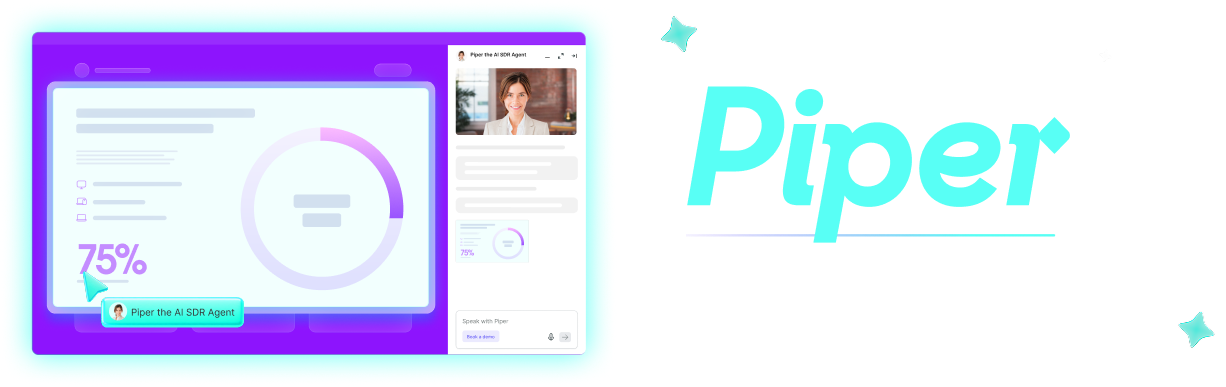

.svg)


