Episode 12 | FourKites on why agentic AI is not set-and-forget
FourKites’ Amanda Dyson breaks down why agentic AI needs human leadership, strong marketers, and intentional setup to deliver real results.

Sarah McConnell
No items found.
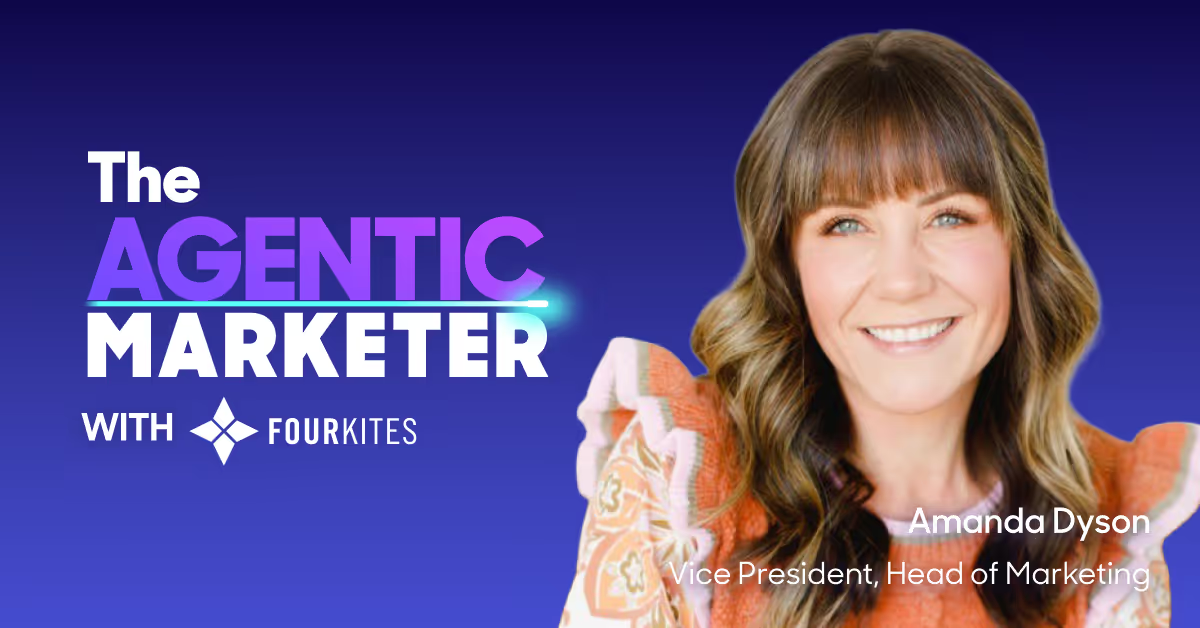


FourKites’ Amanda Dyson breaks down why agentic AI needs human leadership, strong marketers, and intentional setup to deliver real results.



This episode features an interview with Amanda Dyson, Vice President of Marketing at FourKites, a leading supply chain orchestration platform helping global enterprises move from traditional visibility to end-to-end execution with AI-powered digital workers.
Amanda shares how FourKites is embracing agentic marketing by “drinking its own champagne,” using AI agents internally the same way customers use them externally. She explains why marketing teams are often at the forefront of AI adoption, how leadership support accelerates experimentation, and what it takes to move from testing tools to embedding AI into daily workflows.
The conversation dives into FourKites’ use of Felix, their AI SDR, to improve speed-to-lead, ensure every MQL gets followed up with, and drive measurable pipeline impact. Amanda also discusses how AI is reshaping buyer expectations around personalization and instant expertise, why soft skills matter more than ever in an AI-first world, and what agentic use cases she’s most excited about in the year ahead.
Key Takeaways
TRANSCRIPT
Sarah McConnell – Qualified
Okay, everyone, thank you for joining us for another episode of The Agentic Marketer. Amanda from FourKites is joining us today. Amanda, thank you so much. Can you tell us a little bit about yourself and the work that you're doing over at FourKites?
Amanda Dyson – FourKites
Yeah, I'd love to. Thanks for having me on, Sarah. I'm excited to talk about AI and all things kind of agents and all the hype, right? So I'm currently the vice president of marketing at FourKites. I have honestly what I consider a privilege to lead our global marketing team. It's across all things product, customer revenue marketing, and then our marketing operations and our web team. We have a really powerhouse team, so they make my job easy. And we're very AI forward and centric, not just as a team, but as a company. So I feel like this could be a very fun conversation to have with you today.
Sarah McConnell – Qualified
And to your first point there, you said there's a lot of hype around AI and agentic right now. So I like to just sort of level set to kick off this episode, which is what does agentic marketing mean to you? It's a new term, but you guys are obviously very much leaning into this agentic marketing concept. So how would you define that, or what does it mean to your team over there at FourKites?
Amanda Dyson – FourKites
Yeah, so it's really interesting. I'll say FourKites as a company has been on a journey this past year. We have pivoted from a traditional visibility provider to more of end-to-end supply chain orchestration. And part of that has been releasing our own digital workers or AI agents as part of our platform.
So we actually got interesting feedback from customers and others. There's a saying, I guess, of like eating your own dog food. I'm not super familiar with the saying.
Sarah McConnell – Qualified
Yep. Yep. We say drinking your own champagne. Sounds a little bit better than dog food.
Amanda Dyson – FourKites
I'm going to say that from now on. We as a company then were like, you know, we want to embrace AI and we want to live in our customers' shoes type of thing. So I will say marketing has been a little bit more on the forefront of that, more by necessity, frankly, than kind of anything else.
So some of the tools were coming out, the team was experimenting with things. So then when it became a bit more of a company mandate, we were really leading, which was nice. So to me then, you have generative AI, you have agentic AI, you've got a couple of different things.
An agent to me is like an assistant, like an AI assistant, right? So it's autonomously acting. It's automating and routing, and it's data-driven, right? It doesn't think or feel. So there's a lot of human element, I think, that's still required there.
But I do feel like leveraging your own, who doesn't want their own assistant all the time, can be really powerful. So that's kind of how we're leaning into the more or less agentic side.
Sarah McConnell – Qualified
Yeah, I really liked the point that you made of marketing tends to be on the forefront of testing things. And I don't know, especially in this AI era, I feel like marketing tends to be that forefront of that movement. I know we're the same here at Qualified, and I'm in a unique position where we use our own products. So I do tend to be the first one to touch things.
But across most companies I've talked to on this podcast, we're hearing kind of the same things. When the mandate came top down that AI and agentic needs to be in your workflows, marketing teams tend to have the ability to be a little bit more flexible and move faster and be the first ones to try these things. And it's very interesting. Obviously, it sounds like the same thing is happening for you over at FourKites. You guys are really having to lead from the forefront because your own product has agentic capabilities.
Amanda Dyson – FourKites
Yeah, absolutely. And I'd go so far as to say we've got a list of all the tools that we've tried. And we have flexibility because our CEO and founder believes in AI. So we're lucky. I've been in other organizations, and obviously it was a little bit maybe earlier in the AI journey where it was much more hands off and much more nervous about it.
Whereas we have the freedom to try stuff. And I think it's been a learning experience for me. It's been a departure from a lot of our traditional marketing tactics. So it's been pretty fun.
Sarah McConnell – Qualified
Now, you kind of mentioned your CEO is very enthusiastic about AI, and this initiative kind of came top down. But you guys have moved from the experimentation to having it be a part of your day-to-day, which I think a lot of teams struggle with. It's not as if you just view it as a nice to have versus a need to have.
So from your perspective, beyond your CEO being a driver of this, are there some things that teams need to be doing to make that adjustment to go from experimentation into leading with AI within their organizations?
Amanda Dyson – FourKites
Yeah, I think that, you know, I mentioned the marketing team did it a bit more out of necessity. So, you know, in a workforce reduction type of situation, you might still be required to pump out the tremendous content that you've been doing, and you can't have a dip in your lead flow.
So I do feel like that kind of pushed it a little bit more with this team. Really, we couldn't do it without AI, and so that was kind of our leap.
I think every company is going to be a little bit different. Having leadership support of it has been huge, to the extent of like, I had to get on board. My teams were kind of using it. I better learn how to use Claude because they're going to be running circles around me if I kind of don't.
And then the other thing I'll mention is I do still think, just like remember when social media was becoming this new marketing channel that we had never used and suddenly you were having to create guidelines around your social media presence and those kinds of things, the same thing I think is true for AI. You need to have guidelines. And as you're experimenting, I do think you need to start to standardize.
So we have selected tools that we now have enterprise agreements for and things like that. It just becomes a little bit more of your standard operating procedure, at least in my experience.
Sarah McConnell – Qualified
Yeah, I do think setting those standard operating procedures is key. I know we did the same thing internally where when it first started, everyone was messing around with different tools and using them in different ways. And then finally trust and security got involved and had to set some pretty stringent guidelines about what you can and can't do.
And to your point, buying enterprise licenses to make sure that people can use these in the way that they want to in a very safe and secure way. And I do think that to me is an overlooked key to moving from experimentation because you can't use it in your workflows if it's not approved internally within your organization from a security and standard point.
So I think that is a key one that people often forget. Yes, your legal team will remind you. They will be pinging you about it.
Now, I'm curious, you kind of mentioned you had to start incorporating AI to hit metrics. And I do think a lot of us in marketing feel that. Like, I remember a year or two ago, time has gone so fast, the do more with less, which kind of, it was so overplayed and overused, but was also so true.
We still had to hit the same goals. We had the same targets. We had to grow. So AI was like, it was a forcing function. We had to use AI.
From that point forward, where has AI started to show up most visibly in your team? What areas within your organization do you think have adopted AI and used it to the best value?
Amanda Dyson – FourKites
Yeah, I feel like we started with content creation, right? Like you need writers. And actually, even when I joined the company, it's like, man, you guys pump out so much content.
So certainly there. But then it lends itself to research, just the sheer amount of data that AI can ingest and pump something back out to you. Lead flow and routing, I mentioned kind of that automated piece.
We do have a Qualified AI SDR. His name's Felix, and that's been great. I can definitely talk a little bit more about that. And then just kind of being smarter with our tools across web, across PR.
You know, creative. We create a bunch of our agents. We've sort of personified them. And so we use AI to give them a look and feel. Our ABM, even into our events. It touches, I would say, every single piece of marketing on my team at this point.
Sarah McConnell – Qualified
Yeah, that is incredible to hear that it's infiltrated pretty much every part of your team. I think that going back to the how do you go from experimentation to leading with it, you know you've hit that point where it's commonplace in your team when everyone is utilizing it across all your departments.
So you mentioned you hired Felix, your AI SDR agent, which I want to dig into a little bit more. Before we talk about Felix and how they're performing, I'm curious, what made you lean into hiring an AI SDR?
You know, a while ago people were a little nervous. Do they work? Is this something we need? So what was it about hiring Felix that made you and the FourKites team lean in?
Amanda Dyson – FourKites
Yeah, so we have had success with Qualified for inbound lead gen, you know, chatbot on your website. I feel like marketing teams in B2B SaaS have had years of success with that. It's a great addition to your B2B website.
And then I think just taking that step a little bit further with AI to then follow up with leads and communicate with emails and doing that, it's like it's an extension of our human SDR team, which I feel like has been great.
Because you sometimes get into that dilemma of, hey, I want everything to be an MQL, and I want SDRs to talk to every single one of these people and follow up because you're spending marketing dollars to drive a program and you want it to be fruitful and have ROI. But your SDR team can't call everyone.
So then your lead scoring is in question, and then someone sits in a queue too long. So I feel like this AI SDR has been able to remove that, where I can say every MQL will be followed up on.
He's set meetings for us coming out of events. We actually had a lot of success with that, where we met with a bunch of folks on site. And then we took the first step. We have a big speed to lead initiative at FourKites. And we took the first step to use Felix to reach out to each of those people and set 10% of meetings just from doing that. So that success begets success. As we've been experiencing success with that, we want to do more of those kinds of things.
Sarah McConnell – Qualified
Yeah, that is amazing. I was just chatting with someone yesterday, and they were asking, they had just hired Piper and they were the one who renamed them like you did with Felix. They were asking, where do I start?
And they had some of the same issues you just talked about, which is we have a bunch of leads that marketing has generated. We know they're not getting followed up on. And I think that tends to be a marketing problem. That is something we've all known and dealt with over time.
And my advice to him was kind of what you said. Anything that you spend money on, if you want to segment them out and start testing first, marketing tends to have leads that cost more than others. Event leads are a great example of that. When you're hosting these events, they're expensive. The cost per lead is higher.
If you can have those turn into revenue and start to prove some ROI from those leads, that's the best place to start. It's the easiest one and it's the most meaningful to your team because those are the ones you've spent money on. So I think events is always a use case that we've seen work really well here internally at Qualified. And I think a lot of our customers are saying the same thing.
Amanda Dyson – FourKites
Yeah. I mean, another example of that may be like you run a traditional content syndication program and you get 500 leads back. And your human SDRs are like, that's great, they downloaded something. So what?
Felix cares, and he'll go reach out to all of them. And we're seeing it work. So that's the best part.
And then I think you also start to get believers. As you're seeing these things work, they're like, yeah, let Felix have the first cut and then pass it over to us. So your data points become a little bit more reliable too, because you then actually are handing over a more qualified lead.
Sarah McConnell – Qualified
Yeah, I think that is something that was a question I have for you, which is, was there anything unexpected that Felix unlocked for your team? And the reason I want to ask that is I do think your point of content syndication, I know from before I was using Qualified in our Piper instance, if we did anything like content syndication and we had MQL scoring, our SDRs, there was a lot of questions around like, okay, well, is it valid? Like they downloaded something. To your point, who cares? Like I'm not going to work these.
And prior to this, then all marketing had to do was just tweak their scoring model. If there weren't enough leads, you just tweak it and suddenly there's more leads and you just change the scoring threshold. So that was something that was unexpected for us, that it made that sort of moot point. It didn't matter.
But was there anything unexpected that Felix unlocked for the FourKites team?
Amanda Dyson – FourKites
I think, you know, as we're continuing to deepen sort of our usage of Felix, more will come out of it. We have kind of an interesting model where SDRs should be chasing prospects, right? Then you have your sales team. That's a mix of customers and prospects, and they do kind of want things more handed to them that are more baked.
And then we have a customer success team that is talking to our customers. So how can we insert Felix in there, maybe to be a middleman between some of these experiences? So we're experimenting with that.
I think the funniest thing that came to my mind when you were saying unexpected was actually it wasn't Felix. It was some other company's SDR that I didn't know was AI. It was talking to me, and it was about an event, and I was being invited to all these things, and I was fully engaging and interacting and talking to this. I mean, we emailed for like two weeks, and I had no idea that it was AI.
And I found that to be incredibly powerful. When I go back and look, the emails were short and to the point. I could see how maybe that would have been AI. But I also am super busy and appreciate an email that is short and to the point and doesn't have all this fluff that we as people sometimes insert. It's personalization on a different level. That's very interesting and really impactful.
Sarah McConnell – Qualified
Yeah, I always use this example of an unexpected moment. I remember when we were rolling Piper out, and this was last year. And to your we drink our own champagne point, I tend to be the first one utilizing these new products within Qualified.
We were rolling out in phased approaches, and I was looking at answers very consistently to make sure she was on brand and saying the things that we wanted. And there was this very aha moment where a prospect had come to the website. They were asking questions that were pretty technical, and Piper responded with a really great answer but then also pulled up a piece of content and offered it up.
And one, I kind of forgot the content even existed. And I was like, man, if I forgot this content existed, I know my SDR team doesn't know this content exists. And the answer was spot on. The person went to it. They booked a meeting. It was this very seamless, great flow.
And I was like, man, I wouldn't have been able to do that. I live in our content every single day. Our content team rolls up under me in demand gen. I should know all of our content that's out there. And the fact that her AI SDR was able to do that, I remember going to my CEO and I was like, she's ready. We can roll her out to the whole website. That was it for me.
Amanda Dyson – FourKites
Yeah, I mean, that's so cool. I love that. And that gets back to the volume of data that AI is able to ingest and give you back the answer that you want, which is what buyers expect. That is a little bit scary, but that is what they expect and that's what it can deliver.
Sarah McConnell – Qualified
Now the last question I have for you about Felix is people are always curious about how you're measuring success with an AI SDR. So are there any particular metrics that you look at consistently to say, yes, this is working, we want to continue using this AI SDR?
Amanda Dyson – FourKites
Yeah, I think our first test was around follow-up with events. So meetings set is certainly one that we're looking at. And we continue to, anytime Felix is even following up on an email campaign, it's meetings set.
I think our MQL to SQL conversion is another one. As Felix is able to get through those leads and qualify them even further, we're continuing to up the percentage of conversions.
And then my whole team, because demand gen is my background, we're laser focused on pipe gen and sourced opportunities. So we actually have a Qualified dashboard that we had before we even had Felix, but we've integrated Felix into all of those metrics that we can go and look. Because events, website, and SDR are going to be your three hottest opportunity drivers. And so we measure it separately.
Sarah McConnell – Qualified
Yeah, that's amazing. I think that is the one I always come back to, is pipeline. I'm in demand, obviously pipeline is what I live and breathe. So measuring that is what I always advise customers. If this is what you would hold a normal SDR accountable to, it's the same thing you should hold your AI SDR accountable to. And I love that you guys have incorporated it into a dashboard.
Amanda Dyson – FourKites
Yeah, 100%.
Sarah McConnell – Qualified
Now I want to shift to more forward-looking. If you were talking to a peer that's looking to adopt AI, where would you tell them to start? I think it's hard to know. It's very overwhelming. We've gotten so far into this AI era that it can feel pretty daunting.
I know coming back from maternity leave, it was four months, and I was like, my gosh, it's a whole new world out here. That's very hard. What would be your advice on where people can get started to start adopting this more agentic approach?
Amanda Dyson – FourKites
Yeah, so I think my advice would be to get back to the human element of AI. I think you need really smart marketers to deploy AI. And I'm very lucky with the team that I have.
You can't just use AI and expect it to do the marketing for you. I feel like that's a misconception. Teams or leadership may be like, yeah, we don't even need all these marketers because AI can do all this stuff. And I don't think that's the case whatsoever. We see AI get things wrong sometimes too.
I feel like it's become really important to be very thoughtful in how you set up AI, how you prompt AI. So first and foremost, your team has to be prepared for what you're about to embark on. And if your team isn't at that caliber, you're going to start really small because it's a lot. To your point, it's a whole new world.
And then you mentioned moving from experimentation into full-blown strategy. I think you need to be open to experimenting and looking at different tools. There's a lot out there. We've got a running list of all these tools.
We actually did it across the company, not just marketing, of all the different tools that we were trying and the pros and cons and all of that. We attempted to track it all and tie KPIs to what we expected the tools to do and what they actually did.
And just as a marketing leader in general, my team is encouraged to fail fast. If something doesn't work, we move on from it. But giving them the freedom to raise their hand with a new tool has been empowering. It's helped us standardize on some of those tools.
Sarah McConnell – Qualified
Yeah, and you mentioned you encourage your team to fail fast and experiment. Thinking about skills that other organizations need, what are the skills that you're encouraging your team to adopt in this AI era to help them thrive and be better at their jobs?
Amanda Dyson – FourKites
Yeah, it's soft skills all day long. I feel like that is becoming so much more important because AI can't read a room. It doesn't have empathy.
People say it's not creative. I would argue that one a little bit. I think AI can get pretty creative. I use it all the time to help me come up with ideas that are off the wall.
But leadership, organizational skills, problem solving, collaboration, and change management are becoming much more important. As you're harnessing these tools and leveraging your own team of AI assistants, you've got to be able to manage them like you would your team.
Sarah McConnell – Qualified
Yeah, I do think that is interesting. We've moved people into roles where that's the only thing they're doing, managing AI. So I agree. Those soft skills will help you stand out.
Now, you mentioned personalization earlier. With the expectation of buyers now being incredibly high, is there anything that has shifted in this AI era from a buyer expectation standpoint that you think marketers might be underestimating right now?
Amanda Dyson – FourKites
Yeah, the personalization piece, but I really feel like AI has normalized instant expertise. Buyers expect you to answer their questions before they even ask them.
It takes me back to when intent data was all the rage. We were surfacing companies searching on things and feeding them ads. It felt very future-forward. Now buyers want instant expertise. They want personalization without giving you any data.
Nobody wants to give you data. So how do we uncover that? Buyers want to do their own research before they ever talk to a salesperson. We've known that. But if your website or ads are too generic, they're getting overlooked.
My passion is ABM, so personalization is everything. How do we do that at scale and use AI to really do that? Because it's 100% the expectation now.
Sarah McConnell – Qualified
Is there a use case for agents that you're excited about that you think we're going to see in the next 12 months?
Amanda Dyson – FourKites
I think autonomous campaign execution. Scaling A/B testing, channel management, content and creative, and funneling that into intelligent lead nurturing and scoring.
You pump in your campaign elements and it does it for you. There are tools that touch pieces of that, but that end-to-end campaign execution that's fully autonomous feels like it could be on the horizon.
Sarah McConnell – Qualified
I think you might be the third guest who said that. There's obviously an opportunity there. I would buy it for sure.
Amanda Dyson – FourKites
My head of revenue marketing would love that. She can do the strategy. She just needs someone to go build and launch the campaign. Somebody will be a millionaire, but it won't be us.
Sarah McConnell – Qualified
Okay, now we're going to move into our lightning round. Quick questions, quick answers.
Other than ChatGPT, what was the first AI tool you experimented with?
Amanda Dyson – FourKites
Read AI for note-taking. My husband introduced me to it. Canva as well. I still use Canva. Those were probably my first ones.
Sarah McConnell – Qualified
What is the most overrated buzzword in martech right now, besides AI and agents?
Amanda Dyson – FourKites
End-to-end, data-driven, agile. There are a lot.
Sarah McConnell – Qualified
A marketer you love to follow who's ahead of the curve on AI?
Amanda Dyson – FourKites
Jordan Hofer and Tyler Nickel on my team. They are AI first, incredibly smart, and use AI as a force multiplier.
Sarah McConnell – Qualified
If you could use AI to automate any part of your life outside of work, what would it be?
Amanda Dyson – FourKites
My calendar and scheduling. Managing kids, spirit weeks, tasks. If it's not on the calendar, it doesn't exist.
Sarah McConnell – Qualified
Same. Especially with a baby. If you find a tool, let me know.
Amanda Dyson – FourKites
I might get myself one as a Christmas gift.
Sarah McConnell – Qualified
Amanda, thank you so much for joining us today. It was wonderful to have you on the show.
Amanda Dyson – FourKites
You're super welcome. Thank you for having me.
Bonterra CMO Stacy West shares how agentic AI helps marketing teams move beyond basic automation to expand capacity and drive real impact.
Discover how Emburse drives real AI adoption by creating a culture of experimentation. Heidi Wurpel shares why giving teams “permission to play” accelerates agentic marketing.
.jpg)
Learn how G2 approaches agentic marketing, speeds up inbound, and adapts to LLM-native buyers in this conversation with CMO Sydney Sloan.
.jpg)
Brightly Software’s Whitney Rosa explains why B2B marketing is shifting from campaign-centric to system-centric, powered by AI agents that automate decisions, optimize in real time, and scale marketing impact.
.jpg)
Learn how Talkspace uses AI SDR agents and agentic marketing to replace static funnels and turn website traffic into qualified pipeline.
.jpg)
Our show The Agentic Marketer interviews today's leading B2B marketers to discover how they're actually using agentic AI day to day to hit their pipeline goals. Learn the 7 things agentic marketers are doing right now to stay ahead of the curve.
FourKites’ Amanda Dyson breaks down why agentic AI needs human leadership, strong marketers, and intentional setup to deliver real results.
This episode features an interview with Amanda Dyson, Vice President of Marketing at FourKites, a leading supply chain orchestration platform helping global enterprises move from traditional visibility to end-to-end execution with AI-powered digital workers.
Amanda shares how FourKites is embracing agentic marketing by “drinking its own champagne,” using AI agents internally the same way customers use them externally. She explains why marketing teams are often at the forefront of AI adoption, how leadership support accelerates experimentation, and what it takes to move from testing tools to embedding AI into daily workflows.
The conversation dives into FourKites’ use of Felix, their AI SDR, to improve speed-to-lead, ensure every MQL gets followed up with, and drive measurable pipeline impact. Amanda also discusses how AI is reshaping buyer expectations around personalization and instant expertise, why soft skills matter more than ever in an AI-first world, and what agentic use cases she’s most excited about in the year ahead.
Key Takeaways
TRANSCRIPT
Sarah McConnell – Qualified
Okay, everyone, thank you for joining us for another episode of The Agentic Marketer. Amanda from FourKites is joining us today. Amanda, thank you so much. Can you tell us a little bit about yourself and the work that you're doing over at FourKites?
Amanda Dyson – FourKites
Yeah, I'd love to. Thanks for having me on, Sarah. I'm excited to talk about AI and all things kind of agents and all the hype, right? So I'm currently the vice president of marketing at FourKites. I have honestly what I consider a privilege to lead our global marketing team. It's across all things product, customer revenue marketing, and then our marketing operations and our web team. We have a really powerhouse team, so they make my job easy. And we're very AI forward and centric, not just as a team, but as a company. So I feel like this could be a very fun conversation to have with you today.
Sarah McConnell – Qualified
And to your first point there, you said there's a lot of hype around AI and agentic right now. So I like to just sort of level set to kick off this episode, which is what does agentic marketing mean to you? It's a new term, but you guys are obviously very much leaning into this agentic marketing concept. So how would you define that, or what does it mean to your team over there at FourKites?
Amanda Dyson – FourKites
Yeah, so it's really interesting. I'll say FourKites as a company has been on a journey this past year. We have pivoted from a traditional visibility provider to more of end-to-end supply chain orchestration. And part of that has been releasing our own digital workers or AI agents as part of our platform.
So we actually got interesting feedback from customers and others. There's a saying, I guess, of like eating your own dog food. I'm not super familiar with the saying.
Sarah McConnell – Qualified
Yep. Yep. We say drinking your own champagne. Sounds a little bit better than dog food.
Amanda Dyson – FourKites
I'm going to say that from now on. We as a company then were like, you know, we want to embrace AI and we want to live in our customers' shoes type of thing. So I will say marketing has been a little bit more on the forefront of that, more by necessity, frankly, than kind of anything else.
So some of the tools were coming out, the team was experimenting with things. So then when it became a bit more of a company mandate, we were really leading, which was nice. So to me then, you have generative AI, you have agentic AI, you've got a couple of different things.
An agent to me is like an assistant, like an AI assistant, right? So it's autonomously acting. It's automating and routing, and it's data-driven, right? It doesn't think or feel. So there's a lot of human element, I think, that's still required there.
But I do feel like leveraging your own, who doesn't want their own assistant all the time, can be really powerful. So that's kind of how we're leaning into the more or less agentic side.
Sarah McConnell – Qualified
Yeah, I really liked the point that you made of marketing tends to be on the forefront of testing things. And I don't know, especially in this AI era, I feel like marketing tends to be that forefront of that movement. I know we're the same here at Qualified, and I'm in a unique position where we use our own products. So I do tend to be the first one to touch things.
But across most companies I've talked to on this podcast, we're hearing kind of the same things. When the mandate came top down that AI and agentic needs to be in your workflows, marketing teams tend to have the ability to be a little bit more flexible and move faster and be the first ones to try these things. And it's very interesting. Obviously, it sounds like the same thing is happening for you over at FourKites. You guys are really having to lead from the forefront because your own product has agentic capabilities.
Amanda Dyson – FourKites
Yeah, absolutely. And I'd go so far as to say we've got a list of all the tools that we've tried. And we have flexibility because our CEO and founder believes in AI. So we're lucky. I've been in other organizations, and obviously it was a little bit maybe earlier in the AI journey where it was much more hands off and much more nervous about it.
Whereas we have the freedom to try stuff. And I think it's been a learning experience for me. It's been a departure from a lot of our traditional marketing tactics. So it's been pretty fun.
Sarah McConnell – Qualified
Now, you kind of mentioned your CEO is very enthusiastic about AI, and this initiative kind of came top down. But you guys have moved from the experimentation to having it be a part of your day-to-day, which I think a lot of teams struggle with. It's not as if you just view it as a nice to have versus a need to have.
So from your perspective, beyond your CEO being a driver of this, are there some things that teams need to be doing to make that adjustment to go from experimentation into leading with AI within their organizations?
Amanda Dyson – FourKites
Yeah, I think that, you know, I mentioned the marketing team did it a bit more out of necessity. So, you know, in a workforce reduction type of situation, you might still be required to pump out the tremendous content that you've been doing, and you can't have a dip in your lead flow.
So I do feel like that kind of pushed it a little bit more with this team. Really, we couldn't do it without AI, and so that was kind of our leap.
I think every company is going to be a little bit different. Having leadership support of it has been huge, to the extent of like, I had to get on board. My teams were kind of using it. I better learn how to use Claude because they're going to be running circles around me if I kind of don't.
And then the other thing I'll mention is I do still think, just like remember when social media was becoming this new marketing channel that we had never used and suddenly you were having to create guidelines around your social media presence and those kinds of things, the same thing I think is true for AI. You need to have guidelines. And as you're experimenting, I do think you need to start to standardize.
So we have selected tools that we now have enterprise agreements for and things like that. It just becomes a little bit more of your standard operating procedure, at least in my experience.
Sarah McConnell – Qualified
Yeah, I do think setting those standard operating procedures is key. I know we did the same thing internally where when it first started, everyone was messing around with different tools and using them in different ways. And then finally trust and security got involved and had to set some pretty stringent guidelines about what you can and can't do.
And to your point, buying enterprise licenses to make sure that people can use these in the way that they want to in a very safe and secure way. And I do think that to me is an overlooked key to moving from experimentation because you can't use it in your workflows if it's not approved internally within your organization from a security and standard point.
So I think that is a key one that people often forget. Yes, your legal team will remind you. They will be pinging you about it.
Now, I'm curious, you kind of mentioned you had to start incorporating AI to hit metrics. And I do think a lot of us in marketing feel that. Like, I remember a year or two ago, time has gone so fast, the do more with less, which kind of, it was so overplayed and overused, but was also so true.
We still had to hit the same goals. We had the same targets. We had to grow. So AI was like, it was a forcing function. We had to use AI.
From that point forward, where has AI started to show up most visibly in your team? What areas within your organization do you think have adopted AI and used it to the best value?
Amanda Dyson – FourKites
Yeah, I feel like we started with content creation, right? Like you need writers. And actually, even when I joined the company, it's like, man, you guys pump out so much content.
So certainly there. But then it lends itself to research, just the sheer amount of data that AI can ingest and pump something back out to you. Lead flow and routing, I mentioned kind of that automated piece.
We do have a Qualified AI SDR. His name's Felix, and that's been great. I can definitely talk a little bit more about that. And then just kind of being smarter with our tools across web, across PR.
You know, creative. We create a bunch of our agents. We've sort of personified them. And so we use AI to give them a look and feel. Our ABM, even into our events. It touches, I would say, every single piece of marketing on my team at this point.
Sarah McConnell – Qualified
Yeah, that is incredible to hear that it's infiltrated pretty much every part of your team. I think that going back to the how do you go from experimentation to leading with it, you know you've hit that point where it's commonplace in your team when everyone is utilizing it across all your departments.
So you mentioned you hired Felix, your AI SDR agent, which I want to dig into a little bit more. Before we talk about Felix and how they're performing, I'm curious, what made you lean into hiring an AI SDR?
You know, a while ago people were a little nervous. Do they work? Is this something we need? So what was it about hiring Felix that made you and the FourKites team lean in?
Amanda Dyson – FourKites
Yeah, so we have had success with Qualified for inbound lead gen, you know, chatbot on your website. I feel like marketing teams in B2B SaaS have had years of success with that. It's a great addition to your B2B website.
And then I think just taking that step a little bit further with AI to then follow up with leads and communicate with emails and doing that, it's like it's an extension of our human SDR team, which I feel like has been great.
Because you sometimes get into that dilemma of, hey, I want everything to be an MQL, and I want SDRs to talk to every single one of these people and follow up because you're spending marketing dollars to drive a program and you want it to be fruitful and have ROI. But your SDR team can't call everyone.
So then your lead scoring is in question, and then someone sits in a queue too long. So I feel like this AI SDR has been able to remove that, where I can say every MQL will be followed up on.
He's set meetings for us coming out of events. We actually had a lot of success with that, where we met with a bunch of folks on site. And then we took the first step. We have a big speed to lead initiative at FourKites. And we took the first step to use Felix to reach out to each of those people and set 10% of meetings just from doing that. So that success begets success. As we've been experiencing success with that, we want to do more of those kinds of things.
Sarah McConnell – Qualified
Yeah, that is amazing. I was just chatting with someone yesterday, and they were asking, they had just hired Piper and they were the one who renamed them like you did with Felix. They were asking, where do I start?
And they had some of the same issues you just talked about, which is we have a bunch of leads that marketing has generated. We know they're not getting followed up on. And I think that tends to be a marketing problem. That is something we've all known and dealt with over time.
And my advice to him was kind of what you said. Anything that you spend money on, if you want to segment them out and start testing first, marketing tends to have leads that cost more than others. Event leads are a great example of that. When you're hosting these events, they're expensive. The cost per lead is higher.
If you can have those turn into revenue and start to prove some ROI from those leads, that's the best place to start. It's the easiest one and it's the most meaningful to your team because those are the ones you've spent money on. So I think events is always a use case that we've seen work really well here internally at Qualified. And I think a lot of our customers are saying the same thing.
Amanda Dyson – FourKites
Yeah. I mean, another example of that may be like you run a traditional content syndication program and you get 500 leads back. And your human SDRs are like, that's great, they downloaded something. So what?
Felix cares, and he'll go reach out to all of them. And we're seeing it work. So that's the best part.
And then I think you also start to get believers. As you're seeing these things work, they're like, yeah, let Felix have the first cut and then pass it over to us. So your data points become a little bit more reliable too, because you then actually are handing over a more qualified lead.
Sarah McConnell – Qualified
Yeah, I think that is something that was a question I have for you, which is, was there anything unexpected that Felix unlocked for your team? And the reason I want to ask that is I do think your point of content syndication, I know from before I was using Qualified in our Piper instance, if we did anything like content syndication and we had MQL scoring, our SDRs, there was a lot of questions around like, okay, well, is it valid? Like they downloaded something. To your point, who cares? Like I'm not going to work these.
And prior to this, then all marketing had to do was just tweak their scoring model. If there weren't enough leads, you just tweak it and suddenly there's more leads and you just change the scoring threshold. So that was something that was unexpected for us, that it made that sort of moot point. It didn't matter.
But was there anything unexpected that Felix unlocked for the FourKites team?
Amanda Dyson – FourKites
I think, you know, as we're continuing to deepen sort of our usage of Felix, more will come out of it. We have kind of an interesting model where SDRs should be chasing prospects, right? Then you have your sales team. That's a mix of customers and prospects, and they do kind of want things more handed to them that are more baked.
And then we have a customer success team that is talking to our customers. So how can we insert Felix in there, maybe to be a middleman between some of these experiences? So we're experimenting with that.
I think the funniest thing that came to my mind when you were saying unexpected was actually it wasn't Felix. It was some other company's SDR that I didn't know was AI. It was talking to me, and it was about an event, and I was being invited to all these things, and I was fully engaging and interacting and talking to this. I mean, we emailed for like two weeks, and I had no idea that it was AI.
And I found that to be incredibly powerful. When I go back and look, the emails were short and to the point. I could see how maybe that would have been AI. But I also am super busy and appreciate an email that is short and to the point and doesn't have all this fluff that we as people sometimes insert. It's personalization on a different level. That's very interesting and really impactful.
Sarah McConnell – Qualified
Yeah, I always use this example of an unexpected moment. I remember when we were rolling Piper out, and this was last year. And to your we drink our own champagne point, I tend to be the first one utilizing these new products within Qualified.
We were rolling out in phased approaches, and I was looking at answers very consistently to make sure she was on brand and saying the things that we wanted. And there was this very aha moment where a prospect had come to the website. They were asking questions that were pretty technical, and Piper responded with a really great answer but then also pulled up a piece of content and offered it up.
And one, I kind of forgot the content even existed. And I was like, man, if I forgot this content existed, I know my SDR team doesn't know this content exists. And the answer was spot on. The person went to it. They booked a meeting. It was this very seamless, great flow.
And I was like, man, I wouldn't have been able to do that. I live in our content every single day. Our content team rolls up under me in demand gen. I should know all of our content that's out there. And the fact that her AI SDR was able to do that, I remember going to my CEO and I was like, she's ready. We can roll her out to the whole website. That was it for me.
Amanda Dyson – FourKites
Yeah, I mean, that's so cool. I love that. And that gets back to the volume of data that AI is able to ingest and give you back the answer that you want, which is what buyers expect. That is a little bit scary, but that is what they expect and that's what it can deliver.
Sarah McConnell – Qualified
Now the last question I have for you about Felix is people are always curious about how you're measuring success with an AI SDR. So are there any particular metrics that you look at consistently to say, yes, this is working, we want to continue using this AI SDR?
Amanda Dyson – FourKites
Yeah, I think our first test was around follow-up with events. So meetings set is certainly one that we're looking at. And we continue to, anytime Felix is even following up on an email campaign, it's meetings set.
I think our MQL to SQL conversion is another one. As Felix is able to get through those leads and qualify them even further, we're continuing to up the percentage of conversions.
And then my whole team, because demand gen is my background, we're laser focused on pipe gen and sourced opportunities. So we actually have a Qualified dashboard that we had before we even had Felix, but we've integrated Felix into all of those metrics that we can go and look. Because events, website, and SDR are going to be your three hottest opportunity drivers. And so we measure it separately.
Sarah McConnell – Qualified
Yeah, that's amazing. I think that is the one I always come back to, is pipeline. I'm in demand, obviously pipeline is what I live and breathe. So measuring that is what I always advise customers. If this is what you would hold a normal SDR accountable to, it's the same thing you should hold your AI SDR accountable to. And I love that you guys have incorporated it into a dashboard.
Amanda Dyson – FourKites
Yeah, 100%.
Sarah McConnell – Qualified
Now I want to shift to more forward-looking. If you were talking to a peer that's looking to adopt AI, where would you tell them to start? I think it's hard to know. It's very overwhelming. We've gotten so far into this AI era that it can feel pretty daunting.
I know coming back from maternity leave, it was four months, and I was like, my gosh, it's a whole new world out here. That's very hard. What would be your advice on where people can get started to start adopting this more agentic approach?
Amanda Dyson – FourKites
Yeah, so I think my advice would be to get back to the human element of AI. I think you need really smart marketers to deploy AI. And I'm very lucky with the team that I have.
You can't just use AI and expect it to do the marketing for you. I feel like that's a misconception. Teams or leadership may be like, yeah, we don't even need all these marketers because AI can do all this stuff. And I don't think that's the case whatsoever. We see AI get things wrong sometimes too.
I feel like it's become really important to be very thoughtful in how you set up AI, how you prompt AI. So first and foremost, your team has to be prepared for what you're about to embark on. And if your team isn't at that caliber, you're going to start really small because it's a lot. To your point, it's a whole new world.
And then you mentioned moving from experimentation into full-blown strategy. I think you need to be open to experimenting and looking at different tools. There's a lot out there. We've got a running list of all these tools.
We actually did it across the company, not just marketing, of all the different tools that we were trying and the pros and cons and all of that. We attempted to track it all and tie KPIs to what we expected the tools to do and what they actually did.
And just as a marketing leader in general, my team is encouraged to fail fast. If something doesn't work, we move on from it. But giving them the freedom to raise their hand with a new tool has been empowering. It's helped us standardize on some of those tools.
Sarah McConnell – Qualified
Yeah, and you mentioned you encourage your team to fail fast and experiment. Thinking about skills that other organizations need, what are the skills that you're encouraging your team to adopt in this AI era to help them thrive and be better at their jobs?
Amanda Dyson – FourKites
Yeah, it's soft skills all day long. I feel like that is becoming so much more important because AI can't read a room. It doesn't have empathy.
People say it's not creative. I would argue that one a little bit. I think AI can get pretty creative. I use it all the time to help me come up with ideas that are off the wall.
But leadership, organizational skills, problem solving, collaboration, and change management are becoming much more important. As you're harnessing these tools and leveraging your own team of AI assistants, you've got to be able to manage them like you would your team.
Sarah McConnell – Qualified
Yeah, I do think that is interesting. We've moved people into roles where that's the only thing they're doing, managing AI. So I agree. Those soft skills will help you stand out.
Now, you mentioned personalization earlier. With the expectation of buyers now being incredibly high, is there anything that has shifted in this AI era from a buyer expectation standpoint that you think marketers might be underestimating right now?
Amanda Dyson – FourKites
Yeah, the personalization piece, but I really feel like AI has normalized instant expertise. Buyers expect you to answer their questions before they even ask them.
It takes me back to when intent data was all the rage. We were surfacing companies searching on things and feeding them ads. It felt very future-forward. Now buyers want instant expertise. They want personalization without giving you any data.
Nobody wants to give you data. So how do we uncover that? Buyers want to do their own research before they ever talk to a salesperson. We've known that. But if your website or ads are too generic, they're getting overlooked.
My passion is ABM, so personalization is everything. How do we do that at scale and use AI to really do that? Because it's 100% the expectation now.
Sarah McConnell – Qualified
Is there a use case for agents that you're excited about that you think we're going to see in the next 12 months?
Amanda Dyson – FourKites
I think autonomous campaign execution. Scaling A/B testing, channel management, content and creative, and funneling that into intelligent lead nurturing and scoring.
You pump in your campaign elements and it does it for you. There are tools that touch pieces of that, but that end-to-end campaign execution that's fully autonomous feels like it could be on the horizon.
Sarah McConnell – Qualified
I think you might be the third guest who said that. There's obviously an opportunity there. I would buy it for sure.
Amanda Dyson – FourKites
My head of revenue marketing would love that. She can do the strategy. She just needs someone to go build and launch the campaign. Somebody will be a millionaire, but it won't be us.
Sarah McConnell – Qualified
Okay, now we're going to move into our lightning round. Quick questions, quick answers.
Other than ChatGPT, what was the first AI tool you experimented with?
Amanda Dyson – FourKites
Read AI for note-taking. My husband introduced me to it. Canva as well. I still use Canva. Those were probably my first ones.
Sarah McConnell – Qualified
What is the most overrated buzzword in martech right now, besides AI and agents?
Amanda Dyson – FourKites
End-to-end, data-driven, agile. There are a lot.
Sarah McConnell – Qualified
A marketer you love to follow who's ahead of the curve on AI?
Amanda Dyson – FourKites
Jordan Hofer and Tyler Nickel on my team. They are AI first, incredibly smart, and use AI as a force multiplier.
Sarah McConnell – Qualified
If you could use AI to automate any part of your life outside of work, what would it be?
Amanda Dyson – FourKites
My calendar and scheduling. Managing kids, spirit weeks, tasks. If it's not on the calendar, it doesn't exist.
Sarah McConnell – Qualified
Same. Especially with a baby. If you find a tool, let me know.
Amanda Dyson – FourKites
I might get myself one as a Christmas gift.
Sarah McConnell – Qualified
Amanda, thank you so much for joining us today. It was wonderful to have you on the show.
Amanda Dyson – FourKites
You're super welcome. Thank you for having me.
FourKites’ Amanda Dyson breaks down why agentic AI needs human leadership, strong marketers, and intentional setup to deliver real results.
This episode features an interview with Amanda Dyson, Vice President of Marketing at FourKites, a leading supply chain orchestration platform helping global enterprises move from traditional visibility to end-to-end execution with AI-powered digital workers.
Amanda shares how FourKites is embracing agentic marketing by “drinking its own champagne,” using AI agents internally the same way customers use them externally. She explains why marketing teams are often at the forefront of AI adoption, how leadership support accelerates experimentation, and what it takes to move from testing tools to embedding AI into daily workflows.
The conversation dives into FourKites’ use of Felix, their AI SDR, to improve speed-to-lead, ensure every MQL gets followed up with, and drive measurable pipeline impact. Amanda also discusses how AI is reshaping buyer expectations around personalization and instant expertise, why soft skills matter more than ever in an AI-first world, and what agentic use cases she’s most excited about in the year ahead.
Key Takeaways
TRANSCRIPT
Sarah McConnell – Qualified
Okay, everyone, thank you for joining us for another episode of The Agentic Marketer. Amanda from FourKites is joining us today. Amanda, thank you so much. Can you tell us a little bit about yourself and the work that you're doing over at FourKites?
Amanda Dyson – FourKites
Yeah, I'd love to. Thanks for having me on, Sarah. I'm excited to talk about AI and all things kind of agents and all the hype, right? So I'm currently the vice president of marketing at FourKites. I have honestly what I consider a privilege to lead our global marketing team. It's across all things product, customer revenue marketing, and then our marketing operations and our web team. We have a really powerhouse team, so they make my job easy. And we're very AI forward and centric, not just as a team, but as a company. So I feel like this could be a very fun conversation to have with you today.
Sarah McConnell – Qualified
And to your first point there, you said there's a lot of hype around AI and agentic right now. So I like to just sort of level set to kick off this episode, which is what does agentic marketing mean to you? It's a new term, but you guys are obviously very much leaning into this agentic marketing concept. So how would you define that, or what does it mean to your team over there at FourKites?
Amanda Dyson – FourKites
Yeah, so it's really interesting. I'll say FourKites as a company has been on a journey this past year. We have pivoted from a traditional visibility provider to more of end-to-end supply chain orchestration. And part of that has been releasing our own digital workers or AI agents as part of our platform.
So we actually got interesting feedback from customers and others. There's a saying, I guess, of like eating your own dog food. I'm not super familiar with the saying.
Sarah McConnell – Qualified
Yep. Yep. We say drinking your own champagne. Sounds a little bit better than dog food.
Amanda Dyson – FourKites
I'm going to say that from now on. We as a company then were like, you know, we want to embrace AI and we want to live in our customers' shoes type of thing. So I will say marketing has been a little bit more on the forefront of that, more by necessity, frankly, than kind of anything else.
So some of the tools were coming out, the team was experimenting with things. So then when it became a bit more of a company mandate, we were really leading, which was nice. So to me then, you have generative AI, you have agentic AI, you've got a couple of different things.
An agent to me is like an assistant, like an AI assistant, right? So it's autonomously acting. It's automating and routing, and it's data-driven, right? It doesn't think or feel. So there's a lot of human element, I think, that's still required there.
But I do feel like leveraging your own, who doesn't want their own assistant all the time, can be really powerful. So that's kind of how we're leaning into the more or less agentic side.
Sarah McConnell – Qualified
Yeah, I really liked the point that you made of marketing tends to be on the forefront of testing things. And I don't know, especially in this AI era, I feel like marketing tends to be that forefront of that movement. I know we're the same here at Qualified, and I'm in a unique position where we use our own products. So I do tend to be the first one to touch things.
But across most companies I've talked to on this podcast, we're hearing kind of the same things. When the mandate came top down that AI and agentic needs to be in your workflows, marketing teams tend to have the ability to be a little bit more flexible and move faster and be the first ones to try these things. And it's very interesting. Obviously, it sounds like the same thing is happening for you over at FourKites. You guys are really having to lead from the forefront because your own product has agentic capabilities.
Amanda Dyson – FourKites
Yeah, absolutely. And I'd go so far as to say we've got a list of all the tools that we've tried. And we have flexibility because our CEO and founder believes in AI. So we're lucky. I've been in other organizations, and obviously it was a little bit maybe earlier in the AI journey where it was much more hands off and much more nervous about it.
Whereas we have the freedom to try stuff. And I think it's been a learning experience for me. It's been a departure from a lot of our traditional marketing tactics. So it's been pretty fun.
Sarah McConnell – Qualified
Now, you kind of mentioned your CEO is very enthusiastic about AI, and this initiative kind of came top down. But you guys have moved from the experimentation to having it be a part of your day-to-day, which I think a lot of teams struggle with. It's not as if you just view it as a nice to have versus a need to have.
So from your perspective, beyond your CEO being a driver of this, are there some things that teams need to be doing to make that adjustment to go from experimentation into leading with AI within their organizations?
Amanda Dyson – FourKites
Yeah, I think that, you know, I mentioned the marketing team did it a bit more out of necessity. So, you know, in a workforce reduction type of situation, you might still be required to pump out the tremendous content that you've been doing, and you can't have a dip in your lead flow.
So I do feel like that kind of pushed it a little bit more with this team. Really, we couldn't do it without AI, and so that was kind of our leap.
I think every company is going to be a little bit different. Having leadership support of it has been huge, to the extent of like, I had to get on board. My teams were kind of using it. I better learn how to use Claude because they're going to be running circles around me if I kind of don't.
And then the other thing I'll mention is I do still think, just like remember when social media was becoming this new marketing channel that we had never used and suddenly you were having to create guidelines around your social media presence and those kinds of things, the same thing I think is true for AI. You need to have guidelines. And as you're experimenting, I do think you need to start to standardize.
So we have selected tools that we now have enterprise agreements for and things like that. It just becomes a little bit more of your standard operating procedure, at least in my experience.
Sarah McConnell – Qualified
Yeah, I do think setting those standard operating procedures is key. I know we did the same thing internally where when it first started, everyone was messing around with different tools and using them in different ways. And then finally trust and security got involved and had to set some pretty stringent guidelines about what you can and can't do.
And to your point, buying enterprise licenses to make sure that people can use these in the way that they want to in a very safe and secure way. And I do think that to me is an overlooked key to moving from experimentation because you can't use it in your workflows if it's not approved internally within your organization from a security and standard point.
So I think that is a key one that people often forget. Yes, your legal team will remind you. They will be pinging you about it.
Now, I'm curious, you kind of mentioned you had to start incorporating AI to hit metrics. And I do think a lot of us in marketing feel that. Like, I remember a year or two ago, time has gone so fast, the do more with less, which kind of, it was so overplayed and overused, but was also so true.
We still had to hit the same goals. We had the same targets. We had to grow. So AI was like, it was a forcing function. We had to use AI.
From that point forward, where has AI started to show up most visibly in your team? What areas within your organization do you think have adopted AI and used it to the best value?
Amanda Dyson – FourKites
Yeah, I feel like we started with content creation, right? Like you need writers. And actually, even when I joined the company, it's like, man, you guys pump out so much content.
So certainly there. But then it lends itself to research, just the sheer amount of data that AI can ingest and pump something back out to you. Lead flow and routing, I mentioned kind of that automated piece.
We do have a Qualified AI SDR. His name's Felix, and that's been great. I can definitely talk a little bit more about that. And then just kind of being smarter with our tools across web, across PR.
You know, creative. We create a bunch of our agents. We've sort of personified them. And so we use AI to give them a look and feel. Our ABM, even into our events. It touches, I would say, every single piece of marketing on my team at this point.
Sarah McConnell – Qualified
Yeah, that is incredible to hear that it's infiltrated pretty much every part of your team. I think that going back to the how do you go from experimentation to leading with it, you know you've hit that point where it's commonplace in your team when everyone is utilizing it across all your departments.
So you mentioned you hired Felix, your AI SDR agent, which I want to dig into a little bit more. Before we talk about Felix and how they're performing, I'm curious, what made you lean into hiring an AI SDR?
You know, a while ago people were a little nervous. Do they work? Is this something we need? So what was it about hiring Felix that made you and the FourKites team lean in?
Amanda Dyson – FourKites
Yeah, so we have had success with Qualified for inbound lead gen, you know, chatbot on your website. I feel like marketing teams in B2B SaaS have had years of success with that. It's a great addition to your B2B website.
And then I think just taking that step a little bit further with AI to then follow up with leads and communicate with emails and doing that, it's like it's an extension of our human SDR team, which I feel like has been great.
Because you sometimes get into that dilemma of, hey, I want everything to be an MQL, and I want SDRs to talk to every single one of these people and follow up because you're spending marketing dollars to drive a program and you want it to be fruitful and have ROI. But your SDR team can't call everyone.
So then your lead scoring is in question, and then someone sits in a queue too long. So I feel like this AI SDR has been able to remove that, where I can say every MQL will be followed up on.
He's set meetings for us coming out of events. We actually had a lot of success with that, where we met with a bunch of folks on site. And then we took the first step. We have a big speed to lead initiative at FourKites. And we took the first step to use Felix to reach out to each of those people and set 10% of meetings just from doing that. So that success begets success. As we've been experiencing success with that, we want to do more of those kinds of things.
Sarah McConnell – Qualified
Yeah, that is amazing. I was just chatting with someone yesterday, and they were asking, they had just hired Piper and they were the one who renamed them like you did with Felix. They were asking, where do I start?
And they had some of the same issues you just talked about, which is we have a bunch of leads that marketing has generated. We know they're not getting followed up on. And I think that tends to be a marketing problem. That is something we've all known and dealt with over time.
And my advice to him was kind of what you said. Anything that you spend money on, if you want to segment them out and start testing first, marketing tends to have leads that cost more than others. Event leads are a great example of that. When you're hosting these events, they're expensive. The cost per lead is higher.
If you can have those turn into revenue and start to prove some ROI from those leads, that's the best place to start. It's the easiest one and it's the most meaningful to your team because those are the ones you've spent money on. So I think events is always a use case that we've seen work really well here internally at Qualified. And I think a lot of our customers are saying the same thing.
Amanda Dyson – FourKites
Yeah. I mean, another example of that may be like you run a traditional content syndication program and you get 500 leads back. And your human SDRs are like, that's great, they downloaded something. So what?
Felix cares, and he'll go reach out to all of them. And we're seeing it work. So that's the best part.
And then I think you also start to get believers. As you're seeing these things work, they're like, yeah, let Felix have the first cut and then pass it over to us. So your data points become a little bit more reliable too, because you then actually are handing over a more qualified lead.
Sarah McConnell – Qualified
Yeah, I think that is something that was a question I have for you, which is, was there anything unexpected that Felix unlocked for your team? And the reason I want to ask that is I do think your point of content syndication, I know from before I was using Qualified in our Piper instance, if we did anything like content syndication and we had MQL scoring, our SDRs, there was a lot of questions around like, okay, well, is it valid? Like they downloaded something. To your point, who cares? Like I'm not going to work these.
And prior to this, then all marketing had to do was just tweak their scoring model. If there weren't enough leads, you just tweak it and suddenly there's more leads and you just change the scoring threshold. So that was something that was unexpected for us, that it made that sort of moot point. It didn't matter.
But was there anything unexpected that Felix unlocked for the FourKites team?
Amanda Dyson – FourKites
I think, you know, as we're continuing to deepen sort of our usage of Felix, more will come out of it. We have kind of an interesting model where SDRs should be chasing prospects, right? Then you have your sales team. That's a mix of customers and prospects, and they do kind of want things more handed to them that are more baked.
And then we have a customer success team that is talking to our customers. So how can we insert Felix in there, maybe to be a middleman between some of these experiences? So we're experimenting with that.
I think the funniest thing that came to my mind when you were saying unexpected was actually it wasn't Felix. It was some other company's SDR that I didn't know was AI. It was talking to me, and it was about an event, and I was being invited to all these things, and I was fully engaging and interacting and talking to this. I mean, we emailed for like two weeks, and I had no idea that it was AI.
And I found that to be incredibly powerful. When I go back and look, the emails were short and to the point. I could see how maybe that would have been AI. But I also am super busy and appreciate an email that is short and to the point and doesn't have all this fluff that we as people sometimes insert. It's personalization on a different level. That's very interesting and really impactful.
Sarah McConnell – Qualified
Yeah, I always use this example of an unexpected moment. I remember when we were rolling Piper out, and this was last year. And to your we drink our own champagne point, I tend to be the first one utilizing these new products within Qualified.
We were rolling out in phased approaches, and I was looking at answers very consistently to make sure she was on brand and saying the things that we wanted. And there was this very aha moment where a prospect had come to the website. They were asking questions that were pretty technical, and Piper responded with a really great answer but then also pulled up a piece of content and offered it up.
And one, I kind of forgot the content even existed. And I was like, man, if I forgot this content existed, I know my SDR team doesn't know this content exists. And the answer was spot on. The person went to it. They booked a meeting. It was this very seamless, great flow.
And I was like, man, I wouldn't have been able to do that. I live in our content every single day. Our content team rolls up under me in demand gen. I should know all of our content that's out there. And the fact that her AI SDR was able to do that, I remember going to my CEO and I was like, she's ready. We can roll her out to the whole website. That was it for me.
Amanda Dyson – FourKites
Yeah, I mean, that's so cool. I love that. And that gets back to the volume of data that AI is able to ingest and give you back the answer that you want, which is what buyers expect. That is a little bit scary, but that is what they expect and that's what it can deliver.
Sarah McConnell – Qualified
Now the last question I have for you about Felix is people are always curious about how you're measuring success with an AI SDR. So are there any particular metrics that you look at consistently to say, yes, this is working, we want to continue using this AI SDR?
Amanda Dyson – FourKites
Yeah, I think our first test was around follow-up with events. So meetings set is certainly one that we're looking at. And we continue to, anytime Felix is even following up on an email campaign, it's meetings set.
I think our MQL to SQL conversion is another one. As Felix is able to get through those leads and qualify them even further, we're continuing to up the percentage of conversions.
And then my whole team, because demand gen is my background, we're laser focused on pipe gen and sourced opportunities. So we actually have a Qualified dashboard that we had before we even had Felix, but we've integrated Felix into all of those metrics that we can go and look. Because events, website, and SDR are going to be your three hottest opportunity drivers. And so we measure it separately.
Sarah McConnell – Qualified
Yeah, that's amazing. I think that is the one I always come back to, is pipeline. I'm in demand, obviously pipeline is what I live and breathe. So measuring that is what I always advise customers. If this is what you would hold a normal SDR accountable to, it's the same thing you should hold your AI SDR accountable to. And I love that you guys have incorporated it into a dashboard.
Amanda Dyson – FourKites
Yeah, 100%.
Sarah McConnell – Qualified
Now I want to shift to more forward-looking. If you were talking to a peer that's looking to adopt AI, where would you tell them to start? I think it's hard to know. It's very overwhelming. We've gotten so far into this AI era that it can feel pretty daunting.
I know coming back from maternity leave, it was four months, and I was like, my gosh, it's a whole new world out here. That's very hard. What would be your advice on where people can get started to start adopting this more agentic approach?
Amanda Dyson – FourKites
Yeah, so I think my advice would be to get back to the human element of AI. I think you need really smart marketers to deploy AI. And I'm very lucky with the team that I have.
You can't just use AI and expect it to do the marketing for you. I feel like that's a misconception. Teams or leadership may be like, yeah, we don't even need all these marketers because AI can do all this stuff. And I don't think that's the case whatsoever. We see AI get things wrong sometimes too.
I feel like it's become really important to be very thoughtful in how you set up AI, how you prompt AI. So first and foremost, your team has to be prepared for what you're about to embark on. And if your team isn't at that caliber, you're going to start really small because it's a lot. To your point, it's a whole new world.
And then you mentioned moving from experimentation into full-blown strategy. I think you need to be open to experimenting and looking at different tools. There's a lot out there. We've got a running list of all these tools.
We actually did it across the company, not just marketing, of all the different tools that we were trying and the pros and cons and all of that. We attempted to track it all and tie KPIs to what we expected the tools to do and what they actually did.
And just as a marketing leader in general, my team is encouraged to fail fast. If something doesn't work, we move on from it. But giving them the freedom to raise their hand with a new tool has been empowering. It's helped us standardize on some of those tools.
Sarah McConnell – Qualified
Yeah, and you mentioned you encourage your team to fail fast and experiment. Thinking about skills that other organizations need, what are the skills that you're encouraging your team to adopt in this AI era to help them thrive and be better at their jobs?
Amanda Dyson – FourKites
Yeah, it's soft skills all day long. I feel like that is becoming so much more important because AI can't read a room. It doesn't have empathy.
People say it's not creative. I would argue that one a little bit. I think AI can get pretty creative. I use it all the time to help me come up with ideas that are off the wall.
But leadership, organizational skills, problem solving, collaboration, and change management are becoming much more important. As you're harnessing these tools and leveraging your own team of AI assistants, you've got to be able to manage them like you would your team.
Sarah McConnell – Qualified
Yeah, I do think that is interesting. We've moved people into roles where that's the only thing they're doing, managing AI. So I agree. Those soft skills will help you stand out.
Now, you mentioned personalization earlier. With the expectation of buyers now being incredibly high, is there anything that has shifted in this AI era from a buyer expectation standpoint that you think marketers might be underestimating right now?
Amanda Dyson – FourKites
Yeah, the personalization piece, but I really feel like AI has normalized instant expertise. Buyers expect you to answer their questions before they even ask them.
It takes me back to when intent data was all the rage. We were surfacing companies searching on things and feeding them ads. It felt very future-forward. Now buyers want instant expertise. They want personalization without giving you any data.
Nobody wants to give you data. So how do we uncover that? Buyers want to do their own research before they ever talk to a salesperson. We've known that. But if your website or ads are too generic, they're getting overlooked.
My passion is ABM, so personalization is everything. How do we do that at scale and use AI to really do that? Because it's 100% the expectation now.
Sarah McConnell – Qualified
Is there a use case for agents that you're excited about that you think we're going to see in the next 12 months?
Amanda Dyson – FourKites
I think autonomous campaign execution. Scaling A/B testing, channel management, content and creative, and funneling that into intelligent lead nurturing and scoring.
You pump in your campaign elements and it does it for you. There are tools that touch pieces of that, but that end-to-end campaign execution that's fully autonomous feels like it could be on the horizon.
Sarah McConnell – Qualified
I think you might be the third guest who said that. There's obviously an opportunity there. I would buy it for sure.
Amanda Dyson – FourKites
My head of revenue marketing would love that. She can do the strategy. She just needs someone to go build and launch the campaign. Somebody will be a millionaire, but it won't be us.
Sarah McConnell – Qualified
Okay, now we're going to move into our lightning round. Quick questions, quick answers.
Other than ChatGPT, what was the first AI tool you experimented with?
Amanda Dyson – FourKites
Read AI for note-taking. My husband introduced me to it. Canva as well. I still use Canva. Those were probably my first ones.
Sarah McConnell – Qualified
What is the most overrated buzzword in martech right now, besides AI and agents?
Amanda Dyson – FourKites
End-to-end, data-driven, agile. There are a lot.
Sarah McConnell – Qualified
A marketer you love to follow who's ahead of the curve on AI?
Amanda Dyson – FourKites
Jordan Hofer and Tyler Nickel on my team. They are AI first, incredibly smart, and use AI as a force multiplier.
Sarah McConnell – Qualified
If you could use AI to automate any part of your life outside of work, what would it be?
Amanda Dyson – FourKites
My calendar and scheduling. Managing kids, spirit weeks, tasks. If it's not on the calendar, it doesn't exist.
Sarah McConnell – Qualified
Same. Especially with a baby. If you find a tool, let me know.
Amanda Dyson – FourKites
I might get myself one as a Christmas gift.
Sarah McConnell – Qualified
Amanda, thank you so much for joining us today. It was wonderful to have you on the show.
Amanda Dyson – FourKites
You're super welcome. Thank you for having me.
FourKites’ Amanda Dyson breaks down why agentic AI needs human leadership, strong marketers, and intentional setup to deliver real results.
This episode features an interview with Amanda Dyson, Vice President of Marketing at FourKites, a leading supply chain orchestration platform helping global enterprises move from traditional visibility to end-to-end execution with AI-powered digital workers.
Amanda shares how FourKites is embracing agentic marketing by “drinking its own champagne,” using AI agents internally the same way customers use them externally. She explains why marketing teams are often at the forefront of AI adoption, how leadership support accelerates experimentation, and what it takes to move from testing tools to embedding AI into daily workflows.
The conversation dives into FourKites’ use of Felix, their AI SDR, to improve speed-to-lead, ensure every MQL gets followed up with, and drive measurable pipeline impact. Amanda also discusses how AI is reshaping buyer expectations around personalization and instant expertise, why soft skills matter more than ever in an AI-first world, and what agentic use cases she’s most excited about in the year ahead.
Key Takeaways
TRANSCRIPT
Sarah McConnell – Qualified
Okay, everyone, thank you for joining us for another episode of The Agentic Marketer. Amanda from FourKites is joining us today. Amanda, thank you so much. Can you tell us a little bit about yourself and the work that you're doing over at FourKites?
Amanda Dyson – FourKites
Yeah, I'd love to. Thanks for having me on, Sarah. I'm excited to talk about AI and all things kind of agents and all the hype, right? So I'm currently the vice president of marketing at FourKites. I have honestly what I consider a privilege to lead our global marketing team. It's across all things product, customer revenue marketing, and then our marketing operations and our web team. We have a really powerhouse team, so they make my job easy. And we're very AI forward and centric, not just as a team, but as a company. So I feel like this could be a very fun conversation to have with you today.
Sarah McConnell – Qualified
And to your first point there, you said there's a lot of hype around AI and agentic right now. So I like to just sort of level set to kick off this episode, which is what does agentic marketing mean to you? It's a new term, but you guys are obviously very much leaning into this agentic marketing concept. So how would you define that, or what does it mean to your team over there at FourKites?
Amanda Dyson – FourKites
Yeah, so it's really interesting. I'll say FourKites as a company has been on a journey this past year. We have pivoted from a traditional visibility provider to more of end-to-end supply chain orchestration. And part of that has been releasing our own digital workers or AI agents as part of our platform.
So we actually got interesting feedback from customers and others. There's a saying, I guess, of like eating your own dog food. I'm not super familiar with the saying.
Sarah McConnell – Qualified
Yep. Yep. We say drinking your own champagne. Sounds a little bit better than dog food.
Amanda Dyson – FourKites
I'm going to say that from now on. We as a company then were like, you know, we want to embrace AI and we want to live in our customers' shoes type of thing. So I will say marketing has been a little bit more on the forefront of that, more by necessity, frankly, than kind of anything else.
So some of the tools were coming out, the team was experimenting with things. So then when it became a bit more of a company mandate, we were really leading, which was nice. So to me then, you have generative AI, you have agentic AI, you've got a couple of different things.
An agent to me is like an assistant, like an AI assistant, right? So it's autonomously acting. It's automating and routing, and it's data-driven, right? It doesn't think or feel. So there's a lot of human element, I think, that's still required there.
But I do feel like leveraging your own, who doesn't want their own assistant all the time, can be really powerful. So that's kind of how we're leaning into the more or less agentic side.
Sarah McConnell – Qualified
Yeah, I really liked the point that you made of marketing tends to be on the forefront of testing things. And I don't know, especially in this AI era, I feel like marketing tends to be that forefront of that movement. I know we're the same here at Qualified, and I'm in a unique position where we use our own products. So I do tend to be the first one to touch things.
But across most companies I've talked to on this podcast, we're hearing kind of the same things. When the mandate came top down that AI and agentic needs to be in your workflows, marketing teams tend to have the ability to be a little bit more flexible and move faster and be the first ones to try these things. And it's very interesting. Obviously, it sounds like the same thing is happening for you over at FourKites. You guys are really having to lead from the forefront because your own product has agentic capabilities.
Amanda Dyson – FourKites
Yeah, absolutely. And I'd go so far as to say we've got a list of all the tools that we've tried. And we have flexibility because our CEO and founder believes in AI. So we're lucky. I've been in other organizations, and obviously it was a little bit maybe earlier in the AI journey where it was much more hands off and much more nervous about it.
Whereas we have the freedom to try stuff. And I think it's been a learning experience for me. It's been a departure from a lot of our traditional marketing tactics. So it's been pretty fun.
Sarah McConnell – Qualified
Now, you kind of mentioned your CEO is very enthusiastic about AI, and this initiative kind of came top down. But you guys have moved from the experimentation to having it be a part of your day-to-day, which I think a lot of teams struggle with. It's not as if you just view it as a nice to have versus a need to have.
So from your perspective, beyond your CEO being a driver of this, are there some things that teams need to be doing to make that adjustment to go from experimentation into leading with AI within their organizations?
Amanda Dyson – FourKites
Yeah, I think that, you know, I mentioned the marketing team did it a bit more out of necessity. So, you know, in a workforce reduction type of situation, you might still be required to pump out the tremendous content that you've been doing, and you can't have a dip in your lead flow.
So I do feel like that kind of pushed it a little bit more with this team. Really, we couldn't do it without AI, and so that was kind of our leap.
I think every company is going to be a little bit different. Having leadership support of it has been huge, to the extent of like, I had to get on board. My teams were kind of using it. I better learn how to use Claude because they're going to be running circles around me if I kind of don't.
And then the other thing I'll mention is I do still think, just like remember when social media was becoming this new marketing channel that we had never used and suddenly you were having to create guidelines around your social media presence and those kinds of things, the same thing I think is true for AI. You need to have guidelines. And as you're experimenting, I do think you need to start to standardize.
So we have selected tools that we now have enterprise agreements for and things like that. It just becomes a little bit more of your standard operating procedure, at least in my experience.
Sarah McConnell – Qualified
Yeah, I do think setting those standard operating procedures is key. I know we did the same thing internally where when it first started, everyone was messing around with different tools and using them in different ways. And then finally trust and security got involved and had to set some pretty stringent guidelines about what you can and can't do.
And to your point, buying enterprise licenses to make sure that people can use these in the way that they want to in a very safe and secure way. And I do think that to me is an overlooked key to moving from experimentation because you can't use it in your workflows if it's not approved internally within your organization from a security and standard point.
So I think that is a key one that people often forget. Yes, your legal team will remind you. They will be pinging you about it.
Now, I'm curious, you kind of mentioned you had to start incorporating AI to hit metrics. And I do think a lot of us in marketing feel that. Like, I remember a year or two ago, time has gone so fast, the do more with less, which kind of, it was so overplayed and overused, but was also so true.
We still had to hit the same goals. We had the same targets. We had to grow. So AI was like, it was a forcing function. We had to use AI.
From that point forward, where has AI started to show up most visibly in your team? What areas within your organization do you think have adopted AI and used it to the best value?
Amanda Dyson – FourKites
Yeah, I feel like we started with content creation, right? Like you need writers. And actually, even when I joined the company, it's like, man, you guys pump out so much content.
So certainly there. But then it lends itself to research, just the sheer amount of data that AI can ingest and pump something back out to you. Lead flow and routing, I mentioned kind of that automated piece.
We do have a Qualified AI SDR. His name's Felix, and that's been great. I can definitely talk a little bit more about that. And then just kind of being smarter with our tools across web, across PR.
You know, creative. We create a bunch of our agents. We've sort of personified them. And so we use AI to give them a look and feel. Our ABM, even into our events. It touches, I would say, every single piece of marketing on my team at this point.
Sarah McConnell – Qualified
Yeah, that is incredible to hear that it's infiltrated pretty much every part of your team. I think that going back to the how do you go from experimentation to leading with it, you know you've hit that point where it's commonplace in your team when everyone is utilizing it across all your departments.
So you mentioned you hired Felix, your AI SDR agent, which I want to dig into a little bit more. Before we talk about Felix and how they're performing, I'm curious, what made you lean into hiring an AI SDR?
You know, a while ago people were a little nervous. Do they work? Is this something we need? So what was it about hiring Felix that made you and the FourKites team lean in?
Amanda Dyson – FourKites
Yeah, so we have had success with Qualified for inbound lead gen, you know, chatbot on your website. I feel like marketing teams in B2B SaaS have had years of success with that. It's a great addition to your B2B website.
And then I think just taking that step a little bit further with AI to then follow up with leads and communicate with emails and doing that, it's like it's an extension of our human SDR team, which I feel like has been great.
Because you sometimes get into that dilemma of, hey, I want everything to be an MQL, and I want SDRs to talk to every single one of these people and follow up because you're spending marketing dollars to drive a program and you want it to be fruitful and have ROI. But your SDR team can't call everyone.
So then your lead scoring is in question, and then someone sits in a queue too long. So I feel like this AI SDR has been able to remove that, where I can say every MQL will be followed up on.
He's set meetings for us coming out of events. We actually had a lot of success with that, where we met with a bunch of folks on site. And then we took the first step. We have a big speed to lead initiative at FourKites. And we took the first step to use Felix to reach out to each of those people and set 10% of meetings just from doing that. So that success begets success. As we've been experiencing success with that, we want to do more of those kinds of things.
Sarah McConnell – Qualified
Yeah, that is amazing. I was just chatting with someone yesterday, and they were asking, they had just hired Piper and they were the one who renamed them like you did with Felix. They were asking, where do I start?
And they had some of the same issues you just talked about, which is we have a bunch of leads that marketing has generated. We know they're not getting followed up on. And I think that tends to be a marketing problem. That is something we've all known and dealt with over time.
And my advice to him was kind of what you said. Anything that you spend money on, if you want to segment them out and start testing first, marketing tends to have leads that cost more than others. Event leads are a great example of that. When you're hosting these events, they're expensive. The cost per lead is higher.
If you can have those turn into revenue and start to prove some ROI from those leads, that's the best place to start. It's the easiest one and it's the most meaningful to your team because those are the ones you've spent money on. So I think events is always a use case that we've seen work really well here internally at Qualified. And I think a lot of our customers are saying the same thing.
Amanda Dyson – FourKites
Yeah. I mean, another example of that may be like you run a traditional content syndication program and you get 500 leads back. And your human SDRs are like, that's great, they downloaded something. So what?
Felix cares, and he'll go reach out to all of them. And we're seeing it work. So that's the best part.
And then I think you also start to get believers. As you're seeing these things work, they're like, yeah, let Felix have the first cut and then pass it over to us. So your data points become a little bit more reliable too, because you then actually are handing over a more qualified lead.
Sarah McConnell – Qualified
Yeah, I think that is something that was a question I have for you, which is, was there anything unexpected that Felix unlocked for your team? And the reason I want to ask that is I do think your point of content syndication, I know from before I was using Qualified in our Piper instance, if we did anything like content syndication and we had MQL scoring, our SDRs, there was a lot of questions around like, okay, well, is it valid? Like they downloaded something. To your point, who cares? Like I'm not going to work these.
And prior to this, then all marketing had to do was just tweak their scoring model. If there weren't enough leads, you just tweak it and suddenly there's more leads and you just change the scoring threshold. So that was something that was unexpected for us, that it made that sort of moot point. It didn't matter.
But was there anything unexpected that Felix unlocked for the FourKites team?
Amanda Dyson – FourKites
I think, you know, as we're continuing to deepen sort of our usage of Felix, more will come out of it. We have kind of an interesting model where SDRs should be chasing prospects, right? Then you have your sales team. That's a mix of customers and prospects, and they do kind of want things more handed to them that are more baked.
And then we have a customer success team that is talking to our customers. So how can we insert Felix in there, maybe to be a middleman between some of these experiences? So we're experimenting with that.
I think the funniest thing that came to my mind when you were saying unexpected was actually it wasn't Felix. It was some other company's SDR that I didn't know was AI. It was talking to me, and it was about an event, and I was being invited to all these things, and I was fully engaging and interacting and talking to this. I mean, we emailed for like two weeks, and I had no idea that it was AI.
And I found that to be incredibly powerful. When I go back and look, the emails were short and to the point. I could see how maybe that would have been AI. But I also am super busy and appreciate an email that is short and to the point and doesn't have all this fluff that we as people sometimes insert. It's personalization on a different level. That's very interesting and really impactful.
Sarah McConnell – Qualified
Yeah, I always use this example of an unexpected moment. I remember when we were rolling Piper out, and this was last year. And to your we drink our own champagne point, I tend to be the first one utilizing these new products within Qualified.
We were rolling out in phased approaches, and I was looking at answers very consistently to make sure she was on brand and saying the things that we wanted. And there was this very aha moment where a prospect had come to the website. They were asking questions that were pretty technical, and Piper responded with a really great answer but then also pulled up a piece of content and offered it up.
And one, I kind of forgot the content even existed. And I was like, man, if I forgot this content existed, I know my SDR team doesn't know this content exists. And the answer was spot on. The person went to it. They booked a meeting. It was this very seamless, great flow.
And I was like, man, I wouldn't have been able to do that. I live in our content every single day. Our content team rolls up under me in demand gen. I should know all of our content that's out there. And the fact that her AI SDR was able to do that, I remember going to my CEO and I was like, she's ready. We can roll her out to the whole website. That was it for me.
Amanda Dyson – FourKites
Yeah, I mean, that's so cool. I love that. And that gets back to the volume of data that AI is able to ingest and give you back the answer that you want, which is what buyers expect. That is a little bit scary, but that is what they expect and that's what it can deliver.
Sarah McConnell – Qualified
Now the last question I have for you about Felix is people are always curious about how you're measuring success with an AI SDR. So are there any particular metrics that you look at consistently to say, yes, this is working, we want to continue using this AI SDR?
Amanda Dyson – FourKites
Yeah, I think our first test was around follow-up with events. So meetings set is certainly one that we're looking at. And we continue to, anytime Felix is even following up on an email campaign, it's meetings set.
I think our MQL to SQL conversion is another one. As Felix is able to get through those leads and qualify them even further, we're continuing to up the percentage of conversions.
And then my whole team, because demand gen is my background, we're laser focused on pipe gen and sourced opportunities. So we actually have a Qualified dashboard that we had before we even had Felix, but we've integrated Felix into all of those metrics that we can go and look. Because events, website, and SDR are going to be your three hottest opportunity drivers. And so we measure it separately.
Sarah McConnell – Qualified
Yeah, that's amazing. I think that is the one I always come back to, is pipeline. I'm in demand, obviously pipeline is what I live and breathe. So measuring that is what I always advise customers. If this is what you would hold a normal SDR accountable to, it's the same thing you should hold your AI SDR accountable to. And I love that you guys have incorporated it into a dashboard.
Amanda Dyson – FourKites
Yeah, 100%.
Sarah McConnell – Qualified
Now I want to shift to more forward-looking. If you were talking to a peer that's looking to adopt AI, where would you tell them to start? I think it's hard to know. It's very overwhelming. We've gotten so far into this AI era that it can feel pretty daunting.
I know coming back from maternity leave, it was four months, and I was like, my gosh, it's a whole new world out here. That's very hard. What would be your advice on where people can get started to start adopting this more agentic approach?
Amanda Dyson – FourKites
Yeah, so I think my advice would be to get back to the human element of AI. I think you need really smart marketers to deploy AI. And I'm very lucky with the team that I have.
You can't just use AI and expect it to do the marketing for you. I feel like that's a misconception. Teams or leadership may be like, yeah, we don't even need all these marketers because AI can do all this stuff. And I don't think that's the case whatsoever. We see AI get things wrong sometimes too.
I feel like it's become really important to be very thoughtful in how you set up AI, how you prompt AI. So first and foremost, your team has to be prepared for what you're about to embark on. And if your team isn't at that caliber, you're going to start really small because it's a lot. To your point, it's a whole new world.
And then you mentioned moving from experimentation into full-blown strategy. I think you need to be open to experimenting and looking at different tools. There's a lot out there. We've got a running list of all these tools.
We actually did it across the company, not just marketing, of all the different tools that we were trying and the pros and cons and all of that. We attempted to track it all and tie KPIs to what we expected the tools to do and what they actually did.
And just as a marketing leader in general, my team is encouraged to fail fast. If something doesn't work, we move on from it. But giving them the freedom to raise their hand with a new tool has been empowering. It's helped us standardize on some of those tools.
Sarah McConnell – Qualified
Yeah, and you mentioned you encourage your team to fail fast and experiment. Thinking about skills that other organizations need, what are the skills that you're encouraging your team to adopt in this AI era to help them thrive and be better at their jobs?
Amanda Dyson – FourKites
Yeah, it's soft skills all day long. I feel like that is becoming so much more important because AI can't read a room. It doesn't have empathy.
People say it's not creative. I would argue that one a little bit. I think AI can get pretty creative. I use it all the time to help me come up with ideas that are off the wall.
But leadership, organizational skills, problem solving, collaboration, and change management are becoming much more important. As you're harnessing these tools and leveraging your own team of AI assistants, you've got to be able to manage them like you would your team.
Sarah McConnell – Qualified
Yeah, I do think that is interesting. We've moved people into roles where that's the only thing they're doing, managing AI. So I agree. Those soft skills will help you stand out.
Now, you mentioned personalization earlier. With the expectation of buyers now being incredibly high, is there anything that has shifted in this AI era from a buyer expectation standpoint that you think marketers might be underestimating right now?
Amanda Dyson – FourKites
Yeah, the personalization piece, but I really feel like AI has normalized instant expertise. Buyers expect you to answer their questions before they even ask them.
It takes me back to when intent data was all the rage. We were surfacing companies searching on things and feeding them ads. It felt very future-forward. Now buyers want instant expertise. They want personalization without giving you any data.
Nobody wants to give you data. So how do we uncover that? Buyers want to do their own research before they ever talk to a salesperson. We've known that. But if your website or ads are too generic, they're getting overlooked.
My passion is ABM, so personalization is everything. How do we do that at scale and use AI to really do that? Because it's 100% the expectation now.
Sarah McConnell – Qualified
Is there a use case for agents that you're excited about that you think we're going to see in the next 12 months?
Amanda Dyson – FourKites
I think autonomous campaign execution. Scaling A/B testing, channel management, content and creative, and funneling that into intelligent lead nurturing and scoring.
You pump in your campaign elements and it does it for you. There are tools that touch pieces of that, but that end-to-end campaign execution that's fully autonomous feels like it could be on the horizon.
Sarah McConnell – Qualified
I think you might be the third guest who said that. There's obviously an opportunity there. I would buy it for sure.
Amanda Dyson – FourKites
My head of revenue marketing would love that. She can do the strategy. She just needs someone to go build and launch the campaign. Somebody will be a millionaire, but it won't be us.
Sarah McConnell – Qualified
Okay, now we're going to move into our lightning round. Quick questions, quick answers.
Other than ChatGPT, what was the first AI tool you experimented with?
Amanda Dyson – FourKites
Read AI for note-taking. My husband introduced me to it. Canva as well. I still use Canva. Those were probably my first ones.
Sarah McConnell – Qualified
What is the most overrated buzzword in martech right now, besides AI and agents?
Amanda Dyson – FourKites
End-to-end, data-driven, agile. There are a lot.
Sarah McConnell – Qualified
A marketer you love to follow who's ahead of the curve on AI?
Amanda Dyson – FourKites
Jordan Hofer and Tyler Nickel on my team. They are AI first, incredibly smart, and use AI as a force multiplier.
Sarah McConnell – Qualified
If you could use AI to automate any part of your life outside of work, what would it be?
Amanda Dyson – FourKites
My calendar and scheduling. Managing kids, spirit weeks, tasks. If it's not on the calendar, it doesn't exist.
Sarah McConnell – Qualified
Same. Especially with a baby. If you find a tool, let me know.
Amanda Dyson – FourKites
I might get myself one as a Christmas gift.
Sarah McConnell – Qualified
Amanda, thank you so much for joining us today. It was wonderful to have you on the show.
Amanda Dyson – FourKites
You're super welcome. Thank you for having me.
Discover how we can help you convert more prospects into pipeline–right from your website.

Stay up to date with weekly drops of fresh B2B marketing and sales content.




.svg)


